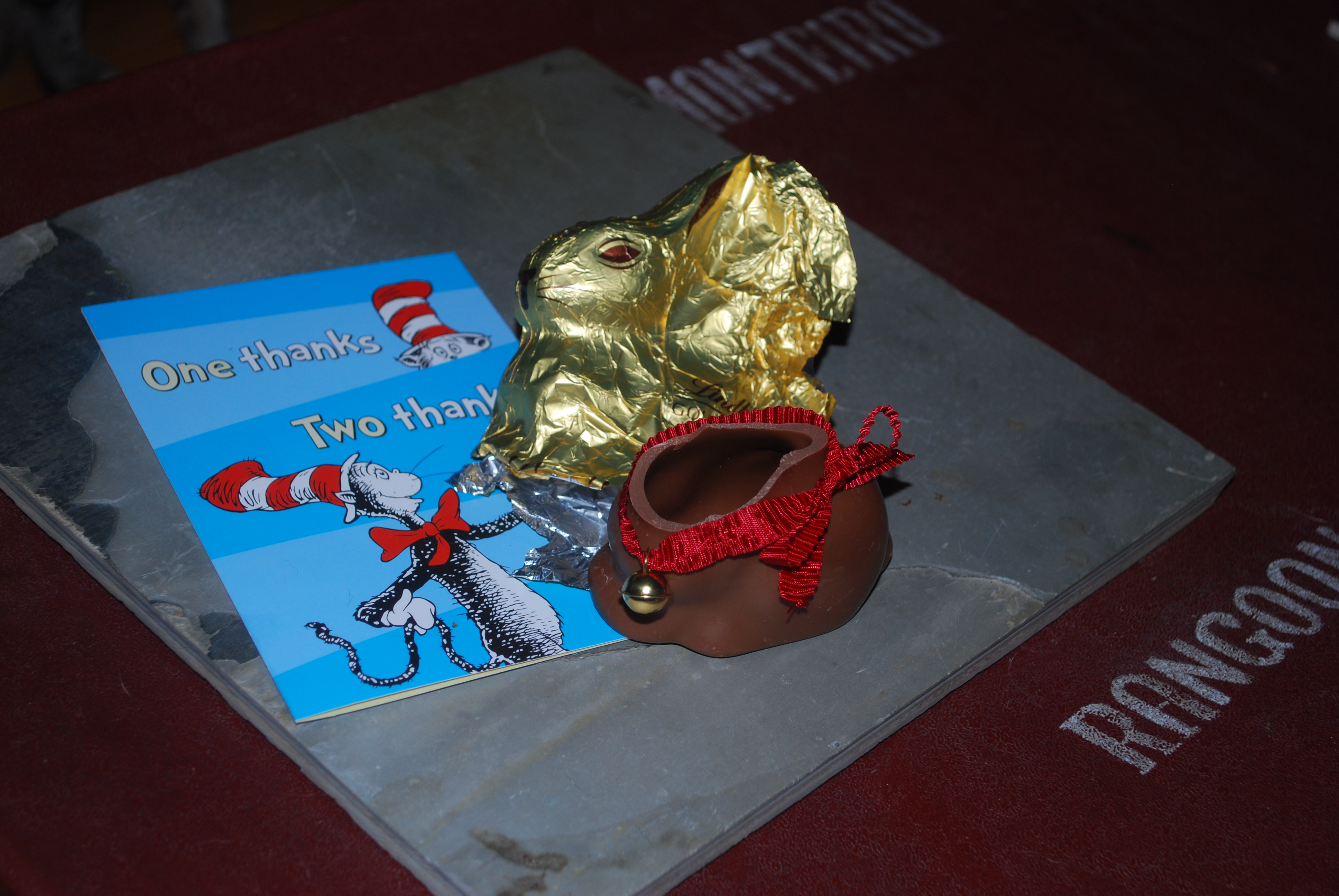
Here’s your ear worm: You’re no bunny ’til somebunny loves you!
And you may have to lose you head before you can apprehend it.
Strangely though all this is quite pertinent to our question of the self in self-compassion that I posted last week. If you scroll back to the post, the comments are well worth the read as they touch on the illusory self, the suffering self, and its need for compassion. There’s a pointer to the “True Self” and that is very interesting because we get into that tricky semantic process of “self” versus “Self.” All very worthy responses and, in particular, the suggestion that the Buddha actually never said there was no self.
So, at the retreat, my response to the question was the executive summary of all these comments. (I don’t remember exactly what I said but this is close enough.) We hold this belief that there is an absolute self, an agent in our lives that directs and orchestrates. When we look closely, we might be able to see that this self is really a construction of expectations, concepts, ideas, reactions, schema (as in Cognitive Therapy) and protections. The form experiences a contact and the mind grabs it with an interpretation. Oh, I’m being abandoned. Oh, I’m being judged. Oh, I’m losing something precious. The practice of cultivating mindfulness of each of these arising, these “I-makings” (see this post on Evan Thompson’s book Mind and Life), results in awareness of our agitation and anxiety from holding to the constructed self of the moment. So what is the “self” in “self-compassion”? I think as we practice acknowledging the unhelpful constructions and the way it causes our suffering, we begin to chip away at the build-up of crap that covers what Jack Kornfield calls our “Original Goodness“, that true, luminous self that is worthy of care and love.
Now, that latter piece is where I took a wrong turn. Not that there isn’t Original Goodness or Buddha Nature because Dogen certainly covers that in Genjokoan. It’s just a huge leap from creating our suffering to that awe-filled moment of seeing the gold under the dross. So, let’s back up this little vehicle!
The self is a performance and therefore not substantial. It emerges out of conditions but is not reducible to them.
Life is a process of “I-making”.
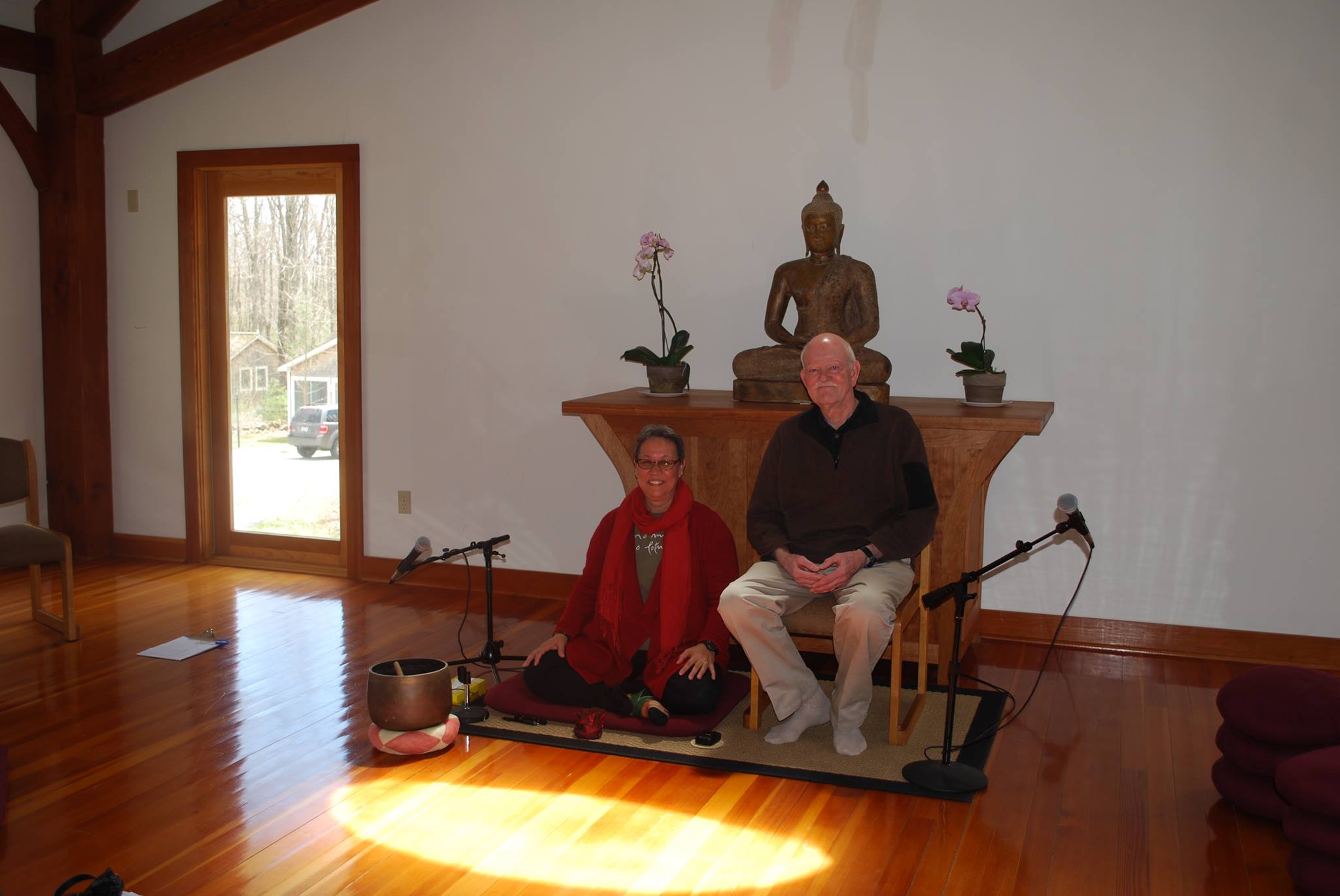
Notes from Evan Thompson’s talk at Zen Brain retreat Upaya Zen Center
I was lucky that the online course given by Robert Wright on Buddhism and Modern Psychology hit the topic of non-self the day after the retreat. Wright (author of the Moral Animal) interviewed Bhikkhu Bodhi who sets the groundwork. You know, all of understanding Buddhism rests on understanding the Buddha’s intention and pedagogy and, not the least, on realizing the Buddha might have been more an epistemologist than a psychologist. (Ooo… Frank just re-stated this: The Buddha was more interested in the human experience rather than what it took to be human. No wonder I keep him around!) Back to Bhikkhu Bodhi: he pointed out in the video interview that the Buddha used different modes of discourse depending on context.
If the context was one of cultivating insight and aspiration for liberation, then we needed to dive into the primary obstacles of the five aggregates and the three poisons. To do that it was necessary to apprehend all objects of clinging as “not self.” If the context was to cultivate ethical action and the consideration of karma and the fruits of karma, then he used the language of self-hood and responsibility. The tricky part – and it’s not just semantics – is that this can be named a self, which may be capitalized to differentiate it, but it’s in the service of acknowledging one has responsibility for one’s actions and intentions.
Wright also introduced Peter Harvey’s book The Selfless Mind which is a terrific analysis of the meaning of non-self in the Pali Canon. Harvey explains that Edward Conze cautioned against the trivial interpretation that because the Buddha is believed to have said that the Self cannot be apprehended, therefore there is no self that exists. Conze’s reasons, according to Harvey, are that “the Buddha taught ‘self’ to coarse materialists, ‘nonexistence of self’ to egoists, and to those near nibbana and free from all love of self, he taught ‘that there is neither self nor not self.’ p. 18” Furthermore, “(h)aving ‘self as master’, then means being in charge of oneself, preserving one’s integrity by not doing anything that one would be ashamed of. No underlying ‘Great Self’ is implied. p.28”
And, our Pali scholar in virtual residence, Justin Whitaker, wrote this great post on week four’s lecture.
(Wright) interviews Dr. Robert Kurzban, author of the dazzlingly titled, “Why Everyone (Else) Is a Hypocrite: Evolution and the Modular Mind.” Kurzban tells him that the ‘self’ he thinks he has is really more of a ‘press secretary’ than an executive officer. A lot of the decision making that is going on is actually not known to that ‘press secretary’ of a self.
Study in Buddhism long enough and you begin to catch on early in a discussion that context determines the teachings. And we can’t forget that the Buddha exhorted his monks to indeed go in search of the self (Vinaya I.23 in the Selfless Mind). This is not that far from each of us seeking to find who we are even as we become someone else. What really stands out here is the subtlety of language. Self as an emergent property of clinging to, rejection of, and confusion about our experiences, inner and outer. Self as ghost writer of our experiences in the genre of shame and blame. Self as agent in discernment of wholesome from unwholesome actions. Self as upaya, process, verb not noun. Harvey summarizes it well:

The press secretary self is a compelling personna and pertinent to the self in self-compassion. Scanning through the Majjhima Nikaya 138, I was really caught by the nuance of the way clinging, rejection, and confusion keep us stuck. In v.20, Maha Kaccana (summarizing the Buddha’s teaching) works through the process and showed that obsession with form, feeling, perceptions, mental formations and consciousness renders us agitated and preoccupied with their changes. This preoccupation gives rise to anxiety, distress, and concern. This is our nub of suffering, these press releases of dire consequences for being who we were in a nanomoment. This is suffering, the self who suffers.
Now the problem with the word “self” is that if we want to use it to point to a materialistic phenomena (these symptoms of anxiety and distress) or if we want to lay claim to a changing cluster of experiences, we’d have to honor Conze’s explanation of the Buddha’s rationale for his teaching style and get stuck with being called a coarse materialist or egoist¹. Neither actually fit the intention of the practice of self-compassion.
But the Buddha taught more than just about non-self so there is a way out of this (thanks to Harvey’s detailed analysis).
Self is protector of oneself,
for what other protector would there be?
For with a well-controlled self
one gains a protector hard to gain.
Dhammapada 160
As well, in the Rajan Sutta, following on King Mallika’s proclamation that there is no one dearer to him than himself, the Buddha says:
Searching all directions
with your awareness,
you find no one dearer
than yourself.
In the same way, others
are thickly dear to themselves.
So you shouldn’t hurt others
if you love yourself.
So, there you have it. Because we know, we are aware of how dear we are to ourselves, we have the opportunity to then be compassionate to others who feel the same about themselves. Compassion for others is contingent on our capacity to see our own value.
But that value often is shrouded in our shame, our sense of unworthiness, our fears of being abandoned, being cast out, being judged as lacking.
The self referenced in self-compassion is a complete self. It is the press secretary, the one velcro-ed to form, feeling, perception, mental formations, and consciousness. And. And it is the self who relishes the joy, competence, thrill, connection, ease, and resonance with others. I’ve quoted Kaz Tanahashi before: the enso contains both perfect and imperfect; that is why it is complete.
When I can be fully with that completeness, meet it with kindness, and know that others feel the same way², I am free of my head, that thinking brain. Being free of that thinking brain, I am also free of that constructed, constricting self (if ever so briefly). And the self in self-compassion is thus rendered neither self nor no-self.
It is just another place marker of where my practice gains traction.
————–
¹I do have to note that in MN 148, the Buddha does teach that the aggregates are “not self” but it is a device to demonstrate the falsifiability of the clinging self through reductio ad absurdum. And it’s antidote “This is not mine, this I am not, this is not my self” is less a denial of selfhood than of gaining clarity of the experience. Don’t take my word; I’m waiting on my Pali scholar pal to get back to me on this one.
² The three components of self-compassion: mindfulness, self-kindness, and common humanity. See Christopher Germer & Kristin Neff