Unknown's avatar

presence as a participant

Continuing with the second of Thich Nhat Hanh’s primary teaching of being in the present moment, I will admit that being in the moment is a wonderful aspiration.  It is the point of practice.  It is practising.  I listen to CD recordings of guided meditations that cheerlead me to congratulating myself for noticing I’ve wandered into the thickets of my mind.  “That’s the moment!  Congratulate yourself and come back to the present!”

For the most part, it trundles along well, this distraction from and retraction to the Now.  Sometimes however, when I’m at my most snarky, I want to stop the CD and pen an email to the creator: But if the moment I notice I’m not here is the moment I’m here, where am I coming back to?

But enough silliness and onto some seriousness.  Frank and I spend a lot of time with beginning mindfulness practitioners who get really confused about what it means to “be in the present moment.”  The practice of mindfulness subtly promises relief from the heaviness of our everyday moments with phrases like “just be in this moment” or “rest in the present” or “know it’s a wonderful moment.”

At one level, it’s true.  Practising is very much about letting go thoughts of past and future.  It is very much about grounding oneself in what is unfolding now.  It is bringing a gentle awareness to the sensations arising and falling away continuously.  Over time, we cultivate a steadiness in the rhythm of letting go and returning.  Through our steady presence in this moment, we are participating in the experience, not being engulfed or buffeted by its wildness.

However, for most of us, the very reason we find ourselves thrashing in the dark thickets of our mind is because the string of moments presented to us are not easy to be with.  What then?

Returning to this moment is, in those moments, a practice of equanimity – a willingness to be with whatever pain is here regardless of our judgement of its worth.  In fact, it is a willingness to be present to our pain regardless of our judgement of our own worth.

Thank you for practising,

Genju
Unknown's avatar

practice as a present participle

Thich Nhat Hanh is fond of teaching that practice has three elements: continuity, presence in this moment, and happiness.  In these times of continuous travel, it’s easy to become unmoored from my daily practice.  Hotel rooms and early starts are not all that conducive to zazen and intense days with late evenings don’t foster mindful consumption.  I like to think there is no “I” but this no-I is having trouble denying the feelings of fragmentation.  And yet, under the shards and slivers of consciousness runs a steady stream of awareness.  It seems knit together the fragments as a river seamlessly knits two shorelines. 

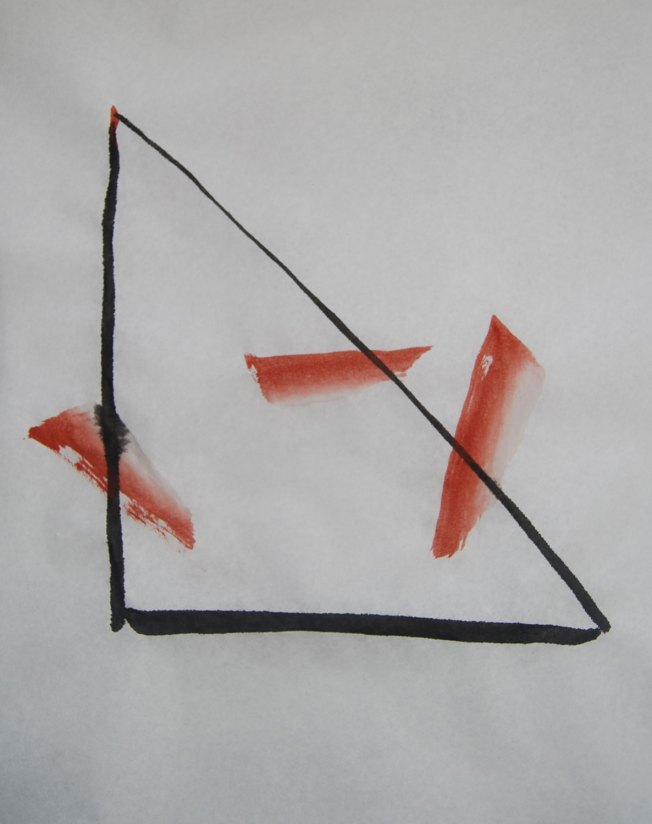
Today, we woke up to rain, snow pellets, and wild howling winds that curved the pine tree tops into sky hooks.  I gave myself a gift of an hour at the art table, playing with shapes and colours.  Then we packed suitcases – again – becoming more and more efficient about what we really need on this trip, and oh-so-reluctantly headed for the nursing home to visit my mother.

The day before was her 93rd birthday.  My brother and his daughter took her a savoury lunch; we were hosting a zazenkai – a day of mindfulness.  She was born in 1918 – the year that saw Daylight Savings Time initiated and when the Red Sox won the World Series.  The last Carolina parakeet died and the Royal Air Force was formed.  Wars began and ended; and, the Spanish flu killed over 30 million people.  A baby girl was born in Rangoon whose continuation leads to this moment when I am writing, you are reading, and even if the Red Sox don’t revive their successes, this moment of being woven together will be irrevocable.

Facing the large glass window with snow pellets pinging on it, I sat with my mother who is now confined to a wheelchair.  She was angry, railing at a universe I can’t access so empathy is just beyond my reach.  Slowly as the words spill out, shredded and disconnected, I decipher her anger is shame.  She can no longer control her bodily functions and, profound though the dementia may be, she knows, feels the humiliation.  As she cries, I try to hold her, awkwardly embracing over the edges of the wheelchair.

The days, minutes, seconds are easy moments to string together as practice.  Surviving time requires no effort.  What time carries along in its flow is the challenge.  The grief, helplessness, rage, and all those visitors from deep in our lives take a bit more effort to sew together.  At least that’s how it feels until I gain the water and feel that steady flow under the fragments and shards of feelings.  Then there is no effort required because it all falls together as segments of a larger experience.

Thank you for practising,

Genju