
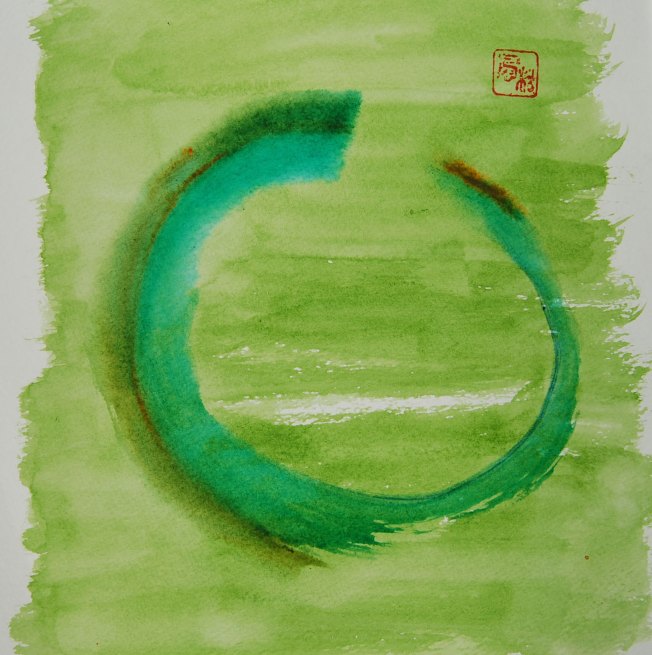
In her comment to yesterday’s post, ZenDotStudio offered to adopt my suffering from the Society for the Prevention of Cruelty to Suffering. This got me thinking about the rather disparaging way I treat my suffering. Of course, the cause of my suffering is that I don’t think anything I do is good enough. Like the paintings you see this week. Not good enough. Yesterday’s was too dark, today’s is too washed out, tomorrow’s will be too obvious. So it’s no surprise that even my suffering is really not up to snuff.
Like a good little Buddhist, however, I’m taking a shot at (so much for ahimsa) looking into the true nature of my suffering before I truck it over the ZDS and sign off on the adoption papers. Two weeks ago we checked out the First Noble Truth – the reality that suffering exists and our responsibility to examine the shape of that suffering. The Second Noble Truth faces us with the way that suffering germinates, the roots of suffering.
Conventionally, cravings is the identified culprit for the cause of suffering. Thich Nhat Hanh, however, points out that the Buddha didn’t say only craving is the cause. It’s just first on a long list of things that cause suffering but for ease of recitation it stands as the exemplar of causes. That helps clarify my own examination because when I look at the causes of my suffering, they are multi-dimensional. It’s not just wanting more, better, bigger, stronger, prettier, steadier (fill in the blank). It’s also “anger, ignorance, suspicion, arrogance, and wrong view…” that pours fuel on the fire.
Take these paintings. I hold this assumption of how they should look, what green, red, ochre look like to someone else, and I forget that I can’t know how someone else’s sense consciousness will consume the painting. Or perhaps, it’s more a case of being afraid that I really don’t and can’t know how someone will perceive the colours. I have no control over their desires which also are born of beginingless “greed, anger and delusion.” And therefore, I have no control over their likes or dislikes of what I put out there. I know this but the fear is powerful and the judgemental mind is compelling.
The Second Noble Truth refers to the power of mind. Suffering is caused by the mind’s ability to generate story lines of desire, rejection, and denial. And the first step – the first turning of the dharma wheel of the Second Noble truth – is to look at how the mind gains and sustains that debilitating power (rather than a beneficial power). In practice, I’ve been noticing how I feed my mind with a constant stream of comparative thoughts and a push-pull of grasping. In fact, I’m beginning to realize I have a whole farming industry that produces these twisty little roots, salty greens, and bitter herbs that I serve myself in generous heapings.
Well, I’m happy to recognize how I sustain my suffering. Just wish I had realized it before I “fixed” these paintings…
Thank you for practising (and try not to fix anything your mind insists needs tweaking).
Genju


 108zenbooks