Unknown's avatar

transparency of water

<– Previous: finding home

Many teachers point out that our suffering is crucial to our transformation.  Lotuses begin their life in the mud.  We are asked to be patient as we steep in that mud, have faith in the nutrients of the slime and ooze of our attachments.  I’m ok with slime and ooze.  But I’ve struggled with faith (maybe I wouldn’t have if I had read Sharon Salzberg’s book more attentively?).  Faith requires me to accept that there is something possible; it also requires me to be at ease with change.  That is much to ask of someone in whose life change is just a harbinger of more pain.  I need to have faith in something more calming.

Contemplating the nature of mind and self, we know the quality of our mind is as if we have stirred up a glass of water mixed with mud (slime and ooze, again).  Left alone, the mud settles and we can see the water clearly.  That clarity is the true nature of mind.  As I contemplate this glass of muddy water, I am aware it is so frequently stirred up that I may as well just call it what it is: muddy water.  And yet, whatever water may contain, it is always clear.  Water does not possess the mud; it does not cling to it.  Water does not obscure the mud; it does not become an obstacle to looking deeply.

The transparency of water is the very reason we can see the mud, see the settling, see the clarity whether or not it splits into water and mud (which it doesn’t).  Even in the lower part that is mud, it is just that: clear as mud.  It is held by water.  The transparency of water provides us with clarity of the nature of our muddiness.  It is always clear; we are always pure.  It is always Home.

Thank you, Jack, for practicing,

Genju
Unknown's avatar

showing up where life blooms

I read one of the most beautiful statements the other day, so compelling in its simplicity that it blew me away.

Life just keeps showing up in front of me.

It opens a post on the zen blog Contemplative Spaces titled Lucky day, Lucky guy.  And that in turn opened up more reflective paths as I continued with Katagiri’s You Have To Say Something.  Somewhere in the rich chapters, Katagiri writes that we tend to live away from where life blooms.  I’m an avid gardener and at this time of year I’m desperate for Spring.  The weekend with its glorious sunshine and melting snow had me hinting to Frank that maybe the vegetable boxes are ready for weeding.  There’s only 8 inches of snow in them, how hardpacked can it be!  Bows to his sweet heart, he actually went out to try and weed them.  Apparently, as much as I am living a few weeks in the future, the earth is not.  So I sat with the anticipation of the magnolia blooming, the Nishiki willow putting out new tendrils, and the inaba shidare, a Japanese maple that glows magenta.  This is much like I live my life – just past where it blooms.

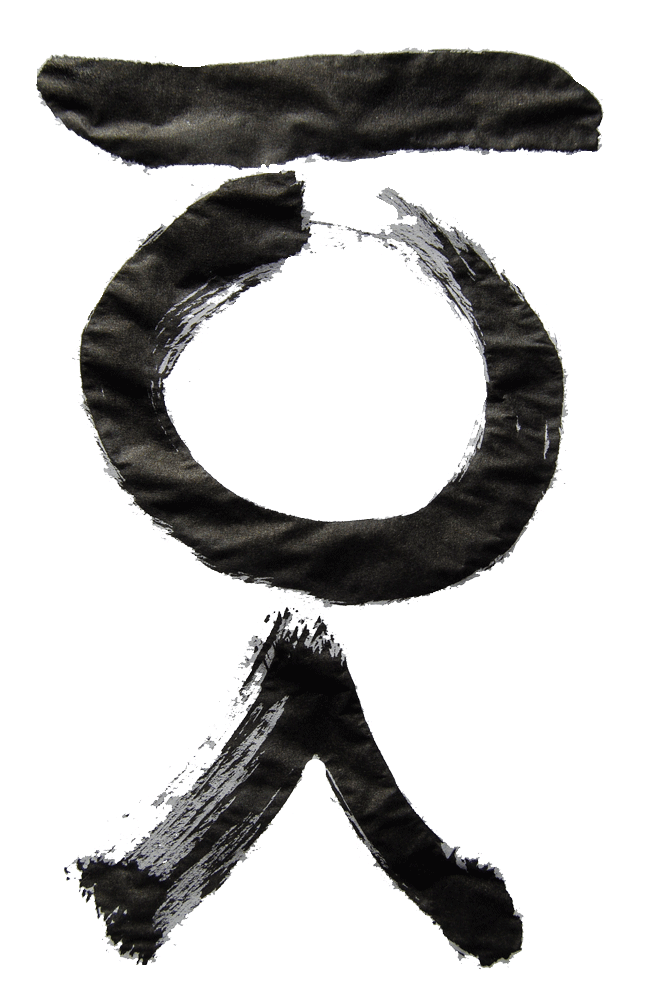
So, I’m immensely grateful when life just keeps showing up in front of me.  (Oh, I could sing that line!)  My brother showed up unexpectedly laden with take out food for our dinner.  This left me free for the afternoon to dust off the table where I practice my brush painting.  Life showed up in some awful attempts at copying Hakuin’s lotus pond.  It showed up again in an enso that’s a definite keeper.  And again, in a playful rendition of 108 in kanji script – my new logo.

Painting took me to another of Katagiri’s chapters on Kyogen’s painted rice cake.  Making a rice cake requires the ingredients of a rice cake (rice, fire, so on).  Painting a rice cake requires the utensils of painting a rice cake: paint, brush, canvas – or in my case, “rice” paper.  A buddha is like the painting of a rice cake because it too requires the coming together of the elements of being Buddha: the Bodhi Mind, practice, and so on.  I highlight the word, practice, because this is where life shows up for me, time and time again.  In the anticipation, arising, and being with the five aggregates (form, feeling, perception, mental formations & consciousness).  These are the ingredients with which, in Katagiri’s terms, I paint my life.

But the real question is, How do we, as the painters of our lives, use our colors?  Which colors do we choose?  If we use the color called “this present moment,” we can paint our life with it, but it’s very narrow.  If we use the colors of the past and future, we can paint a broader picture of our life, which is a little better than just painting our life in the present only.

This is a lovely teaching: the present moment as a narrowed view on canvas.  As for the past, oh!  How I love the black ink of my past for how it slices up the white space into seemingly organized chunks.  These past moments by themselves can be narrow too, I suppose, along with the pigments of my imagined future.

On the table is a box of different coloured ink sticks sent to me by a dear friend.  Time to mix up a new batch of visions!

Thank you for practicing,

Genju