Unknown's avatar

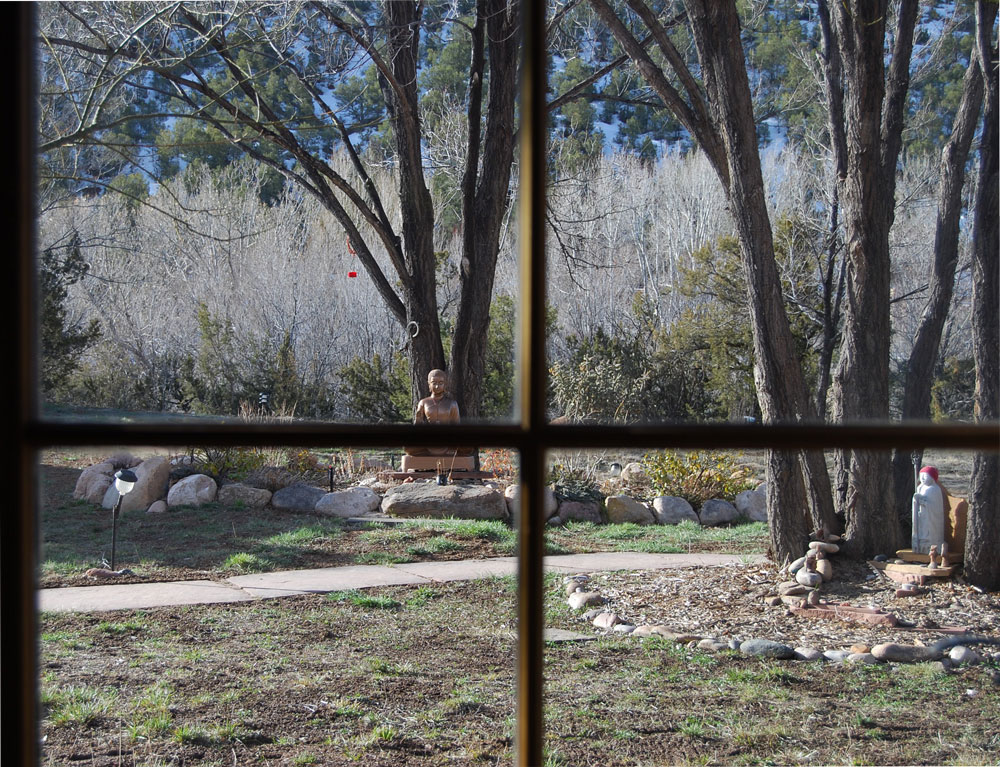
sitting buddha versus jizo

The view out onto the Upaya grounds reminds me of the divisions I create between stillness and activity: sitting Buddha and Jizo in counterpoint.

I want things to be easy.  Show up, laugh, eat, sit, become enlightened, manifest compassion.  Can someone out there write a little program that I can download into my brain as a memory capsule?  I’m sure this balance between contemplation and engagement really is as easy and it seems for everyone else.  Don’t you love those self-revelatory books that make it seem that way?  Compressed into a 100 or 200 pages are all the peak experiences of becoming Buddha.  Do you ever read behind the lines to confirm what you know really happened?  Having lived your own life as an enlightened being, you do know what it takes.  Which means you know the lines on the pages are wonderfully crafted to slide over the boulders and rubble (thank you, Helmut!) left from the earthquakes and aftershocks in your inner landscape.

Maybe I’m being a bit too cynical.  Some time ago, Barry (Ox Herding) and I had a fun exchange about Layman Pang’s whinge about how hard it was to sow the seeds of practice; Pang’s wife responded that it was easy, and their daughter cheekily retorted that it was all there on a blade of grass just for the having.  If I read it again, it seems to me the Layman is addressing the outer form of practice, his wife the inner form, and their daughter points to the 84,000 dharma doors that we can choose from.  Hard, easy, effortless – it’s our choice.

Dogen is uncompromising on the issue of true practice.  It’s easy to chop off arms and fingers, he says, in the way our ancestors chose to prove their commitment.  But harmonizing the body and harmonizing the mind are difficult.

Brilliance is not primary, understanding is not primary, conscious endeavor is not primary, introspection is not primary.  Without using any of these, harmonize body-and-mind and enter the buddha way.

Old man Shakyamuni said, “Avalokiteshvara turns the stream inward and disregards knowing objects.”

That is the meaning.  Separation between two aspects of activity and stillness simply does not arise.  This is harmonizing.

Dogen on Guidelines for Studying the Way from Moon in a Dewdrop edited by Kazuaki Tanahashi

I learned this chopping onions.  A calm mind and fully engaged body goes a long way to keeping the fingers whole.

Thank you for practicing,

Genju

Unknown's avatar

practicing wellbeing

Previous: clear waters

The Practice of Wellbeing

Living Well

The practice of living well is simple.  Choose the actions that sustain physical health and joy.  Engage in the activities that are useful and beneficial to ourselves and others.  Adjust and adapt when conditions change and those activities are no longer useful or beneficial.  When we are on autopilot and catch ourselves hopping on a train, we can remember our intention to practice wellbeing and return to that station with ease.

The practice of living well is not easy.  We tend to be distracted or hyper-focused, demanding or disconnected, clinging or disinterested.  We hold beliefs that we are entitled to certain things in our life that are also a measure of our acceptability or success.  And often the actions that grant us those things have a cost.  We feel off kilter, off center, tipping too far over into distress and ill health.  We become reactive and forget our skillfulness in living well.  Our lives are filled with trains that take us nowhere or to destinations that are unpleasant.

Wellbeing is not the absence of illness or distress.  It is the recognition that we are tipping over, remembering where we felt balanced, and returning that center point.  When we engage in our actions with awareness of what is useful, beneficial and the cost of our choices, we are practicing a skillful way to return to the center.  The stronger the skill in remembering and recovering that center, the more skillful we become in at practicing wellbeing.

That process of noticing, remembering, and recovering embody the practice of mindfulness.  We pay attention, become aware, recall past consequences and skillful actions, and make choices in this moment that are based in our belief that living well is the only act of kindness possible for ourselves and others.

A poem by Naomi Shihab Nye:

Kindness

Before you know what kindness really is
you must lose things,
feel the future dissolve in a moment
like salt in a weakened broth
What you held in you hand,
what you counted and carefully saved,
all this must go so you know
how desolate the landscape can be
between the regions of kindness.

How you ride and ride
thinking the bus will never stop,
the passengers eating maize and chicken
will stare out the window forever.
Before you learn the tender gravity of kindness,
you must travel where the Indian in a white poncho
lies dead by the side of the road.

You must see how this could be you,
how he too was someone
who journeyed through the night the plans
and the simple breath that kept him alive.
Before you know kindness as the deepest thing inside,
you must know sorrow as the other deepest thing.

You must wake up with sorrow.
You must speak to it till your voice
catches the thread of all sorrows
and you see the size of the cloth.

Then it is only kindness that makes sense anymore,
only kindness that ties your shoes
and sends you out into the day to mail letters and purchase bread
only kindness that raises its head
from the crowd of the world to say
It is I you have been looking for,
and then goes with you everywhere
like a shadow or a friend.

Naomi Shihab Nye

Thank you for practicing,

Genju