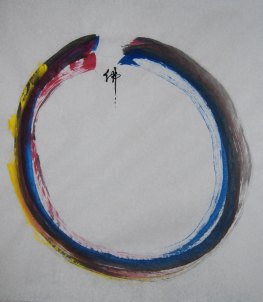
 Is it now an Enso-Friday? Or a Poem-Friday?
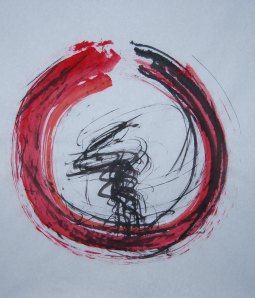
Anyway, this is what I get when I want to use up all the ink by holding all four brushes close, squishing the hair bristles together, and GO!
Pre-composting is like pre-satori – it can be fun and turn out some neat stuff. I’m reading Wild Ivy, Hakuin’s autobiography and am considering the implications of pre- and post-satori experiences, not to mention repeated experiences of satori. James Austin had a lot to say about that in his Zen Brain talk on ego- and allo-centric processing and the kensho experience. But more on all that when I finish the book. What I am struck by, in this moment, is the resonance I feel with Hakuin’s Song of Zazen. A balm, especially after all the chatter this week about what can only be summarized as “sex, pray, more sex.”
How easily we forget the interpenetration of water and ice.
How quickly we get lost on dark path after dark path – pre- and post-satori.
Hakuin’s Song of Zazen
Translated by Norman Waddell
All beings by nature are Buddha,
As ice by nature is water.
Apart from water there is no ice;
Apart from beings, no Buddha.
How sad that people ignore the near
And search for truth afar:
Like someone in the midst of water
Crying out in thirst,
Like a child of a wealthy home
Wandering among the poor.
Lost on dark paths of ignorance,
We wander through the Six Worlds,
From dark path to dark path–
When shall we be freed from birth and death?
Oh, the zazen of the Mahayana!
To this the highest praise!
Devotion, repentance, training,
The many paramitas–
All have their source in zazen.
Those who try zazen even once
Wipe away beginning-less crimes.
Where are all the dark paths then?
The Pure Land itself is near.
Those who hear this truth even once
And listen with a grateful heart,
Treasuring it, revering it,
Gain blessings without end.
Much more, those who turn about
And bear witness to self-nature,
Self-nature that is no-nature,
Go far beyond mere doctrine.
Here effect and cause are the same,
The Way is neither two nor three.
With form that is no-form,
Going and coming, we are never astray,
With thought that is no-thought,
Singing and dancing are the voice of the Law.
Boundless and free is the sky of Samádhi!
Bright the full moon of wisdom!
Truly, is anything missing now?
Nirvana is right here, before our eyes,
This very place is the Lotus Land,
This very body, the Buddha
Have a colourful weekend!
Thank you for practising,
Genju


 108zenbooks