

My dharma friend at Ox Herding has announced a new book on women ancestors in the Zen tradition titled Zen Women: Beyond Tea Ladies, Iron Maidens, and Macho Masters. I ordered it as soon as I got the Wisdom Publications notice – yes, I only use Facebook for its dharmic content -and they kindly informed me that it should be arriving this week. I’m thrilled; it’s like waiting for a visit from a good friend. So, yesterday, I cleaned up the shelves to make room for it and that lead to interesting finds.
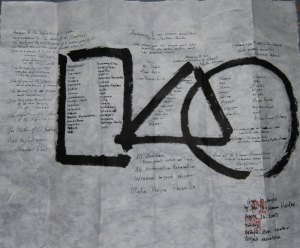
matriarch's bloodline
The bloodline of female teachers in Buddhism is not often discussed and I’m somewhat embarrassed to say I actually never thought about it. In fact (and this is really embarassing), it’s taken me a few years to see the many disconnected dots on my bookshelves. Maurine Stuart is there. As is Sallie Tisdale‘s penetrating stories beginning with Maha Maya. There is Ayya Khema. And the Therigatha, the poems of the women elders. Of course, Sharon Salzberg, Sylvia Boorstein, Pema Chodron, and Joko Beck. Evidence of my face-to-face teachings with my Dear Hearts is tucked into the spaces above and between the books: Myozen, Roshi Joan, and Sister Annabelle (Chan Duc) Laity. Why then, did I not question who was the face of these women before they were?
Add that preparing a matriarch’s lineage is part of taking the precepts (jukai) and I have to wonder if I should surrender a piece of my X-chromosomes.
This is particularly perplexing because I’m no fainting flower of femininity. Nor am I a feminist. I have done things that many would say are outside the box of conventional female pursuits. Perhaps. I tend not to experience things that way yet I also have felt in my body and heart/mind the yin and yang of every practice center that has held me.
In university, there were several of us who broke the barriers of being women in the physical sciences. My mentor was not-so-affectionately called the “Tasmanian Devil” for her whirlwind way of decimating anyone she perceived as only using their minimum of two neurons. For the longest while, our role in our careers was to educate our bosses (who were usually always and seemed evermore to be men) that we were not hired to wash the glassware, sweep the floors or bake cookies for Friday socials. Although we founded organizations like W.I.S.E. (Women in Science and Engineering) and did our best to encourage the next generation of women to see science and all careers as equally available to them, I eventually walked away from all that because it felt too much like religious fervour.
Several years later, while writing my dissertation, I got bored and went for a drive. There in a store window was a call for volunteer firefighters. It wasn’t and never had been an issue of challenging male bastions. It just interested me to push my own boundaries of physical and mental tolerance. Zen as now. And in this now, my day job takes me to interesting places and things. It’s only in retrospect that I am likely to notice I’m in the company of only one or two other women colleagues.
So I wonder. This essential part of my spiritual history. Call it female and it’s wrong. Call it not and it’s wrong too. What is it?
What a question! What a great day for it to appear!
The true life of our Zen practice comes from sitting quietly, doing nothing, and then getting up quietly and acting dynamically and directly in our everyday lives.
from Our own light, in Subtle Sound: the Zen teachings of Maurine Stuart, ed. Roko Sherry Chayat
The way of being human is beyond all shapes. It has no form. When we use words like “Buddha” or “Tathagata” there is some danger that we think of this as something apart from us. Searching for the mystery outside oneself leads us astray. The mystery is right here.
from Who is the real you?, in Subtle Sound: the Zen teachings of Maurine Stuart, ed. Roko Sherry Chayat
Thank you for practicing,
Genju
 Looking up into the woods, I wonder about the herd of deer now growing in number because they know the hunters can’t reach them here; I wonder how they know the boundaries of safe/unsafe. There’s a sense of calm and security, a feeling that we are protected as we transition through Autumn to Winter. I wonder how I know this.
 Why does Moishe pray? “I pray to the God within me for the strength to ask Him the real questions.”

