

 In August, Joseph and Chong Go Sunim of the amazing Wake Up and Laugh! blog delivered a one-two punch on the topic of “difficult people” and “difficult emotions.” Being the quintessential difficult person, I side-tracked the discussion to the picture Joseph had included of Huik’o cutting off his arm in an effort to be accepted by Bodhidharma. The comments devolved from there to Joseph’s suggestion that, with the closing of the 108buddhas, I might consider a new project of 108Bodhidharmas.
The answer is an enthusiastic: “Nope.” However, we did chat about sharing some experiences of the First Patriarch.
108buddhas come to a close this week as we head to the first anniversary of 108 Zen Books. A deep bow of gratitude to all of you who have encouraged my practice and tracked the paintings! It has been a fascinating journey, all the more for the approach-avoidance pattern I have with the brush. The idea of productivity is still deeply ingrained in my mind. One paints for a reason and that reason is to produce something of (monetary) value. Throughout this journey, I’ve struggled to embrace these 108buddhas as sufficient in and of themselves. Breath, brush, and body are not the the path to a practice of shodo. They are practice.
I thought Bodhidharma would be a nice way to explore this progression from productivity to presence (with no suggestion that I’ve cultivated presence!) especially through his presence in Zen art. In The Art of Twentieth-Century Zen, Audrey Seo & Stephen Addiss describe Zen master and calligrapher, Nakahara Nantenbo (1839-1925), as fiercely dedicated to the practice of Zen and whose “use of the brush (was) a form of Zen practice.” Nantenbo was often impatient with the constant demands to produce works by his hand; he was prolific and productive but not willing to be controlled by quotas. His style was unrestrained and the often-over-sized characters exploded across large doors, screens and scrolls. The characters he painted are blunt, direct, and filled with spirit and his attitude to painting reveals an unrelenting practice:
The reason for not speaking while writing a large character is that the character will “die” unless it is written in one breath. One should magnify one’s spirit and write without letting this magnified spirit escape. The character will die unless it is written using the hara (literally, gut, here suggesting the center of one’s spirit).
Seo & Addiss, p 21
There are so many examples of Nantenbo’s art that embody this passionate dedication to magnifying one’s spirit. 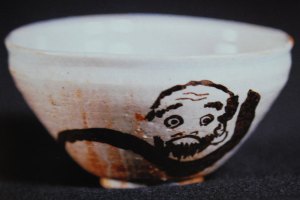 Daruma painted on a tea bowl (1913) is my favourite. Bodhidharma is rendered with childlike simplicity: the wide-eyed look, bushy eyebrows, uncompromising mouth. And the ear-ring. I like to think of this rendering of Daruma as the early days of the Holy Man from the West: youthful, determined, and still able to be astonished by his unfolding practice.
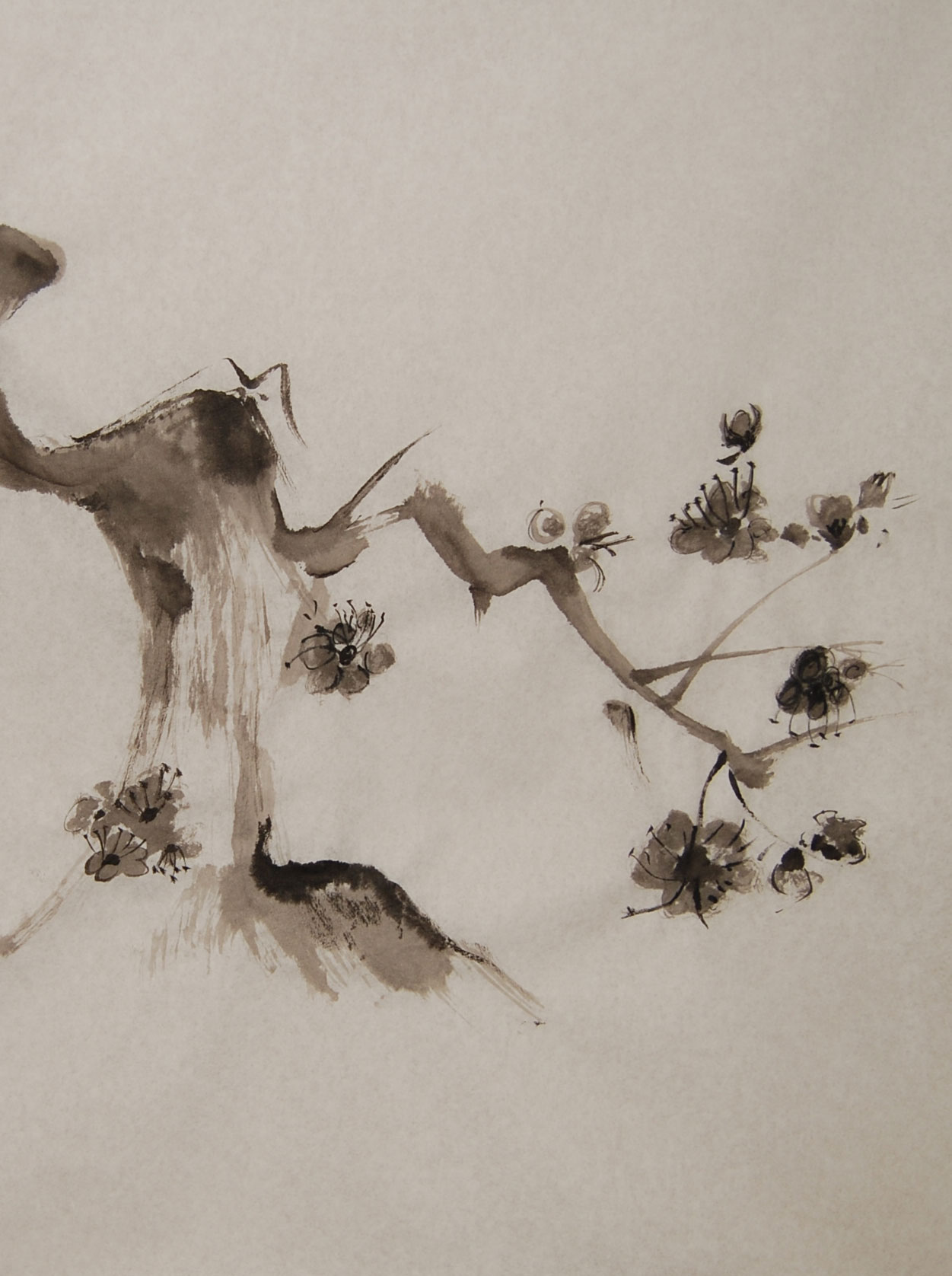
My version (above) of the tea bowl Daruma likely reflects more of my own early days. The eyes are not straight ahead, ready to meet whatever shows up. They glance to the side and down as if watching for some obstacle I might trip over. And no ear-ring; not yet ready to be different. I do remember innocently buying into the form of practice as it was in the first sangha I attended. But in a short space of time, under the weight of the blind, unquestioning faith that was required to be in that community, I began to feel my spirit shrink with the breath rather than magnify. And then the real teachings began.
I appreciate the shared worry in our expressions. Perhaps Bodhidharma is wondering why he had crossed the subcontinent to end up in Northern China, doing battle with the already established Buddhist practitioners who found his wall-staring meditation style somewhat on the fringe. I know I worried about the vast inner expanses I was covering doing battle with established habits and reactionary behaviours, feeling this new way of being unravel my fringes.
Nantenbo’s inscription on the tea bowl is Vast emptiness; nothing sacred.
And so it is in the practice of staring down the self.
Thank you for practising,
Genju
Image: Tea bowl from Plate 7 in Seo & Addiss, The Art of Twentieth-Century Zen
 108zenbooks