Unknown's avatar

a child lost

There’s a beautiful cemetery near my office, about a kilometer away, with a botanical garden and beautiful Interfaith chapel.  Strange as it may seem I love taking my friends there for a picnic, which was how it was first introduce to me.  Sitting by the koi pond, sharing sandwiches and salads with a neighbour who worked in town as well, I fell in love with the huge trees, hosta beds, and day lillies.

Later, when I ran out of daring friends, I used the winding paths for my outdoor runs and winter walks.  If I got the pace right, I could cover most of the trails in my 45 minutes of gasping.  Sometimes when Frank would run with me, I reminded him that slowing down in more ways than one would likely delayed our journey to the be the next headstone.

The cemetery is the resting place for many notable Canadians, Prime Ministers, hockey legends, and kingmakers.  There are also military and police members who lie there, many from decades ago left by their families who have long since moved on.

A few years ago, at the end of one of my runs, I stopped to rest on a grassy slope across from the hosta gardens.  Beside me, covered with weeds and overgrowth, was this little gravestone.  It marks the grave of Susan Anna, infant daughter of Harry & Verse Crerar, born 20 May 1933 and died 14 June 1933.  I cleaned away the growth and weeds, brushed off the stone and sat back in wonder at this little life that barely lasted 25 days.  Not even long enough to become “beloved daughter” of Harry & Verse, not even long enough to warrant more than a descriptive with a categorical word: infant daughter.

Over the months, I wrote stories in my head about who they were.  1933 in Ottawa would have seen the 16th season of the Ottawa Senators before they left for 58 years, Cyrville Road was a potato-growing field, there was an increase of 850% in case load at the Ottawa Welfare Bureau, and the charitable organization that would become the United Way was founded.  I imagined Harry as a slight man, likely a labourer who eked out a living working in a bakery or driving a trolley.  Verse, of course, stayed home, holding her grief and sorrow tight to her bosom while making meals, caring for her other children, and cleaning the house.  Or perhaps, they had left Ottawa, the area being to burdened with poor pay and sad memories of their lost child.  I imagined that if Susan Anna had a sister (I never thought she would have a brother), she would now be in her 70’s.  Greyed and slight with a stoop in her walk, she may still come by the grave to remember her sibling whom she never knew or only knew fleetingly.

My breath caught and my heart tightened each time I walked or ran past the little marker.  There were never signs of anyone’s visit and its carved words seem to fade more and more.   I became frightened that, in time, Susan Anna would fade unwitnessed into history.  So my visits became more than an adjunct to my activities.  I took the time to rub the lichen off the gravestone, clear the base of grass and weeds, and chatted with little Susan Anna, bringing her up-to-date on all the wondrous changes in the world since she entered and so quickly left it.  Sometimes, I even tried to explain that her parents and family loved her and perhaps were constrained in how that love could manifest.

I think I spoke as much to reassure Susan Anna that she had been loved as I did to reassure me.


… tomorrow: truth be told

Thank you for practicing,

Genju

Unknown's avatar

10-foot-square life

This week I received wonderful news about two people I deeply admire and respect.  They each have played a deeply significant role in my spiritual and professional life which always leaves me wondering at the way random meetings and chance occurrences can shift the bedrock of our being. Melissa Myozen Blacker will receive inka from her teacher James Myo’un Ford Roshi in July creating a new bud in the long. flowing branch of Zen ancestors.  Melissa and Florence Meyer were my training teachers at the MBSR Practicum at the Center for Mindfulness in UMass and it was a life-changing experience.  My very first sesshin was at Melissa and her partner, David’s, zendo where I learned how not to stop fish from drowning.  You can follow Melissa’s teaching at Firefly Hall.  The other is  Dr. Al Kazniak, neuropsychologist and long-time student of Roshi Joan Halifax, who received Dharma Transmission on Sunday May 30th at Upaya Zen Center.  Al & I shared the great honor of being the bathroom cleaning crew during one sesshin which generated my favourite memory of sweeping the ground around Al’s feet.  Little did I know that washing those bowls and polishing the flagstones would become this extended opportunity to learn from and practice with him.

I was telling a friend about all this and said that it feels like there are amazingly clear footprints for me to follow.  She asked if I ever felt frustrated by expectations of where my path would take me.  Of course I am!  Looking at my somewhat peripatetic spiritual path, I feel as though I’ve wasted my time poking around the quick-fix types of practice, missed the boat, and shooed away the rescue workers trying to pull me from the disaster zones of my life.  And yet… and yet… there has been such a deep teaching in all of this.  The early disappointments came with the wild horsewomen of abandonment, shame, and blame.  Later let downs came with denial, distancing, and deconstruction.  Being older and tiring more easily, now I laugh.  Both with irrepressible joy for my dear dharma friends (who have always been teachers) and for my silliness in wishing something would grow from the disasters and calamities of my life.  I am learning, slowly and less painfully, to live in my own space, challenged and enriched by these wonderful people around me.

Kamo no Chomei, third author in Watson’s Four Huts, met with disappointments in his own life.  Born to a family of Shinto priests in Kyoto, he was not allowed to succeed his father, causing him much bitterness.  He turned to writing poetry and became a distinguished player of the lute although these accomplishments did not seem to fulfill him.  He became a Buddhist monk (I hate to think hie thee to a monastery is a solution but it does seem so for some of these tragic figures!) and wrote The Ten-Foot-Square Hut in his 10-foot-square hut.  Despite his accomplishments, Chomei’s writings play a repeating chord of defeat.  Still, he asks a penetrating question:

Possessing power, a man is filled with greed and desire; lacking supporters, he is an object of contempt.  Riches bring manifold fears, poverty finds one seething with discontent.  Depend upon others and you become their creature; have dependents of your own to look out for, and love and obligation ensnare you.  If you abide by the world’s ways, you suffer the loss of freedom; if you flout them, you are looked on as mad.  What place can you live, what activities can you pursue, in order to ensure a haven for your body and bring even a moment of peace to your mind?

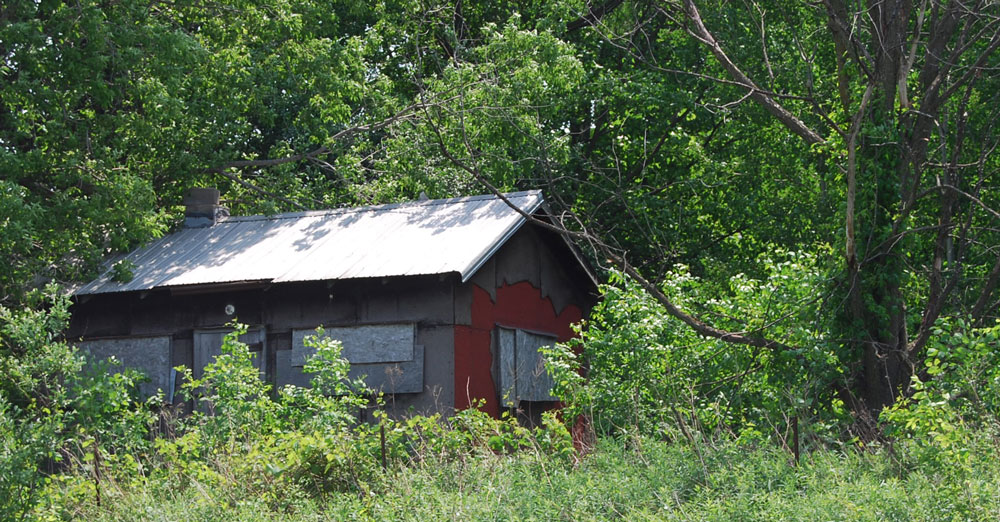
My neighbour’s uncle lived in this little shack until he became ill in his late 70’s.  There is no electricity or running water in the hut; chopped wood, carried water all his life.  As most of his farm became surrounded by the ever-growing village, he became more and more reclusive.  Like Chomei, he escaped into silence and isolation.  I don’t know if, like Chomei, he hoped to escape creating any bad karma with (his) tongue.  Perhaps like Chomei, he too felt freed of judgment and censure if he did not perform the expected offices of the day. It seems tempting.  However, my strongest influences are from the Sutra on a Better Way to Live Alone and the life of Sodo Yokoyama (you can read about the “grass flute monk” here and here) which means I can’t resort to flight when the world fails me.

Reading Kamo no Chomei’s prose and feeling the great joy for my dharma friends, I am reinforced in the belief that there is no need to flee the world or seek peace through insulation.  Moreover, there are innumerable 10-foot-square huts in my life.  My office happens to be those dimensions – and there is so much that happens in these 100 square feet!  My gardens, study, and even the 2.5 sq feet of my zabuton are all huts in which and from which I practice.  These are also places where I meet all the stress points that become new growth.  Anyway, how can we run away from that ultimate abode – our own self?

Thank you for practicing,

Genju