Unknown's avatar

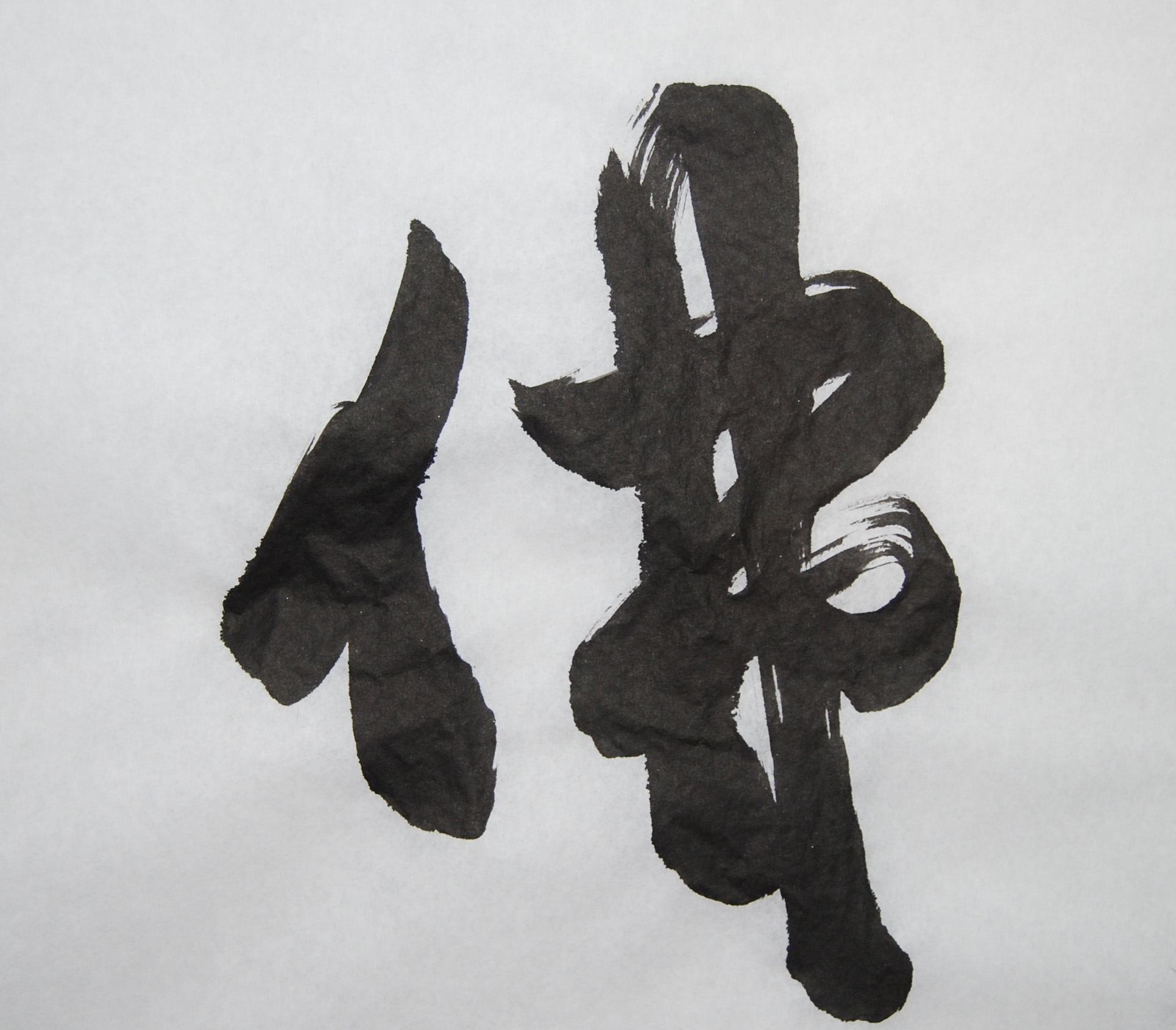
99 buddhas on the wall

I woke up (I wish!) with a silly refrain in my head: 99 Buddhas on the wall, 99 more to go.  Take one down, pass it around… 98 more to go…

So far, my commitment to creating 108 Buddha calligraphies is bringing up interesting issues about practice.  This is Buddha9 which means my brain was doing some strange arithmetic as I was sleeping.  There really are 99 more to do.  Or maybe that’s the pointy-end of practice for me.  There are no more to do except that I think there are.  But that’s important too.  The practice of Zen is about not doing which, in the Ourobouros of Zen, is about noticing what the doing is.  What I notice when I get the brush and ink ready is all the arising hope that this one line will define the direction of who I can be, will shape the container of my joys and pain.  That’s a lot ask from masticated fibers, a patch of horse hair bound in a wooden handle and a concoction of pigment and glue.  Honestly, what am I thinking!

And therein lies the problem.  The Thinking Brain comes online and the next thing I know there is this mound of crumpled “not-good-enough’s” on the floor.  Practice with these Buddhas has become watching that Thinking Brain and with gentleness, escorting it to the mental couch where it can rest.  What research there is on burn out and trauma shows that recovery is in allowing different parts of the brain to come out and play.  But there’s no wisdom in waiting until burn out happens.  I like to see each Buddha that pours out of the brush as a buffer or a deposit in the bank of resilience. Allowing each one to be just what it is without judgement of the line, balance, composition or anything contrived is tough – and the pokey part of practice.

Dealing with loss and grief is not much different.  I’ve never lost a child, but in walking with parents who have, the depth of that pain seems insurmountable.  And yet, and yet, they go on.  What I’ve learned from these amazing teachers is that in my pain what I want most is for it to be different – and by that I usually mean: it would be nice if it was over.  So, I ask myself: what might happen if I let go of wanting this experience to end?

The answers are a fascinating revelation of the need for self-compassion.

Thanks to Jay at DigitalZendo for this link to Thay’s talk on Suffering & Compassion:

Thank you for practicing,

Genju

Unknown's avatar

a family found

After a year or two of caring for Susan Anna’s grave, I became curious about her origins.  I did what any 21st century researcher devoted to truth would do.  I went to the Oracle of All Things Known and Registered in the Universe: Google.  There, listed like the castings of the I-Ching, were thousands of links to the query, Who was Harry Crerar?  I found it hard to believe – as I do when I ask the I-Ching to take responsibility for my life decisions – that the answer would be so simple.

Harry Crerar was a Canadian General.  Henry Duncan Graham “Harry” Crerar served in the Canadian military and is remembered by critics and admirers alike as “mediocre,” “dour,” “colourless,” as well as “competent.”   This finding was somewhat hard to reconcile with the little seemingly abandoned gravesite.  On the other hand, soldiers were remarkably transient and even high-ranking military men, in wartime Canada, were not likely to remain in any one city for long.  Searching further, I connected with a military history writer, Paul Dickson who had published a biography of Crerar.  Impulsively, I wrote to Dickson asking if Susan Anna was a child of Harry and Verse Crerar and told him of my time spent caring for Susan Anna grave.  I received a reply almost immediately.  I’m guessing he doesn’t get many requests about Crerar as unique as mine.

Dickson confirmed that Susan Anna was indeed their child but that he had only referred to the “death of a newborn child” and “personal difficulties of 1933” in the book*.  The family, it seems, was intensely insular and Harry particularly private.  Harry married Verse (actually “Marion Verschoyle Cronyn” and considered a stunning beauty) in 1916 accompanied only by one friend who witnessed the ceremony.  They went on to have three children, Margaret (Peg), Peter, and Susan Anna.  Margaret was a bright spot in Crerar’s life as he struggled with the losses in the battles in the Somme, remained close to both parents, and acquired a PhD in Chemistry later in life.  Peter was born in 1922, joined and left the military, had a strained relationship with his father, and lived the latter years his life in a veteran’s hospital in Toronto.  There is little suggestion that anyone outside the immediate family even knew of Susan Anna.

After her death, Harry’s ambitions cushioned him and he pushed on for promotions which eventually lead him to become endeared to the Queen of the Netherlands for his role in the liberation of Holland (hence all our tulips!) and later aide-de-camp of then-Princess Elizabeth for her coronation.  It was different for Verse.  She and Peter left for England in 1933 where Peg was in boarding school.  The only hint of the grief Verse endured was in Harry’s letter commenting that she “had not been feeling well” when they arrived but bounced back quickly as family life took hold.  Eventually, the Fates gathered them all up to settle in Ottawa where things appeared happy and content with the usual dollop of military-influenced parenting.  Harry died in 1965; Verse and Peg too now are deceased.  Dickson couldn’t tell me where they were buried (perhaps in Southern Ontario or Toronto where Peg lived) and, in the absence of similar family names around her grave, I realized that Susan Anna was alone.

And then one day, in that strange way dots have of connecting, I realized that Crerar might be buried in the military part of the cemetery.  Expecting a long and tedious search through the miles of uniform white headstones, I went determined to read each headstone.

It was the first grave.  A few hundred yards from Susan Anna.  He’d been there all this time.

Thank you for practicing,

Genju

*These quotes were not accessible in the book online when I first researched the Crerars and I only had Dickson’s comment via email.