Unknown's avatar

what am i doing? lessons from the edge

L&F-BCBS

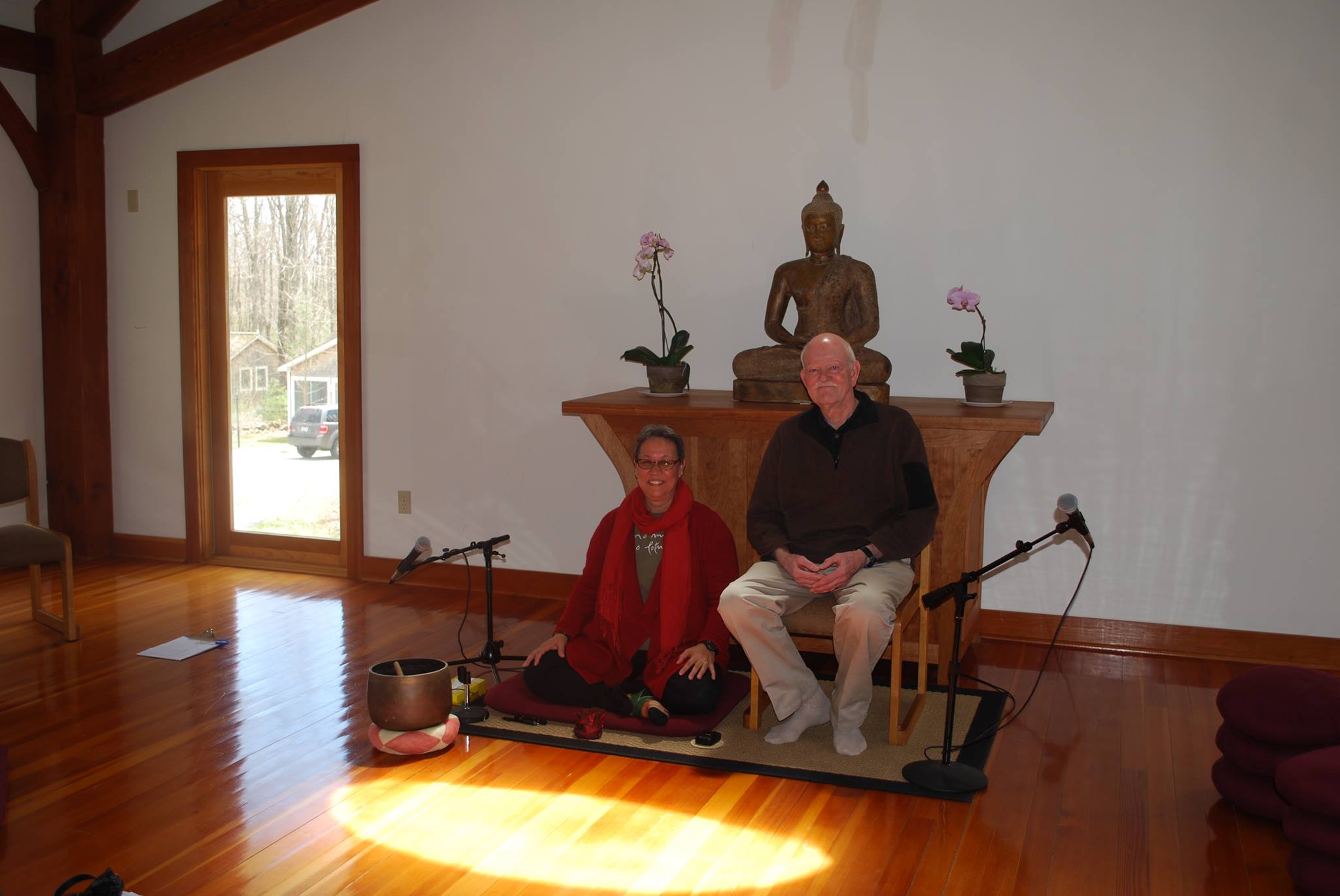
Hardly the next power couple in the dharmic world but we are perhaps a good example of karmic consequences of not steering clear of muddy waters.  Frank & I lead a retreat on the Buddhist roots and ethics that underlie mindfulness programs at the Barre Center for Buddhist Studies. This was an opportunity gifted through the immense generosity of Chris Germer, Kristy Arbon, Mu Soeng, and BCBS Executive Director Laurie Phillips, all of whom galvanized the work we’ve been doing on making explicit the root teachings that inform the psychological aspects of contemporary mindfulness.  Although the retreat was not intended to be a journey into personal practice, it had that effect and spoke to the need for these foundational teachings. It keeps what tends to be superficial attempts at attention and awareness grounded in the original intentions of practice.

Stepping into that liminal space between Buddhist philosophy and psychological models of suffering is not difficult. But it does require a willingness to let go of one’s tribal mentality and concede that wisdom only arises as a result of contact and community. It was uplifting to be with so many practitioners who willingly entered into the intention of the retreat and shared their personal and professional wisdom with us.

Happily, our article, Traditional and Contemporary Mindfulness: Finding the Middle Path in the Tangle of Concerns, was published in Mindfulness the day before the retreat. The email response so far is mostly positive and supportive with one rather wild foray into psychology-bashing & mindfulness as the Ultimate realm where everything is One. This, along with a few comments from surprising sources, makes me wonder if we’ve forgotten that the Buddha recommended teaching to one’s audience. I tried to make the point that most people don’t show up on my doorstep and say, “I’m struggling with the evanescent nature of experience.” They tend to come with a felt though poorly articulated sense that something is amiss. As teachers of any ilk, we are meant to meet those who suffer where they are on the path, not where our elevated egos think they should be.

Not just “know your audience” but also “what am I doing?” This is the edge we found ourselves walking moment by moment as we opened up the texts and poetry that inform contemporary mindfulness. Of course, “what am I doing” occasionally took on the feeling tone of “why the hell did I think I could do this!?” But that’s a post for another day.

I’ve thanked Justin Whitaker in the article but it is worth repeating it here: Thank you for keeping this discussion going at so may levels.

Unknown's avatar

a thousand hands of compassion – book review

Thousand-hands1

Some time ago, one of my dharma friends sent me this lovely book. A Thousand Hands of Compassion: The Chant of Korean Spirituality and Enlightenment by Seon Master Daehaeng¹. I was strangely moved. Strangely because I have never really believed that people who haven’t met face to face actually have the capacity to activate a resonance that one might call a bond, a quiet joy, a sense of being considered kindly. More strangely because I thought I’d done enough work on my own walls and thickets, been the recipient of enough gifts from people I’ve not yet met and those I may never meet to have these walls become porous enough for kindness to flow in.

But there you have it. I am one gnarly, snarly nut to riddle with holes.

Kindness is an interesting thing. It’s one of those behaviourally-based activities that is only known when seen. I do find it easy to be kind. Ultimately it doesn’t cost anything and there is a feel-good factor when all is said and given.

DSC_0006

Compassion, however, is something else all together. It costs everything. And it requires that we are willing to be in the presence of everything. There are no options or substitutions allowed.

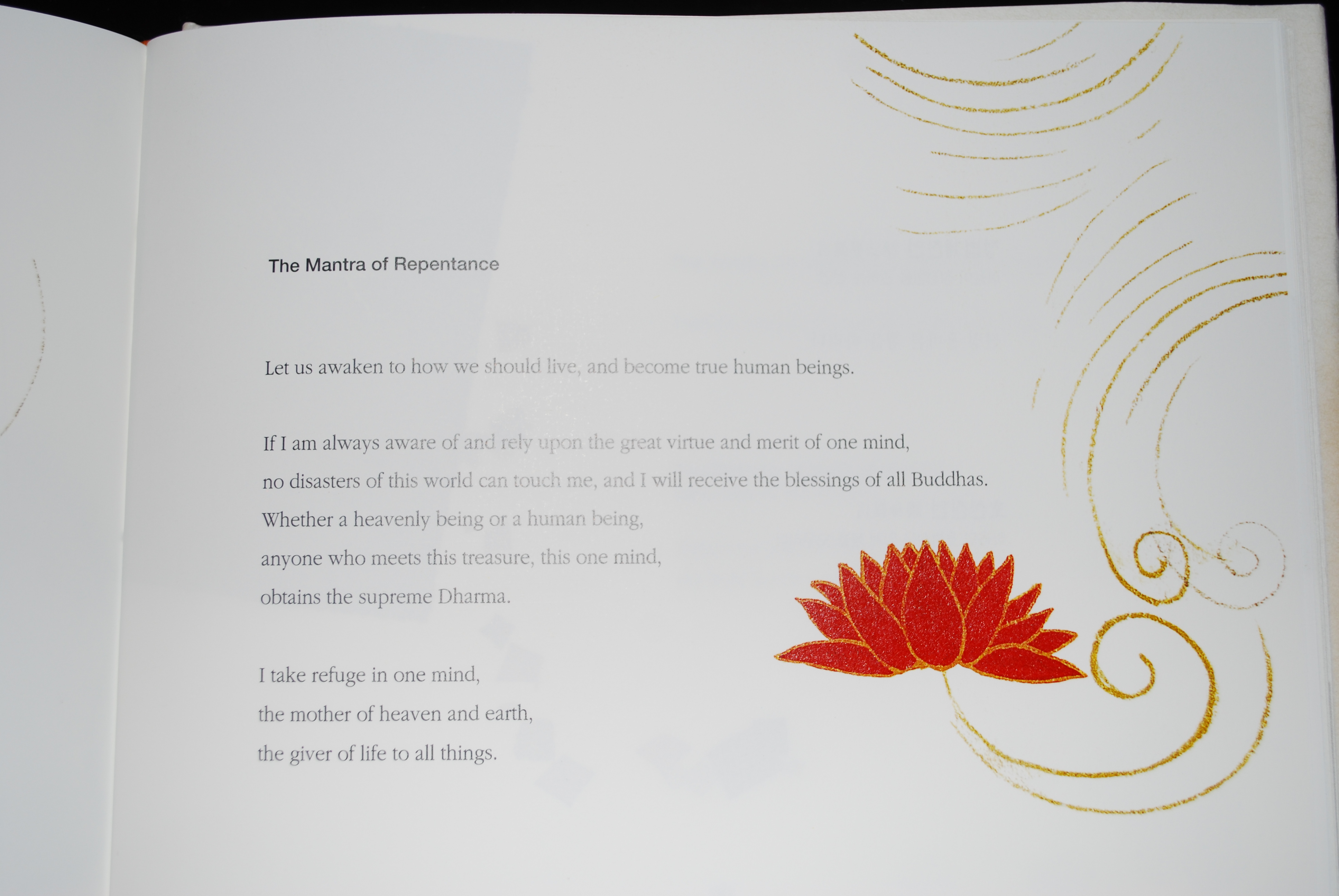
My one mind is the root of all things.
All things arise from it,
so all things I completely entrust to it.
This letting go
fills my heart with light. (p. 36)

This book is an amazing opportunity to practice just that fortitude. Taken from different sutras, it is compiled as a single text and chanted daily in Korean temples. The verses call on us to devote ourselves to that one mind that is the mind of all Buddhas. Some read as short recitations that almost evoke a full prostration. Others are slightly longer tracts that evoke an inner call-and-response. Each page carries a verse, Korean on one side, English on the other, and is enriched by the stunning art of Hyo Rim.
DSC_0007

The minds of all Buddhas are my mind.
Nothing I see, hear, or do
exists apart from
the truth they realized.
My one mind itself is the Buddha-dharma,
present throughout all aspects
of my life. (p.24)

Tomorrow Frank and I leave for our respective retreats. He’s off to something somewhere that hopefully won’t have him terrorizing other meditators with his death stare. I’m off to learn a bit about self-compassion. It seems an oxymoron this term “self-compassion” but I do recall spending about two years on the first two lines of the Metta Sutta.

May I be free from suffering
May I be at peace

So I’m taking this book and my mala beads and an appreciation for T.S. Eliot.

We shall not cease from exploration
And the end of all our exploring
Will be to arrive where we started
And know the place for the first time.
― T.S. EliotFour Quartets

——————————

¹You can read more about Seon Master Daehaeng here.