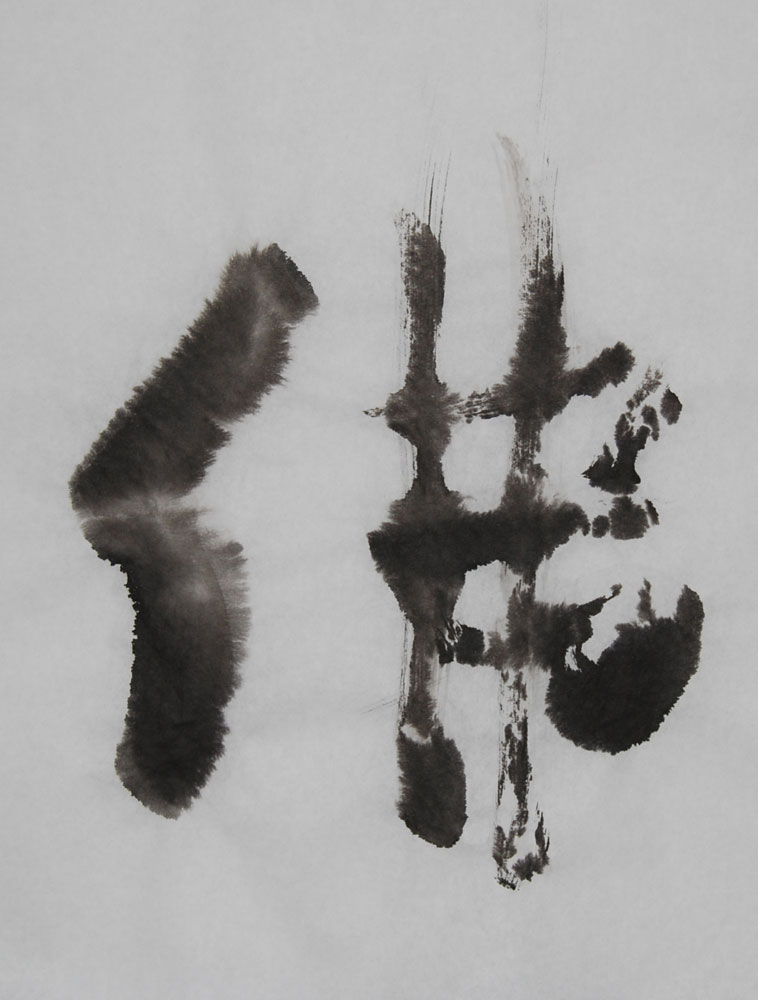
Odd. How things come together. Buddha35 of 108Buddhas was done by inking over a wash of the kanji strokes for the character of Buddha. (I’m sorry if I’m getting repetitive; it’s just my assumption that most people reading this are arriving here for the first time.) I like the way the structure turned out – angular but with a softness in the belly. It also makes a great Rorschach, doesn’t it? I kept seeing huts and looms until I saw a little creature.
In trying to find a suitable dharma teaching to go with Buddha35, I picked up Thich Nhat Hanh’s little book, The World We Have: a Buddhist approach to peace and ecology. I’ve skimmed through it occasionally and have had trouble getting into it. That’s my struggle with Thay’s writings; in the early days of my practice, everything I read of his resonated. Now… well, it’s hit-and-miss. That’s just the nature of my impenetrable mind; I think I have to be in deep suffering and torn open by it to really feel the dharma rain. When life is pinballing along, there tends to be a lot of hubris about my enlightenment as I flash my “do nothing because you’re already there” card.
Anyway, back to TNH’s book. Actually, back to the Introduction by Alan Weisman.
A few years ago, while researching my book The World Without Us, I visited a tribe in Ecuador whose remaining shred of once bountiful Amazon forest was so depleted that they’d resorted to hunting spider monkeys. This was especially grim because they believed themselves to be descended from those very primates. In essence, they’d been reduced to eating their ancestors.
I wanted to go through the chapters of TNH’s book to find something (I was about to type “meaty”) zen-like about my little critter in the painting but, honestly, Weisman’s first paragraph dropped on me like a stone. Once in a while, a teaching from the past will reach forward and haul me back into the zendo to hear it with cleaned ears. This was one of those moments. Thay is fond of the Sutra on the Son’s Flesh – a parable about our greed destroying the future for our children. It’s a profound teaching on ecology if you can get pass the gruesome imagery of the parents’ eating the son’s flesh to survive their situation. With Weisman’s real life, real time story, I get it – again.
Spider monkeys and children – killing our past and future.
I have no more words.
Thank you for practicing,
Genju