

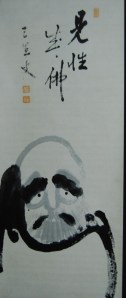
 See your own nature,
become Buddha
Yuzen Gentatsu
(1854-1930)
At some point along the journey there is a moment of softening. This Daruma is a shift from the stern Patriarch and shows a gentling in the old teacher’s features. The artist, Zen Master Yuzen (his Daruma is below) was best known for his plum blossom paintings and the soft hues that reflected his calm nature. Although he began to paint from a young age, he was discouraged from continuing because, he was told, it would interfere with his training as a monk. He put aside the ink and stone but, thankfully for us, took it up again later.
The beauty in Yuzen’s perception of practice is the softness he elicits from ink and paper. Bodhidharma no longer needs to project the harsh unyielding authoritarian teacher (inner or outer) but rather can sit in an empathetic space. The upturn of the inner brows, the open gaze, and cartoon nose invite us to pour our struggles out to him.
No. Really? he says. Why struggle against yourself? You are not the enemy.
 In the path of practice, there was a moment when I felt the shift from hoping practice would make me a better person to realizing practice was only going to bring me face-to-face with this person I am. And, in bearing witness to the reality of who I am, I had to face the harsh, unforgiving, relentlessly self-abusive ways I had developed to deal with myself. Jomon, author of Nothing to Attain, quoted her teacher, Rev Hogen, saying, “Zen is not a self-improvement project.” I really liked reading that – and also feel it’s one of those pronouncements that can too easily slip away from what is really meant. Zen cannot bring about self-improvement; but the practice of zazen is like calling in a housing inspector before the renovations start.
To see my own nature, as Yuzen exhorts us to do, is to be that inspector poking around in the rotted beams and taking disciplined measure of the flow of water and electricity. In fact, I’ve had inspectors come through This Olde Farmstead who ended up looking at me with the same kindly expression on Daruma’s face.
“Really? No, seriously. I know you’re really attached to these wall switches but they are short-circuiting your lights.” The wall switches went and enlightenment was possible – when I remembered to flip the switch. And that was what practice becomes: not just a process of pointing out the warped planking or the rattling plumbing and restoring them to their true nature. It becomes a process of remembering to flip the new switches so that I can see everything alight.
Yuzen was also fond of putting off his patrons who demanded art from him. He was crafty:
“Hmmmm. That painting? Well, to make a painting requires a lot of zazen.”
(Seo & Addiss, pp. 65)
Well, to make a person requires a lot of zazen.
Thank you for practising,
Genju

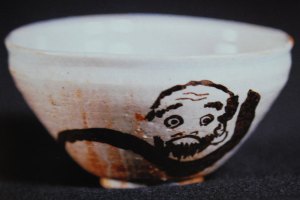 Daruma painted on a tea bowl (1913) is my favourite. Bodhidharma is rendered with childlike simplicity: the wide-eyed look, bushy eyebrows, uncompromising mouth. And the ear-ring. I like to think of this rendering of Daruma as the early days of the Holy Man from the West: youthful, determined, and still able to be astonished by his unfolding practice.
 108zenbooks