

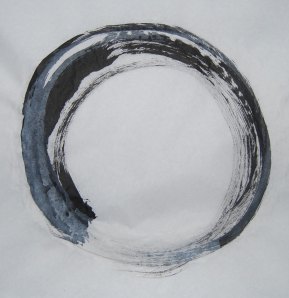
It’s been a while since I’ve had the inclination to play with breath-brush-body. When we lived in Montreal, Quebec, every evening, my parents and I would go for a walk after dinner. The route took us squarely from our home along a major thoroughfare, and across a boulevard lined by industrial shops on one side and the commuter railway on the other. That end of the neighbourhood bordered another where the beer factories spewed out columns of white gases, rank with hops. When the wind blew from the southwest, the rancid smell floated across into the parallel blocks of red brick duplexes and occasional bungalow that huddled together waiting to be gentrified. On days like that, walking past the shops, my father would stop at one, sniff the air, and read aloud the hand-inked cardboard in the sooty window: Inspiration, Limited.
He would laugh, “You don’t have to look far to see why, m’girl, eh?”
A silly memory but in the last few weeks, it’s been popping up. Inspiration, Limited. Head-learning will do that: limit all inspiration. I’ve been scrambling through my notes from the chaplaincy retreat to write the papers, catching up on technical articles in preparation for the next cohort of soon-to-be MBSR teachers, surveying my library for an inspirational Zen book to blog about, and just plain sneaking in a novel. This is too much brain candy and I think I went into knowledge-shock, a non-life-threatening form of insulin shock. But it’s definitely a state that can bring on a similar form of delusional process – I started to believe I knew things.
Thankfully, one of the aspects I was working on from the chaplaincy retreat, which coincided with my re-reading of Roshi Aitken’s book on the Paramitas, was the “shadow” side of each paramita. The cultivation of Prajna or Wisdom, for example, is an “inspirational” practice (to use Roshi Aitken’s term). However, it is more related to striping away the layers of delusion than collecting the flotsam and jetsam of information. When approached with the over-zealous, driven quality we tend to bring to cultivating Wisdom can manifest as a righteousness. It can lead to fixed positions which then bring about misunderstandings and suffering. Similarly, single-focused concentration is an inspirational practice. Not only is it a form of coming home, it gives rise to stick-to-it-iveness, hanging in when the difficult and unwanted come to visit. Pushing it beyond the edge of Dhyana results in obsession or a tunnel-vision that excludes important aspects of one’s life.
“Inspiration limited” has taken on a new meaning and is a neat little mindful bell for me over this week as I work with the paramitas and their shadow. I’m finding it a challenge to sense that tipping point where the practice shifts from light to shadow – or at the very least notice the layering of shadow elements over what is.
Thank you for practising,
Genju
 108zenbooks