Unknown's avatar

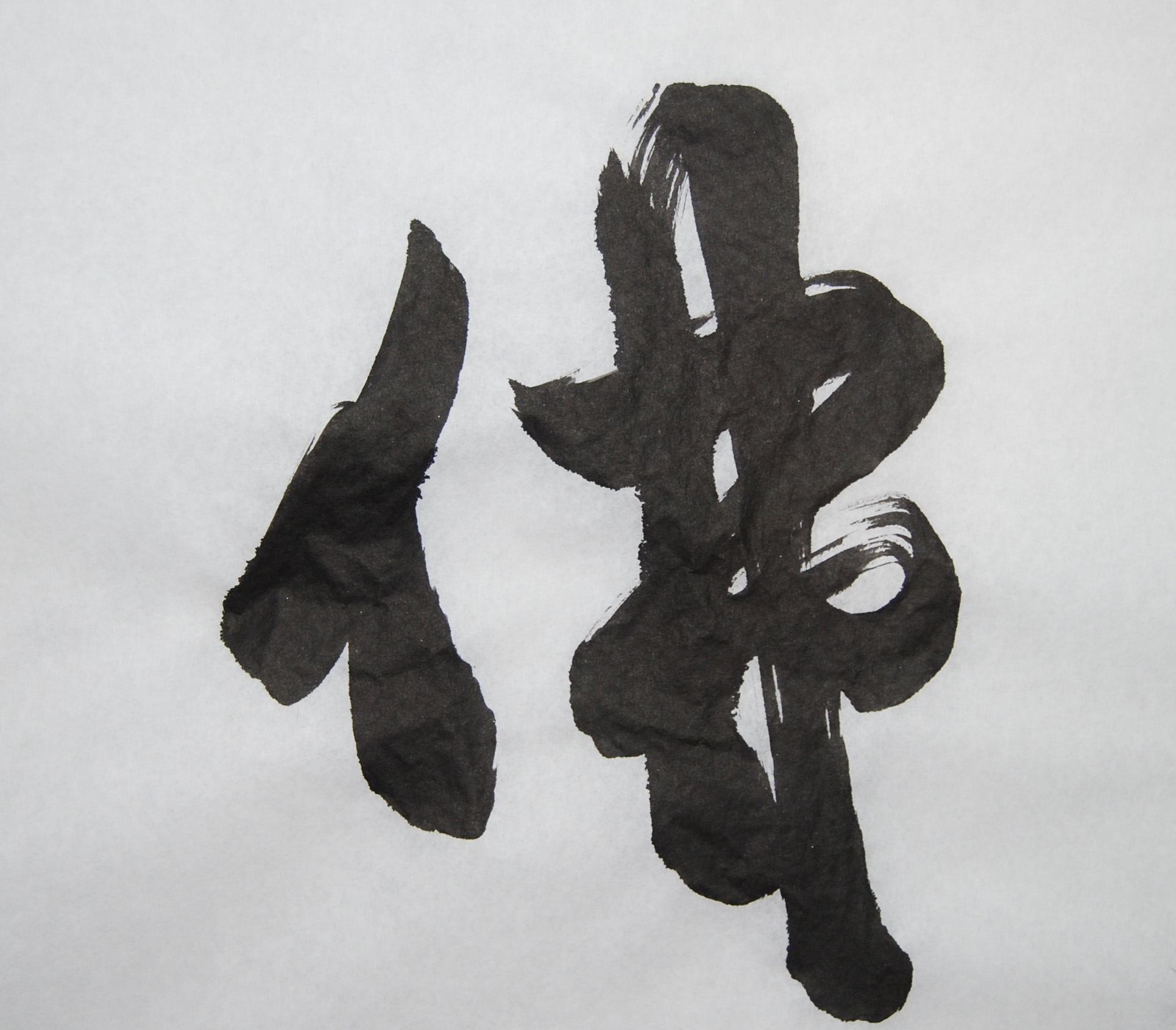
99 buddhas on the wall

I woke up (I wish!) with a silly refrain in my head: 99 Buddhas on the wall, 99 more to go.  Take one down, pass it around… 98 more to go…

So far, my commitment to creating 108 Buddha calligraphies is bringing up interesting issues about practice.  This is Buddha9 which means my brain was doing some strange arithmetic as I was sleeping.  There really are 99 more to do.  Or maybe that’s the pointy-end of practice for me.  There are no more to do except that I think there are.  But that’s important too.  The practice of Zen is about not doing which, in the Ourobouros of Zen, is about noticing what the doing is.  What I notice when I get the brush and ink ready is all the arising hope that this one line will define the direction of who I can be, will shape the container of my joys and pain.  That’s a lot ask from masticated fibers, a patch of horse hair bound in a wooden handle and a concoction of pigment and glue.  Honestly, what am I thinking!

And therein lies the problem.  The Thinking Brain comes online and the next thing I know there is this mound of crumpled “not-good-enough’s” on the floor.  Practice with these Buddhas has become watching that Thinking Brain and with gentleness, escorting it to the mental couch where it can rest.  What research there is on burn out and trauma shows that recovery is in allowing different parts of the brain to come out and play.  But there’s no wisdom in waiting until burn out happens.  I like to see each Buddha that pours out of the brush as a buffer or a deposit in the bank of resilience. Allowing each one to be just what it is without judgement of the line, balance, composition or anything contrived is tough – and the pokey part of practice.

Dealing with loss and grief is not much different.  I’ve never lost a child, but in walking with parents who have, the depth of that pain seems insurmountable.  And yet, and yet, they go on.  What I’ve learned from these amazing teachers is that in my pain what I want most is for it to be different – and by that I usually mean: it would be nice if it was over.  So, I ask myself: what might happen if I let go of wanting this experience to end?

The answers are a fascinating revelation of the need for self-compassion.

Thanks to Jay at DigitalZendo for this link to Thay’s talk on Suffering & Compassion:

Thank you for practicing,

Genju

Unknown's avatar

moving the kamo & the bodhisattva zeno

Our next author on the simple life is Yoshishige no Yasutane who was strongly influenced by Po Chu-i whose grass thatched hall we visited yesterday.  Although Yoshishige no Yasutane wrote of a large mansion in the heart of Kyoto rather than a thatched hut, his sensibilities were rooted in the simple and the spiritual.  After he retired from the civil service in 986, he became a Buddhist monk.  His Record of the Pond Pavilion describes the displacement of people from areas of the city as the landscape was dramatically shifted to accommodate urban sprawl.  Changing the course of the river Kamo and the widespread deforestation to make room for estates caused floods in many areas.  Yoshishige no Yasutane describes the vast changes in the community:

There are abandoned homes where thorns and brambles grew till they covered the gate, and foxes and raccoon dogs dug their burrows there in peace.  From all this it is clear that it is Heaven that is destroying the western sector and no fault of men.

Despite the attempts of farmers and gardeners to adapt, rice paddies flood. Do they expect the citizens of the capital to turn to fish?

The exodus into what were recreational lands cause the loss of forests and streams.  Is Heaven causing this as well, or is it the madness of men themselves? he asks.

He describes his own home: the buildings cover four tenths of the area, the pond three ninths, the vegetable garden two eights, and the water-parsley patch one seventh…  Everything I’ve loved all my life is to be found here.

Just outside the range of the picture to the right are rows of townhouses and supersized homes built on what was farmland and marsh.  The joke in one of the new developments was that they built a pond to replace the marsh because the latter was smelly.  But that only expanded the ground of water and floods everything in the Spring.  It’s natural, I suppose, to want shiny, new things – homes, cars, gadgets.  I freely admit to lusting after the iPad at the moment.  So I can’t be judgmental about the buyers and sellers of what are the grass thatched huts of others.  An externally constructed hunger is an illusion and only feels so real because it mirrors an inner hunger.  We each design our excesses to feed this imagined hunger and, strangely, are surprised when it can only mirror lack.

Yasutane pushes the edge: if we can’t control many aspects of our outer environment, we can be master architects of our inner environment. In its construction, our spiritual abode causes no expense to the people, no trouble to the spirits.  We use benevolence and righteousness for the ridgepole and beam, ritual and law for the pillar and base stone, truth and virtue for a gate and door, mercy and love for a wall and hedge. The piling of goodness is the family fortune.  Such a house cannot be destroyed, invaded, or fall victim to disaster and it passes long into successive generations.

But first, I do have to deal with the external mirages of wanting more and more.  Out of the neural mess I call thinking, Zeno’s challenge emerged as an interesting bodhisattva practice.  So, I invite myself to see how I can get by with half of what I think I need and push to practice with even half less and half again – 1/2, 1/4, 1/8, 1/16, 1/32, 1/64, ad infinitum.

Thank you practicing – and not by halves,

Genju

Addendum:  Please read Ox Herding today for Barry’s brilliant insight to the difference 1% can make.