There was a sangha I used to travel to every month for an all day session. In Thich Nhat Hanh’s tradition it’s called a Day of Mindfulness. It starts around 9:30 AM with a series of sitting and walking meditations. Then there’s usually a dharma talk followed by lunch, a nap (total relaxation with snores) and an afternoon of sharing your experience of the day. I met a number of good and kind people during those days which made the 4 hour round trip commute very worthwhile.
The search for community can be frustrating and filled with disappointments. We take with us templates about personalities and patterns in the hopes that the “good fit” will happen with an audible CLICK. Sometimes it does. I’ve been lucky that way. Except for one, the communities I’ve connected with have been warm and comforting. If something didn’t work out, it was usually because of physical 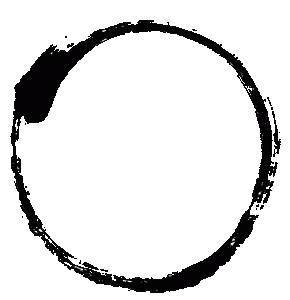 or philosophical distance and not dissent. The one community I left because of feelings of discomfort was just odd: black clothing, no eye contact, no talking to each other, no standing around in the hallways, and (my personal favorite) no flicking your eyes in dokusan.
When the search brings us to a space that feels like we have found refuge it can be a tremendous joy. My early days with my root sangha were exciting. I felt filled with wonder and hopelessly curious about the Dharma. That’s a capital-D-large-font-bold-italicized “Dharma”. Having been recently released from the prison of academe, I was prepped to the teeth to tackle sutra studies, koans, dharma debates, and tea ceremonies. I likely drove everyone nuts and it is a testament of their practice that I wasn’t sent to meditate in the snow in the hopes I would expire under a white mound or drown in Spring slush.
There were huge moments of growth. Learning the practices: incense chants, touching the earth, sutra chants, tea ceremonies (yes, I got to do that!). The Evening Chant and the Heart Sutra never fail to choke me up to this day. I even took voice lessons so I could lead the sangha without defaulting to recitation. There were also massive disappointments over the years. Looking back from where I am now, I can see the clash of templates we all brought to the zendo. I can understand all but one. Some day I will get my head around it enough to write about that one.
 Now, I lead a sangha with my partner. We watch the interplay of newcomers with “regulars” and the clash of templates is ever so obvious. We also watch our own expectations closely and weigh their value carefully. Practitioners come and go. We never hear why one way or the other. It’s our own practice to not become hooked into their templates or become the outcome of their predictions about self and other. We light the candles, ring the bells, serve the tea, and touch the earth in unison as best we can.
The search is an imperative in each of us. It is fed by the longing to fall into that moment in that space with that being – and know it is all me.
I noticed in the stats of this blog that the most frequent search engine term used is “enso” and the least is “great things about Buddhism.” Both terms brought people to this space in a moment of seeking.
So perhaps, I should offer something direct about the terms.
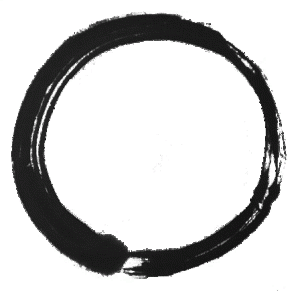
An enso is a circle drawn in one stroke, starting somewhere on a surface and ending wherever it does. It is a path you trace that starts wherever you want it to and ends where you lift off into the air. It can be open or closed. It can be thick or thin. It can be solid or spacious. It is a mirror which reflects your true self and contains the ancestral history of your becoming. It cannot be perfect or imperfect. It is always complete.
One of the great things about Buddhism is tracing that path with your life, starting and finishing wherever you are, lifting off into boundlessness, open, closed, thick, thin, solid, spacious. Neither defiled nor immaculate, neither increasing nor decreasing. It is not perfect or imperfect. It is always complete.
In short: An Enso is one of the great things about Buddhism.
You can also read Enso: Zen Circles of Enlightenment by Audrey Yoshiko Seo (see sidebar) or follow the tags for Kaz Tanahashi below.
Start each morning drawing an enso; it can be one of the great things about waking up.
Thank you for practising,
Genju



 108zenbooks