

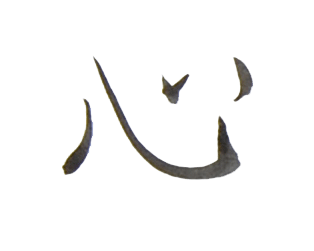
What kind of thing is kokoro (heart)?
I cannot say…
There is an openness in Stephen Addiss’ translation of the first two lines of Ikkyu’s poem. It’s an invitation to enter the aspect of life that cannot be spoken to through the intellect. It’s also an invocation of an aspect of my life which often slides away from me. The idea of not knowing conjures up much anxiety:
not knowing what
not knowing how
not knowing when
Zen stories abound with the idea of not knowing. They repeatedly say “not knowing is the most intimate.” It’s taken a long time for me to accept that “not knowing” is not “being ignorant.” Nor is it “not caring.” At the same time, to say “I don’t know” is a death knell in our current culture of information addiction. Power and control are now exerted through knowledge. But knowledge is not the same as knowing.
Perhaps that’s the difference. In practice, to say “I don’t know” is not about knowledge. It is experiencing this life as it is, for what it is. It is realizing that anything is possible and – like it or not – I will end up intimately participating in it.

Knowing has no doubts. It is “just exactly so”; from the bottom of our heart, we say “Yes.” (From Returning to Silence by Dainin Katagiri).

Allowing the brush to carve the lines for shin (heart/mind), I have to be willing to “not know”, to be open to all possibilities of edge, tip, and ink. The form of the character for shin or heart/mind is simple  enough; a schematic of the physical heart, the organ. Yet when I bring together breath, body, brush, and ink, there is no knowledge of technique that will help. There is simply the sensation of our relationship whose only trace is the black ink line.
The final goal is that we have to participate in intimacy itself. We have to live there. This means we have to live in the samsaric world.

The experience of intimacy is not a particular practice we have to do, separate from everyday life. We have to see intimacy within the form of everyday routine. Everyday routine is the practice of intimacy. This is the basic practice that we have to carry on forever.

To not know what kind of thing is the heart allows for all possibilities to be openhearted. It becomes a progression from the strict form of a character to a spacious yet subtle notation that is the beating of my heart.
Thank you for practising,
Genju


 108zenbooks