

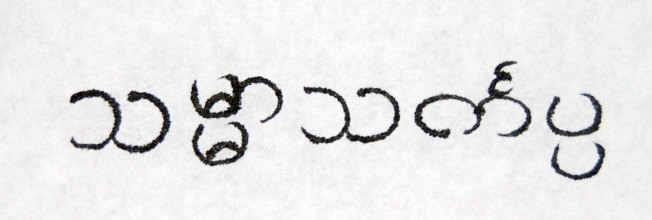
This should be an easy post to write on Right Thinking, the second practice on the Eightfold Path, but I keep getting my neural pathways mixed up. Developmentally, I suppose you could say I grew up as a cultural Buddhist and a spiritual Catholic. It wasn’t a bad mix behaviourally; I seem to recall being opportunistically evangelical and it worked like a charm on most of the adults, which in my childhood seemed over-represented by priests, nuns, monks, and the occasional saint. As a result, my thought patterns were some screwed up variation of life-is-suffering-what-does-it-matter-even-if-you-go-to-confession-you’re-gonna-go-to-Hell. That being a well-worn neural path, on some days, those thoughts still feel like the truth.
I’m not surprised that I gravitated to cybernetics, cognitive science, and eventually forms of therapy that relied on challenging our thinking process. Equally unsurprising is the fact that I only developed faith in the capacity of Cognitive Therapy to be useful and beneficial because I tried it on myself. (Thankfully, I didn’t become a psychiatrist specializing in electro-convulsive therapy.) Why wouldn’t I? Can you imagine telling someone “Look, you need to let go of that thought about being a loser and just challenge it with a question like ‘What’s the data that I’m a loser?'” with no idea of how hard it is to do that?
It’s not impossible. It can be done. But until I actually sat with this rampaging bull of a mind and tried to get it to turn right when it was careening left, I didn’t have a clue what it took. For a period in my life, I remember creating a little template with five questions that I hauled out and asked myself every time the bull started thrashing around.
What was the Behaviour?
What Affect are you noticing?
What Sensations?
What Imagery?
What Cognitions?
This B-A-S-I-C is a template from a researcher named Arnold Lazarus whose concept of cognitive appraisal dove-tailed with the rising theories on stress in the 70’s. Even when the surge of Cognitive Theories and Therapies hit psychology, I stayed loyal to Lazarus’ theory of how we generate suffering for ourselves by interpreting situations as catastrophic when other perspectives may be more useful. It seemed so… well… Buddhist. And besides, it made sense. And, it had strong backing from Buddha to Marcus Aurelius to Shakespeare.
Recently, I’ve started using Thich Nhat Hanh’s four practices for Right Thinking (The Heart of the Buddha’s Teaching):
Are you sure? It’s easy to mistake a rope for a snake, a friend for a foe, a helping hand for an ambush. I’m good at these thought twisters. Asking myself if I’m sure of what I perceive is a checkpoint on the road to suffering.
What am I doing? Unfortunately, when I ask this question of myself, it sounds a bit panicked! The intention is to be – right here, in this moment. This works really well for me when I’m chopping vegetables or doing something routine where the probability is greater that I will be caught up in discursive thought. Thich Nhat Hanh writes that the initial thought is not the problem; it’s the developing thought that can run us down paths that are judgemental and unpleasant.
I’m relieved to read this because there are too many mindfulness teachers spouting “Thoughts are not facts” and really confusing folks about the obvious: thoughts help organize facts. Fact or not, “She’s probably mad at me” is not the problem. Expanding it into a three-part mini-series of betrayal and vengeance is – all the more so if she really is mad at me.
Here you are, my Habit Energy. Neural paths are easy to lay down and hard to avoid once entrenched. There is safety in habits: taking the same route avoids getting lost, eating the same food avoids disappointment, sticking to the same relationships avoids risk of rejection. I’m a creature of habit but I’m starting to push that edge of comfort out of curiousity, adding colour to my palette.
Bodhichitta. In The Heart of the Buddha’s Teaching, Thich Nhat Hanh doesn’t really dig into the practice of cultivating the mind of love as a part of Right Thinking. I can see some obvious connections: bodhichitta is a perspective of relating with compassion to all beings which requires a form of non-preferential thought, non-judgemental mind. It is linked with Right View as cart to ox, pulling along together in the rutted road. I have to work on this one. Really work on it because the initial thought I get with some folks is likely only going to be dislodged with some high voltage current.
Thank you for practising,
Genju


 108zenbooks