Unknown's avatar

first love

the stream of all ancestors

carrying the wisdom
of all my teachers

in empty hands,
shaped, hollowed out,

by the stream of
all ancestors

~~~~~~~~~~~~~~~~~~~~~~~~~~~~~~~~~~~~~~~~~~~~~~~~~~~~~~~~~~~~~~~~~

Thich Nhat Hanh has written almost a hundred books; I’ve lost count.  Each one is a jewel but none as challenging and raw as Cultivating the Mind of Love.  In it, he speaks candidly of his first love, a nun met when he was teaching at a temple in the Highlands of Vietnam.

I knew that I loved her.

How simple.  How incredible.  I knew that I loved her.  Thay takes this story of his “first love” and weaves it into a journey to find our “original face.”    Just as the face we are born with may not have been our original face, our first love may not really be our “first love.”  So he “goes upstream” to show the many streams that feed into who we are in this moment.  For Thich Nhat Hanh, the source of who he is in the present moment arose in his childhood experiences of seeing a drawing of the Buddha, searching for the hermit in the woods, drinking from a clear mountain stream, his brother’s ordination as a monk, and his mother’s dedication to his well being.  When he met the young nun who ignited strong feelings of love, he writes that he could see the line of ancestors that flowed into the stream of his life and hers.

Please look into the river of your own life, and see the many streams that have entered it, that nourish and support you.  If you practice the Diamond Sutra and see the self beyond the self, the person beyond the person, the living being beyond the living being, the life span beyond the life span, you will see that you are me, and you are also her.  Look back at your own first love and you will recognize that your first love has no beginning and no end.  It is always in transformation. (p. 60)

He goes on to say,

Whether water is overflowing or evaporating depends on the season.Whether it is round or square, depends on the container.  Flowing in spring, solid in winter, its immensity cannot be measured, its source cannot be found.  In an emerald creek water hides a dragon king.  In a cold pond it contains the bright full moon.  On a bodhisattva’s willow branch, it sprays the nectar of compassion.  One drop of water is enough to purify and transform the world in ten directions.  Can you grasp water through form?  Can you trace it to its source?  Do you know where it will end?  It is the same with your first love.  Your first love has no beginning and will have no end.  It is still alive in the stream of your being.  Don’t believe it was only in the past.  Look deeply into the nature of your first love, and you will see the Buddha. (pp. 75-76)

I struggle with this, trying honestly to see all the loves and not the losses.  Going to the source of the mind of love, bodhicitta, means letting go of the loss and opening to each love as a branch of the stream that originates deep in the past and flows forever into the future.  If I value that powerful, steady outpouring of love in the river of my life, I have to value myself as a steam in the lives of those I touch.

For now, I invite you to look far enough into the future, so far that you cannot help but see yourself, become yourself, the source of a stream of love and life.

Thank you for practicing,

Genju
Unknown's avatar

going home

going home

here,
in this moment
we tread a path

that not-knowing
stamped out.

familiar
and new,

ordinary
and amazing.

as simple
as
going home.

~~~~~~~~~~~~~~~~~~~~~~~~~~~~~~~~~~~~~~~~~~~~~~~~~~~~~~~~~~~

Now that was an eventful week!  Before I continue on this meander, let me give a deep bow to Philip Ryan at the Tricycle Editors’ Blog who graciously picked up 108ZB’s Ox Herding adventure and made this whole enterprise a chance to practice a lot of calming breaths.  It was fascinating to watch the oxy-moronic mind grab the event and create catastrophic dramas out of it – with rumbling omens provided by our little 5.5 earthquake on Wednesday.  And that precisely is the process of Ox-Herding, isn’t it?  How great to have it unfold all in Real Time!

In this stage of Ox-Herding we are in partnership with ourselves, integrating practice into the everyday, bringing the disciplined mind into service so that there is a seamless quality in our interactions.  In my own staggering along the path, I get to a point, after the dance and the trusting embrace, where I can no longer deny the relational.  Not only do the Ox and I continue to create each other, we now also create the world we move in.  In that world, I can no longer see things the same way, interact with the same unskillfulness – well, I can, but no longer without awareness that I’m doing so.  And interestingly, I don’t want it to be any other way.  This feels real; it feels like the compass is set in the right direction.

In sangha, last week, I was asked to talk about where I was with the Upaya Chaplaincy studies.  I preferred to talk about Ox-Herding.  It turns out it’s one and the same.  One of the sangha members asked if the stages were re-visited at different points in our lives or if we “got it” enough to fall forward continuously.  If I think about the unfolding of many (all?) of my experiences, I can definitely say it starts with a search; more accurately it starts with a yearning.  After that, trajectory and mileage on the ox will vary.

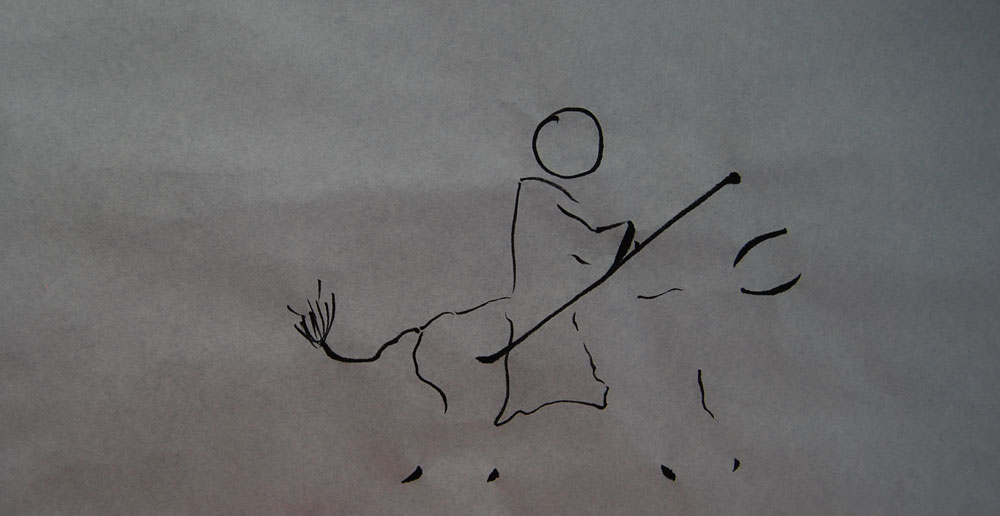
That this is a recursive process was really evident upon seeing my posts tagged as “art” on the Tricycle Editors’ Blog.  It threw me into Stage 3 (Seeing the Ox), triggering all the concepts what “this means.”  Twenty or thirty years ago, when I bought my brush for $1.96 + tax, the only intent was to take lessons to feed my love of all things Japanese (there’s a karmic link there that I will explore someday).  As my teacher’s inept student, taming the grasping and wild mind definitely overlay the other stages of seeing the traces and actuality of how I could grow.  At some point, I invested myself in the process (in first glimpse, did you notice the hat transforming into the horns of the ox).  If I rode the ox home then, it was along paths that were tangled with thorny bushes which tore at my skin.  I left the teacher but not the path – or the ox – and started the search again and again.

The Chaplaincy process is similar – but different.  The ox is larger – about the size of Babe the Blue Ox and I’m no Paul Bunyan.  It too started with a search; unlike the art, this began with a yearning to create some meaning out of this mess I call “my life.”  What I saw as traces and then the reality of who I am in this particular journey has been hard to comprehend.  I feel I’m asking to learn how to offer the incense but instead, I’m caught up in a whirlwind of learning how to grind the ingredients and glue them together.  But that’s fine because I’m reminded that when I grind the ink for my paintings, it gives them a special depth.  More important, there are moments when I am struggling to do things differently; graduate school was an abusive environment and it gave me survival skills that I’d prefer never to re-activate.  So up to this stage, dancing with the Ox is giving me a lot of practice cultivating different skills – trust, boundless joy, equanimity, understanding presence.  And walking away quietly.

I do feel I’m riding the Ox home in the Chaplaincy and the path has to be negotiated with both intention and awareness of lessons learned.  It cannot be goal-driven, not simply to catch a ride home; this time it must be different at every level of my body/mind.  But, cattle love to take the same route home to the barn each evening.  Look out across a field where they have been wandering and you will see well-defined tracks.  Creatures of habit, they are not easily dissuaded.  So Babe the Blue Ox and I have some negotiating to do because some of these well-worn tracks are not how I want to get home.

Thank you for practicing,

Genju (and Babe)