

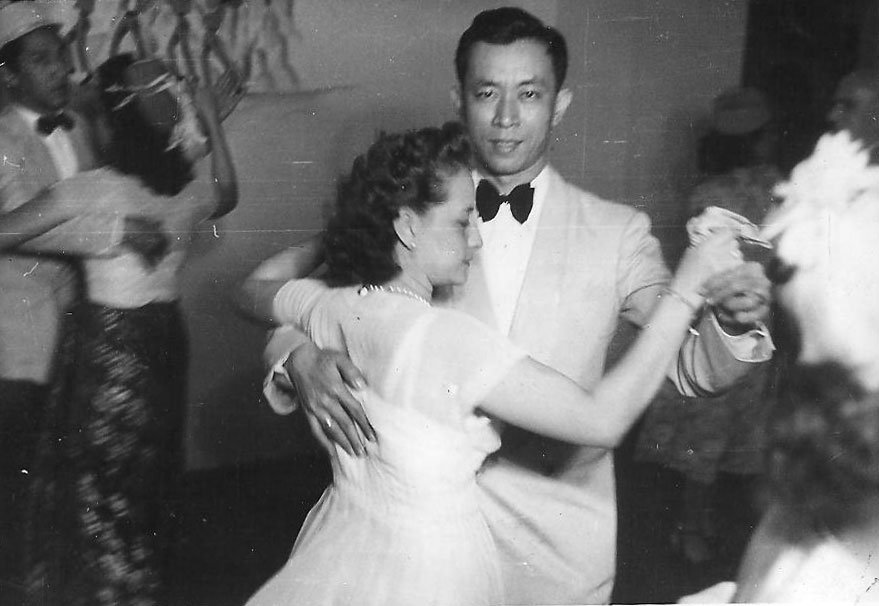
 We had our first formal zazenkai today after a few years of hunkering down in formless practice. As formal as it gets, I suppose, given my tendency to laziness when it comes to form and ritual. Yet those moments of chanting and prostrations are a lovely dance we should all take part in if we are to learn to embody practice, to live vow. And I felt it was important to honour the 7th day after my mother’s death.
Oh. That’s my father and mother to the left. They cut quite a dashing couple in the old days – which were actually the new days for them. New days of hope that the British Occupation would bring them comfort and opportunity – which it did. I think the picture is taken after WW II and around the time of Great Optimism. They were both rising stars in the newly formed government, sometime after Aung San’s assassination and the military take over by Ne Win in 1963. By then, they had learned to weave through the many political ups and downs including losing much of their acquired wealth when Ne Win demonetarized the Burmese kyat. In fact, they had both retired and built their dream home only to have my father return to work when asked because, drawing from the rhythms of his poverty-ridden childhood, he couldn’t imagine a world that didn’t need him or a family that ever had enough money to survive.
This was their legacy: work hard, do what’s necessary, never wonder if things could be better, make them better by waking up each morning and doing what is necessary.
Monk: What is the essence of your practice?
Basho: Whatever is needed
So today, we chanted the Honoring of the Bodhisattvas, lowered our bodies to the ground in gratitude for all the Bodhisattvas and Mahasattvas, the Stream of All Our Ancestors which now includes my parents and the parents of some of my friends whose mothers and fathers made their transition this week.
There’s a reluctance about the form of practice. I feel it in myself even now after these years of lighting incense, bowing, prostrating, and stepping back before turning away from the altar. As if somehow I would like this Buddhism to be something pure and separate from the religiosity of my childhood, the cathedrals and the black-frocked Christian European priests speaking to us poor Asians as if we were just south of a Neanderthal lineage. And yet I resist the neo-spirituality I find that sucks in Buddhism as the panacea for and talisman against all sins past and future.
So yes, I’ve shopped my way around but in my defense it was only because of my ignorance of the many factions (I use that deliberately). I grew up in a cultural Buddhism which had little to do with meditation and a lot to do with chanting at the pagodas, prostrating and feeding male monastics. That said, a bit of buffet-surfing was to be expected and having (quickly) settled in Zen, I am quite content and even allow my Latin-Mass Catholic heritage to relish in the rise and fall of Namo Shakyamunaye Buddhaya.
Still, I have to say that meeting so many on this path who are caught in the confounding of being spiritual and being non-religious frustrates me. Even more do claims to a Selectionist-Buddhism, as if that makes it more spiritual, annoy the heck out of me. If there was one thing I learned standing my parents’ deathbed – even a decade apart – was that rituals don’t help ease the pain. That’s not why we step into that space. Rituals offer an opportunity to see how our mind grabs the nearest thing and makes it fuel. That’s all.
And that’s likely the most important teaching we will ever receive whether it’s lifting a cup of coffee to our lips, checking the rear view mirror before backing out the driveway, packing our life’s belongings to cross an ocean, or bowing to the stream that awaits us as future ancestors.
~~~~~~~~~~~~~~
Note bene: Interestingly, I am reading Dispirited: How contemporary spirituality makes us stupid, selfish and unhappy by David Webster. He has a fascinating thesis on spirituality having been hijacked by the New Age and the buffet mentality of seekers. The book is good if somewhat problematic in being poorly edited, the occasional philosophical rant and difficulty with having to infer whether he’s talking about “authentic” or “let-me-look-spiritual” spirituality. But I’m liking it and, for the more philosophical among you, it may be worth the read. (He actually does a great job of it on his blog post, Spiritual But Not Religious.)

 108zenbooks