

 I posted this comment on Ox Herding yesterday:
I don’t want happiness.
I want an IPad.
Very simple, really.
If Ihad an Ipad,
I would be able to acquire all the things I want to acquire
and then
I would have power, fame, and fortune.
If Ihad an Ipad.
What would you sacrifice to have that bright, shiny new toy? The question is not a couched accusation. I ask because I found myself caught in a moment’s dilemma a few weeks ago. An email arrived from a group list of mindfulness practitioners that offered a free iPad (yes, in the poem above I’ve inverted the caps in the letters for good reason). All I had to do was go to the Apple site, click on the links and I would get an iPad to beta test some apps. OK, any opportunity to be pimped out to a technology giant, I’m first in line! It’s an adorable failing of mine and my family has attempted a few interventions to no success – unless you count that sucking sound of Frank and The Kid falling into the black hole of Kindles, cell phones, notebooks, and nanopods.
Following the instructions carefully, I entered all the relevant information on the website as it dangled luscious pictures over and over again of all the things I could do with my new iPad (which I get to keep after the beta-testing). My addiction tends to put me in a jhana level I call Fire, Ready, Aim. Click, yes please include me. Click, here’s my vital statistics. Click, yes you can harass my husband about my worst habits. Click, you can have my first-born (and no exchange or replacement allowed). Click, here’s access to my contacts…
It is in moments like this that I am deeply grateful for my years of practice in paranoia. Contact list? I don’t think so. Sacrifice my spouse and first-born, no problem. Share my Contact List, well… let’s talk about that, shall we?
But there’s no talking to be had with software designed to get more from you than it’s designed to give. You’ll be proud of me: I let go of my desperate need for an iPad to preserve the sanctity of your email box.
Starting with yesterday’s post and into this week, I’ll be circling the drain of mindless consumption. My friends in the US are celebrating Turkey Day and Black Friday (is that a celebration?) this week. And the world is zooming in on that Season-Who-Should-Be-Renamed. ‘Tis the season for a peek at the subtle ways we are lead astray. One of the chapters in Stephanie Kaza’s terrific book, Hooked: Buddhist Writings on Greed, Desire, and the Urge to Consume is by Diana Winston titled You are what you download. Using the 12 links of “dependent (or not) origination,” Winston explores how her addiction was triggered by the Internet:
On the day I realized that I could have anything I wanted over the Internet, I bought ten new books, a subscription to a simple-living magazine, and a pair of black leather boots, and sent myself daily quotes of the Buddha. The Buddha sent me an email about the law of karma. He said actions have results. If I plant a plum pit, I will get a plum tree. If I practice greed, I will be more greedy. If I practice generosity, I will be more generous. Buddhism 101.
It’s easy to get sucked in. It’s easy in that vortex to have the light that glows from what we value diminish and flicker. It’s easy to believe then that what we want is so much more valuable than what we have – or are about to give away. However, that moment in the iPad seduction was more insidious than my usual unrestrained forays into Internet shopping. For whatever the reason, that split second of realization that I would have to surrender all the names in my address book broke the trance. I was being asked to offer up relationships of trust for a piece of technology. Lovely technology, mind you. Sexy, smooth, vibrant, del.icio.us technology. And that seductive software made the fatal error of asking me to betray a trust. Fulfilling Internet-fueled cravings was no longer an individual matter.
Winston goes on to point out that it helps to have more space between the first arising of craving and the grasping (or aversion) that follows. Although she is quite correct in exploring this aspect of Internet-fueled greed as an individual risk, I realized it is very much a relational risk too. From the chain emails to i-viral infections, we are asked to expose our connections to others either deliberately or inadvertently. And, I haven’t even got into the whole exposure process of social networks which are a variant on the body count issue of yesterday’s post.
Winston offers many possible antidotes to being in the thrall of the Internet. Limiting the time spent, having a one-to-two ratio of time spent on the Internet with time spent with friends and so on. I like the metaphor that arrived in my mail – the real, drop it off in your box at the end of the laneway mail.
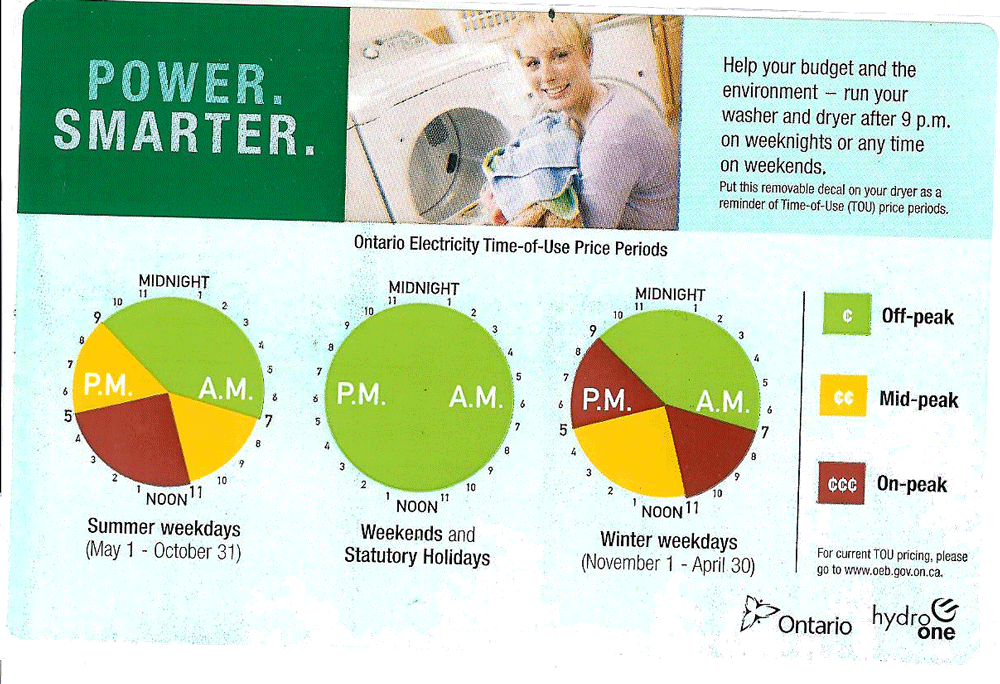 Our electricity company now charges based on the time of day I use my appliances. High to low peak hours remind me to use the green-zone times to do the wash, run the dishwasher so that I consume less and minimize the impact on my environment. The potential duplicity of corporations aside, this is a neat sticker to place on my desk, reminding me that there are times when my actions will have a greater relational cost and to use those times wisely. Looks like Internet offers of satisfying lack go in that red zone.
Thank you for practising,
Genju


