Unknown's avatar

transitions, light & faith

from the dark

from the dark

“…or I can forgive and forget…Oh, but my treasure, it is so much less exhausting. You only have to forgive once. To resent, you have to do it all day, every day. You have to keep remembering all the bad things…we always have a choice.” Character in The Light Between Oceans by M.L. Stedman.

It’s been a long time since I’ve been shaken by a book. Stirred, certainly. Bored, frustrated, annoyed, informed, inspired – yes. But shaken? Not recently. And that’s saying a lot given the hellish six months of holding together body and soul. Or may be it’s just easier to be shaken when there’s no more resistance to what the universe decides to throw at you.

“Sometimes life turns out hard, Isabel. Sometimes it just bites right through you. And sometimes, just when you think it’s done its worst, it comes back and takes another chunk.” Tom, one of two principal characters in The Light Between Oceans.

The story takes place on Janus Rock playing on the trope of the Roman god Janus, who presides over transitions and can see both past and future. Janus Rock is home to the main character, Tom who is its lighthouse keeper and later to Isabel his wife. Their transitions, as with most beginnings and endings, are turbulent, riven with loss that leads to secrets, and decisions that can be argued from both sides of one’s moral face. It’s a slow read, evoking the meticulous cleaning of the lighthouse light, its record keeping, the passage of time on an island between the Indian Ocean and the Southern Sea half a day away from the coast of Australia. But that steady unwinding of the tale only makes the ending more breathtaking.

Many of our moral judgments are made sitting on Janus Rock, between here and there, what I want to say and what I say, what I believe and what I need to you believe. We craft our stories with threads we summon from past and future – often at will and if only to gather evidence to justify a decision already half-made. We tell stories and tell them so well that we often forget what is truth and what is needed to be heard by the inner and outer senses. Or more correctly, we forget there is no real truth and that what we hear (inner and outer) serves only as the chinking that holds together a rather wobbly lighthouse tower.

gold center

center light

And in our story-telling we are so convinced that our intention is noble, protective, caring. These are beacons we send out hoping that someone will be saved, alerted to our edges. Because for as much as we believe we are good, well-intentioned, loving and caring, we are also terrified that we can do harm by the structure of our very nature.

My dear friend, Carole, over at the dot (Zendotstudio) has written an eloquent post about stories. She does summon the devil in me though with a poke about Eckhart Tolle. What I think of Tolle is my well-worn story perpetrated on anyone I think needs to be saved from the shoals of Tolle’s teachings. In fact, there are a number of characters in the convoluted political states of mindfulness, psychology, and Buddhism who have sent me tearing up the lighthouse stairs to set the beacon afire.

Yet lately, I have begun to tire of that long climb up the lighthouse. I’ve learned that a lighthouse beam is set at night and turned off during the day. Once set, it needs no further tending; it functions with equanimity, sending out electromagnetic metta to anyone who wishes to attend to their state of being. It really only needs us to act our discipline by polishing the lens, oiling the nuts and bolts, and turning it on and off at its assigned time.

There’s an element of faith in this. All this to-ing and fro-ing trying to keep shipwrecks from happening simply stirs up resentment when we are disregarded and as the character quoted at the opening of this post, it can be burdensome to keep those fires burning. In the end, it is a choice to see the rose glistening as the rainfall pauses rather than the soaked, muddy ground. It is a choice to see the wonderful fruition of all our hard work rather than what didn’t flourish despite our care. And making those choices generates faith in our commitment. And faith is so much lighter to carry.

As for Tolle, I had the cheeky rejoinder though it is true of psychology and meditative practice: I have come to realize that if I hold true to the hope of my own transformation then that has to be rooted in the hope of all beings’ transformation. Ole Tolle included.
Unknown's avatar

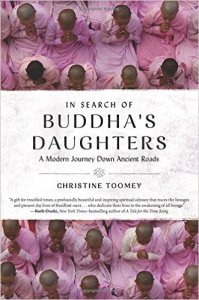
Book Review: In Search of Buddha’s Daughters by Christine Toomey

“The difference between a path and a road is not only the obvious one. A path is little more than a habit that comes with knowledge of a place. It is a sort of ritual of familiarity. As a form, it is a form of contact with a known landscape. It is not destructive. It is the perfect adaptation, through experience and familiarity, of movement to place; it obeys the natural contours; such obstacles as it meets it goes around.”
― Wendell Berry, The Art of the Commonplace: The Agrarian Essays

Buddhism’s mainstay is a constant repetitive invitation to step onto the path, enter the practice by cultivating the skills of the Eightfold Path. It’s a familiar image and anyone having embarked on such a path would easily say it’s not a straight road from here to wherever. In her book In Search of Buddha’s Daughters*, Christine Toomey’s intimate portraits of the nuns in various traditions in Buddhism offer clear evidence that the path is neither simple nor easy, not only in their individuals paths that brought them to ordination but also in the over-arching path of the legitimacy of ordination for women. Toomey crafts a biography of each nun she meets with a balanced touch of both intimate details and their place in challenging the larger religious obstacles of ordination for women.

Christine Toomey comes to this topic with impressive credentials. A polyglot and twenty-year veteran covering foreign affairs for The Sunday Times Magazine, she has been shortlisted for a number of articles and won the Amnesty International Awards for two hard-hitting articles on the murder of young girls in Guatemala and a “school of assassins” in the US. (Toomey’s articles are available on her website here.) Her approach to these topics and writing style are uncompromising, making her softly even-handed approach in Buddha’s Daughters an interesting read.

As with most seekers who write of seeking, Toomey’s journey began with a growing awareness of her own suffering, both in her personal life and as a result of her exposure to world scale tragedies.

Buddhas-Daughters“After so much time spent shedding light on some of the darkest corners of humanity, the consequences of such tragedies have become frighteningly familiar….

…In the months before I embarked on this journey both of my parents died…. There had been painful losses before this, but the shock of losing both my parents so suddenly and within just a few months of each other brought my life to a standstill. I felt at a crossroads. After so much time spent bearing witness to the suffering of others, I realized I barely knew how to handle my own.”

– Christine Toomey, Preface, In Search of Buddha’s Daughters, pp. 9-11

Perhaps it is this rawness and deep sensitivity that make Buddha’s Daughters a process book rather than one that offers facts and details about the characters within. The authenticity of this book is not only that Toomey writes about the topic and people but that she actively takes part in their lives, brief though it may be. Certainly Toomey also doesn’t shrink from the facts of the unfairness and even misogyny of complete ordination that is withheld from women in some Buddhist traditions.

Toomey’s journey begins in Nepal with the nuns trained in kung fu at the Druk Gawa Khilwa nunnery near Kathmandu. I feel for her struggle with the 4AM wake-up call and the challenges of following an intense schedule. However, it gives a sense of an embodied approach to her perspective – part biographer, part historian, part social commentary. From Nepal (with a side trip to Lumbini), she proceeds to India and Dharamshala where she explores the deep suffering of Tibetan refugees, especially the nuns who have survived torture in Chinese prisons. I’m deeply affected by one interview with the nun, Dhamchoe who had been imprisoned in Drapchi jail, the largest prison in Tibet. The nun, no longer wearing her robes and working in a cafe in Dharamshala, speaks of her commitment to hold onto her life as a nun despite no longer having the outer form of robes and community. When asked if she wouldn’t prefer to live in sangha, Dhamchoe speaks of her feelings of impurity because she cannot say she holds “no hatred towards (her captors).” This stands in such stark contrast to the anecdote about the Dalai Lama’s astonishment that people would feel self-loathing (see here).

Toomey then goes to Burma, interviewing nuns in the Theravada tradition – in which resides the strongest resistance to full ordination of women. She weaves a solid history of the growth of Buddhism in Burma (with a description of Bagan that makes me want to avoid it were I to return). Interestingly, Toomey skims over the British occupation that galvanized Ledi Sayadaw’s laicization of Buddhist meditation in an effort to protect Buddhism against colonialism (see here) thereby missing out the source of the momentum of Buddhist practice that eventually gave rise to the mindfulness juggernaut (which she visits by coming home to Oxford and the Oxford Mindfulness Center at the end of the book).

It is here in the chapters about the nuns in Burma that the topic of ordination for women reaches it’s stride. The controversy of the nun Saccavadi and the ensuing political battles between monks and monasteries which saw Ajahn Brahm banned from speaking on the topic at the UN Vesak Day in Vietnam in 2009 and Bhikkhu Analayo writing an articulate argument on the legal status of ordination. At the micro level, it becomes clear from Toomey’s interviews that there is a grassroots movement alive that is supporting the education and support of women who wish their commitment to the Dharma is valued as more than housekeepers for monasteries. Toomey also makes an insightful comment that many male supporters of women being ordained have been affected by a personal history of an absence of significant women in their lives (loss of connection with mothers, sisters, etc.); this gives them an appreciation of the power of the feminine as part of healthy growth.

Toomey travels then to Japan (interestingly Korea with its long history of ordained women is not on the itinerary), winds back through North America, and then home to the UK & France. Perhaps the Western stories are impacted by a different cultural perspective but I had trouble feeling the same tension and dynamic between the characters and the storyline. Perhaps it is that these women are not as embedded in cultures that find it unimaginable to value women beyond the utilitarian. I don’t suggest that Western nuns have not had their own deeply wounding struggles with systemic bias and rejection; there is ample evidence of sexual and psychological abuse at the hands of teachers. Something has shifted in the tone of the book and I’m very willing to think that it may be more my own resistance to something in these women’s stories.

Chapter 19, however, is poignant. There is a palpable feeling of coming home in Toomey’s words. While I’m an “early-adopter” of MBCT (at least that’s what publishers keep telling me when they send me MBCT books to review), I did find the foray into Oxford’s MBCT center a bit off-center, having nothing to do with Buddha nor his “daughters”. Still, I’ll grant Toomey that detour simply for being one of the few journalists who actually took part in an 8-week program and completing it before she wrote about it.

All in all a powerful testament to the female spirit and the necessity for the feminine in Buddhism.


*Published in the UK as The Saffron Road: A journey with Buddha’s Daughters.