
Unknown's avatar

the river of heaven

Diving into Aitken Roshi’s book of haiku, The River of Heaven: The haiku of Basho, Buson, Issa, and Shiki (publication date June 14, 2011).  It opens with a bittersweet recollection by Susan Moon of Roshi’s stepping down ceremony. 

“Someone asked him, “What is the most precious thing?” and he replied, “A good night’s sleep.” “

Moon reflects that after all he had contributed to the world of Zen, a good night’s sleep must have indeed been a precious thing.  The River of Heaven is a gentle collection of haiku with Aitken Roshi’s commentary on each poem.  The commentaries reveal not only something about the authors of the haiku but also of Roshi himself.  At times critical, at times nostalgic, he finds a delicate presence between his persona of Zen Master and a humble reader of the Zen Masters.

The book is divided into The Summer Moor which showcases the haiku of Basho and The Spring Sea with the poetry of Buson, Issa and Shiki.  Aitken Roshi leads with Basho, clearly a favourite of his as he describes in the eponymous haiku:

The sea is wild!
stretching to Sado Island
is the River of Heaven.

The Milky Way is the River of Heaven and it conjures up wondrous images of celestial beings walking the path through the skies.  In the commentary, Aitken writes that he fell in love with Basho upon reading this haiku in the Library of Hawai’i in 1938.  Roshi Aitken passed from this earth on August 5, 2010, hopefully to stroll restfully along the River of Heaven.
Unknown's avatar

fluid wisdom

I’m enjoying reading Steve Hagen’s Buddhism Plain & Simple.  Part of my final project for the Chaplaincy program is an exploration of different perspectives of the Four Noble Truths and his book was the only one in the Zen tradition I’ve read so far that takes an organized approach to teaching these fundamentals of the buddha-dharma.  (It’s an approach more typical of the Theravadin teachers.  But I’m sure it’s not the only Zen perspective to do so.  If you have any suggestions please let me know.) 

After a very compelling explanation of the first three Noble Truths, he begins to work on the Eight-fold Path with Right View.  By describing it as a fluid process, something constantly in motion, he opens the way to clearly see how we facilitate our mind of suffering through a false certainty about our reality. 

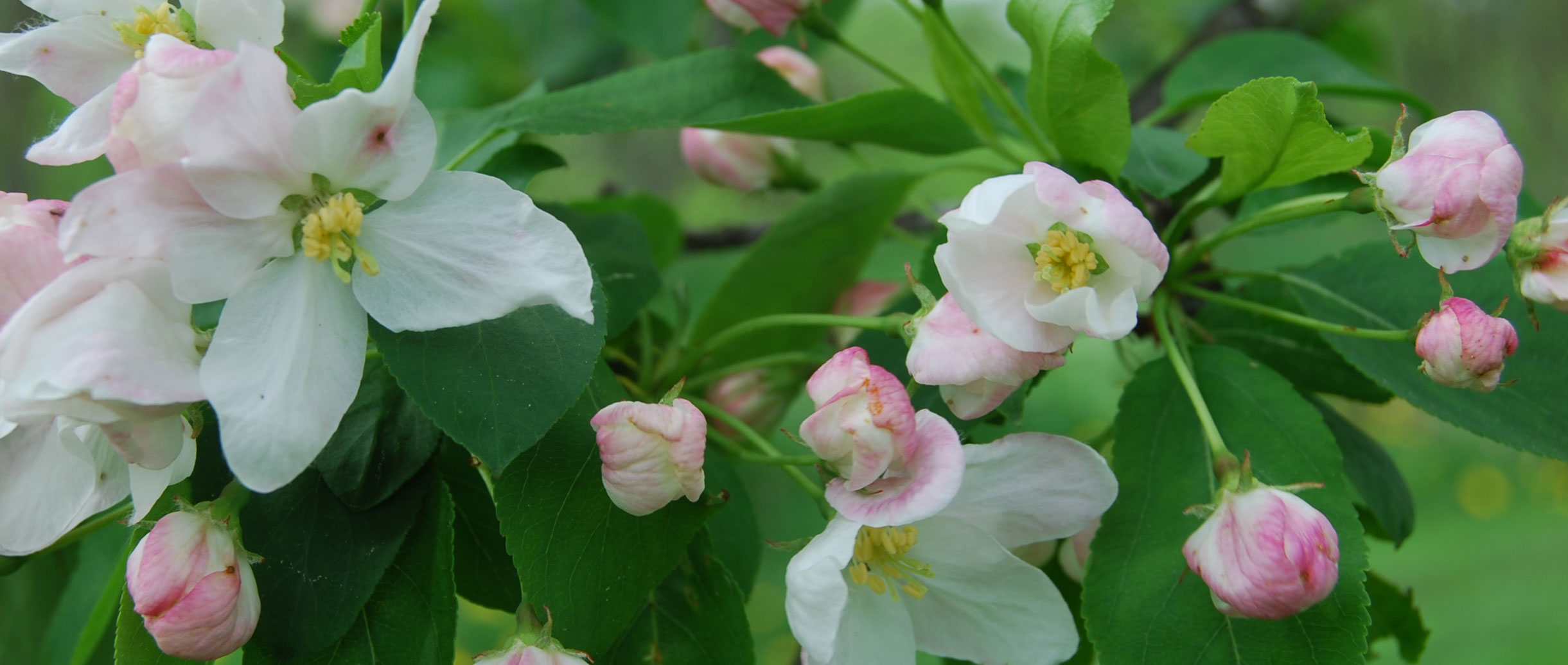
Take the banner picture of this post.  If asked, I would say, “Oh, that’s my apple tree in bloom.”  Actually, I did say that and watched my “are-you-sure-mind” kick in.  Well, it’s not really MY apple tree.  If it were I should be arrested for floral neglect given the minimal attention it’s received from me.  And actually, it’s not in bloom but perhaps blooming because even as I was playing around it, the sun was warming the buds coaxing them open.  Or maybe it wasn’t really blooming but dying because the wind was lifting petals off the stems and depositing them on the lawn. 

And all that would be wrong too.  It’s not an apple tree in bloom at all.  It’s a picture, a two-dimensional representation of a slice of time and space.  It’s a bracketed moment holding sensations of eyes, nose, hand, and desire.

Not too many books take me into these treacherous philosophical waters.  But I like it.

This is how we commonly deal with the world.  By our very attempt to grasp an explanation, we leave things out.  In just such a manner, to take any frozen view is to leave out a piece of Reality.  What we repeatedly fail to notice is that there is never a static object to observe – nor, for that matter, a static, clearly-defined observer.

Hagen goes on to point out the fallacy of a fixed identity and the pitfalls of latching onto it.  Frozen in static awareness, we become fearful and, through that fear, we adopt a rigid stance to our experience.  “I am” becomes the separator, the device to keep us from truly connecting with the world, relating to it in skillful ways.

It doesn’t have to be this way.  The fact is, I’m not anything in particular.  Nor are you. Nor is anyone.