
Unknown's avatar

what can you do?

Step Four: Take Action.  The final step in The Misleading Mind by Karuna Cayton is to use the clarity developed through the practices of stilling and connecting with our emotions.  As we see that our reality is constructed, we detach from its power to define us, to set our identity in stone.  The remainder of Cayton’s book covers a lot of ground, beginning with the way we create (and re-create) our reality and diving into the need for ethics and self-compassion.  By his definition, the litmus test of ethics – or rather the way one knows if an action is ethical – is if it leads to creating health and well being.  

I’m chewing on this.  Harkening back to the first post of this series about past actions that ripen into present karmic consequences, I have to wonder about Cayton’s definition.  I wish things were so clear-cut when choosing actions that avoid harm and foster good.  One thing I’ve learned about making decisions to divert harm: someone is always invested in the trajectory of the present moment and you’re bound to piss them off when you mess with their equation.  And the reason is simple: in your mind, their actions may bear harmful fruit; in their mind, your actions may bear harmful fruit.  I’ve often found it useful to sit with some people and, as a starting point, agree that we are likely both delusional in our perceptions.  We strike up a partnership to pool our investments and determine the best course possible.  Sometimes it works.  Sometimes it doesn’t.

There’s no “most times” because inevitably someone decides that their delusion is more important to defend than adapt.

In matters of determining ethical actions, I keep returning to René Girard’s monkeys and the banana (see Things Hidden Since the Foundation of the World).  Initially, the conflict is about eating the banana.  Inevitably however, it becomes about who owns the banana.  Getting caught in right and wrong is also like that.  Initially, it’s about the right thing to do.  Eventually, it’s about who is seen as doing the right thing.  This is where the self-awareness and clarity of mind is crucial.  Once I can see that I’ve become invested in being the one who is doing the right thing, I’ve lost the ground I stand on.

Nevertheless, I’m pleased that Cayton raises the issue of ethics as an important aspect of practice.  There can never be enough said, written, or taught about it.
Unknown's avatar

you can do better

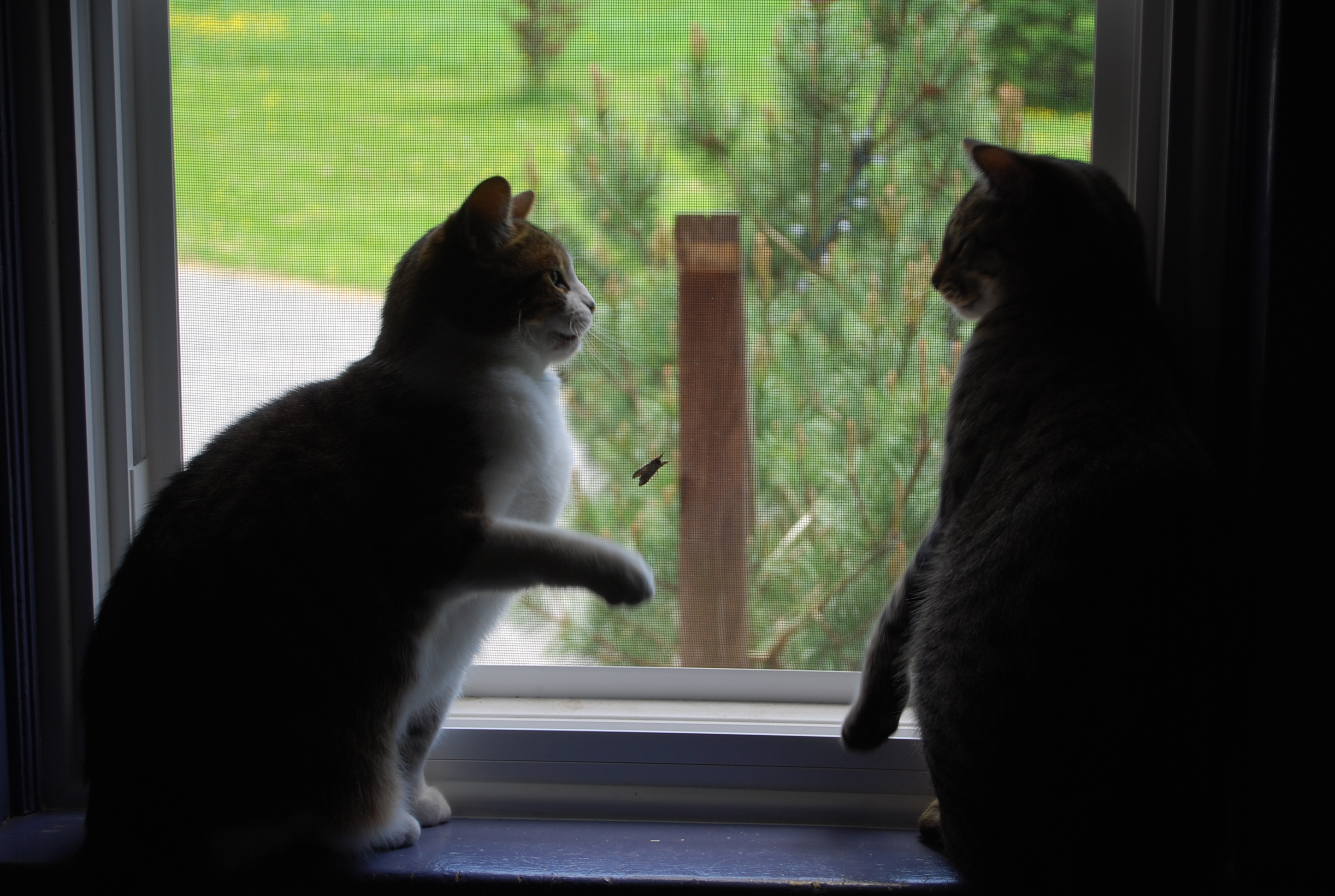
A little lesson from Zen Master Sprout to go along with The Misleading Mind and Karuna Cayton’s Third Step: What’s going on?  Over the few months, Volvo (on the left) has been suffering the boisterous bouncing of Sprout.  He takes great delight in pouncing her off the rocking chair, sofa, zafus at every opportunity, taking advantage that she is clawless and he is fully loaded.  For a while, we worked hard at intervening, insofar as one can intervene with a lightning fast kitten who has perfected the surgical strike.  Even when we caught him and applied an appropriate reprimand, there was neither remorse nor reflection, making rehabilitation unlikely.  Shame and blame were not effective on the monster and we decided that Volvo (who was at least losing her pudginess from the running around) was going to have to handle it on her own.

The middle sections of Cayton’s book deals with the destructive emotions – he also calls them “disturbing emotions.”  Attachment, aversion, and ignorance are covered rather well.  I particularly like his work up of “ignorance” which causes all kinds of… well… confusion when we try to understand it.  Confusion, doubt, fogginess, uncertainty, illogical thinking, blind faith, forgetfulness, and absence of introspection are some of the ways we manifest ignorance.  In fact, this little list helped me track my reactions to the caterwauling when Volvo and Sprout were duking it out over something or the other.  I had no idea if leaving this up to animal nature was the right thing to do.  I think at some level my contemplation and intention in letting them sort it out was based on the eternal koan: does a cat had Buddha nature?  I was hoping they did because animal nature was not proving tolerable.

In the section on blame versus accountability, Cayton makes some clear points about the difference between the two concepts and the litmus test of that difference.  Blame leads to unskillful action; accountability leads to skillful ones.  In my rather simple terms, blame says “everything conspired so I couldn’t do better.”  Accountability says, “I can do better.  Period.”

I watched the two cats leap to the windowsill together and held my breath.  They sat there for a long time enjoying the breeze and the swooping starlings.  Sprout turned to Volvo and she made it clear that whatever he was telegraphing was not on.  No howls, snarls, or shrieks.  Just a clawless paw suspended in the space between them.

“You can do better.  Period.”