

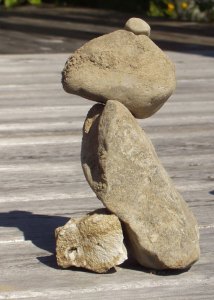
here is home
… (I)n Zen liturgy we manifest that which is known to us intuitively in the form of a visible, tangible reality. In this way, liturgy tends to make palpable the common experience of a group…. (W)e seem, in fact, to be a culture with distinctly polarized reactions to liturgy. While at the one end there are those who become very attached to the forms, at the other extreme are those who adamantly reject everything even remotely resembling religious ritual. (Bringing the Sacred to Life by John Daido Loori)
When we started our little sangha, we agonized over the ten thousand things that might offend people and keep them from returning. To bow or not to bow; to light a candle or not; to use Buddhist terms or not? Was it a mat or a zabuton, a cushion or a zafu? Was it the Heart Sutra or the Prajnaparamita? Oh heck, was it a sutra or a reading! Were we making practice accessible or copping out?
Over the years, as we listened to the sangha members (or are they meditation friends!), we began to hear the undercurrents of fear. Fear that rituals would be traps or untenable rules that would always have us being “less than”. Fear that the already painful belief of being less than would become a leverage for the unscrupulous. As we cultivated our language of being together, some of those fears eased. Others have morphed into rituals. Go figure!
Zen liturgy is upaya, skillful means...it functions as a way of uncovering the truth which is the life of each one of us. (All practices) point to the same place: the nature of the self.
For myself, the fear of not getting things right (the first time, every time), creates this push-pull with ritual. Have a metric and there’s a measure of performance. Have no metric and how do you know what the measure is? From that fissure in my thinking often comes a lack of discernment and a draw to what distracts from the anxiety.
And that distraction takes the form of an impulsive tendency to pick up chicken droppings thinking they are eggs.
(But) it is not a matter of knowing. It has to be realized as the functioning of our lives. And for practice to function, for liturgy to function, it must first be wholeheartedly engaged. Practice is always with the whole body and mind. Just … aping the form … is a dead end.
Practice now is in holding the anxiety, not the distraction which can be a ritual, a book or a word. It is feeling the sense of true nourishment which brings me home the first time, every time.
Thank you for practicing,
Genju




 108zenbooks