In my last post, I closed with the suggestion that the Conflict Resolution Guide (Conflict-Guide) from the Plum Village Lineage North American Dharma Teachers Sangha was a Straw Man whose intention (wittingly or unwittingly) may serve to scare away those who need the resources of the sangha rather than provide very necessary resources. This is the koan that all of us in our communities must confront, absorb, and feel its heaviness in our bellies if we are to create environments of practice that are truly in the service of ending the suffering of all beings. Pragmatically, how do we set up a safe zone in which complaints of all forms can be addressed with discernment and compassion while ensuring that the process itself is not a re-traumatization or a discouraging bureaucratic mangle that distorts truth and prevents transparency?
The first post of this series was generously shared among several zen teachers and practitioners’ social media. Among the many comments was one that offered a kind consideration that this guide may be simply for low level conflicts and not the more serious ones such as sexual, emotional, and/or physical abuse. There is no argument against that however one would wonder why the North American Dharma Teachers Sangha of the Plum Village Lineage would not have been precise about the purpose of the document. So let’s start with the document’s introduction which I approached (in real life and as a thought experiment) as someone seeking resources and recourse in the event of an incident of abuse.

The Meta-perspective
Nothing in the background explanation or subsequent paragraphs define the purpose of the document other than its aspiration in the vague occurrences of “conflict.” While conflicts can be very useful occasions for deepening one’s practice, it is not always the best time to do so, particularly if the conflict involves potential harm or increased probability of harm. The fact that this document was provided to me as evidence of available resources and recourse for people who have experienced sexual misconduct on the part of their dharma teacher implies one of two (or many) things. First, the dharma teacher who sent it me has no clue what I was trying to point out (that the PVL sanghas have no clear path for dealing with sexual misconduct). Or, second, the PVL’s NADTS don’t know the difference between conflict and abuse. Now, I find that really hard to believe because the NADTS is comprised of people who are lawyers, teachers, former law enforcement members, chaplains, and some trained in the medical field. Nevertheless, I’ll grant a third possibility which is that this document is intend solely for interpersonal disagreements and not the more serious issues of abuse. But if that’s the case, the game of “telephone” between the NADTS and the very senior level dharma teacher who spoke to me needs a bit of noise reduction.

Here we have a definition of conflict from the perspective of the DTS as a “disturbance” in the atmosphere of the sangha and its intention is to “always” restore that balance (in the service of harmony) [as a sidebar – there’s a bit of conflation of balance and harmony]. At this point, as someone concerned for the person who has reported an issue of sexual misconduct, I am wondering what the term “always” will mean when placed in the service of restoring balance so as to be harmonious. In other words, what will be sacrificed to reach this absolute and non-negotiable goal. “Always” is a big word with hard edges that can blind us to our insight and separate us from our ability to be with someone’s suffering (com+passion).
I’m also concerned about the naïveté in the idea of transcending “adversarial punitive approaches.” If we’re dealing with personality conflicts or arguments related to the bells, yells, and smells of practice, then it would be admirable to find an alternative measures to dispute resolution. However, in the case of abuse, there is a larger context in which this needs to be placed. Whatever we may wish the local laws to be, they are what define recourse. I, as a health care professional, am bound by law to report harm and risk of harm, not because I don’t have skills to facilitate conflict but because some levels of “conflict” are against the law and their adjudication is outside my scope of practice.
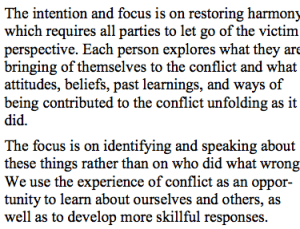
Although I have misgivings about the use of victimology perspectives, I can’t disagree with the initial statement. However, it then goes astray by assuming that everyone coming into the resolution process is endowed with the ability to self-reflect when they are feeling threaten or unsure of the level of support they have. To explore what we bring of ourselves into any situation is a lifetime process and best done well before sitting face-to-face with the person whom we believe has perpetrated the harm. In the case of serious harm, asking the person who feels the harm done to them to reflect on their role, their habits, and stances to difficulties is not only premature but unrealistic. In fact, it may just plain be cruel. Furthermore, despite the high, albeit uninformed, ideals, I wonder (as did other Zen teachers who wrote to me) whether the restoration of harmony should be a priority over determining truth and creating a safe environment in which to express the harm done.
Taking Apart the Straw Man
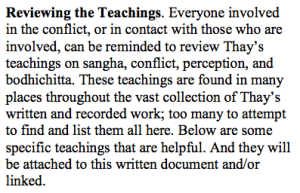
And now for the bait and switch. Having read and accepted (presumably one would have to so as to move forward from that “stuck” place) the aspirations of the DTS, we enter into that phase where the Straw Man tries to look threatening enough to scare away the complainants.
“Review Thay’s teachings…” Yes, all hundred plus books on every Buddhist topic imaginable. They are wonderful books, no doubt. I’ve read almost all of them and find them a terrific entry point to Buddhist practice. The DTS even admits the readings are vast and offer a few to narrow the field. Which few? Well…
The Second (non-attachment to views), Fifth (taking care of anger) and Eighth (true community and communication – includes the directive to stay in the sangha) Mindfulness Trainings of the Order of Interbeing AND the second of the Fifty Verses on the nature of consciousness. Pause here for a moment and consider not only the pragmatics of this directive but a bit of reality testing.
First, the Mindfulness Trainings of the Order of Interbeing are a complex set of vows requiring study and ordination is equivalent to taking jukai. The typical complainant is not likely to be an OI aspirant or, feeling under threat, to have the psychological energy to wade through the somewhat convoluted and idiosyncratic wording of precepts in the middle of feeling at risk.
Second, the Fifty Verses is based on the Abhidharma’s theory of mind. Not something to be taken lightly, Reb Anderson states in his Introduction to Understanding our Mind. “These teachings on mind are difficult, daunting, and complex,” he writes, explaining that he has gone over and over them in his lifetime as a Zen practitioner. Moreover, the second verse, when misperceived, can run very close to the edge of blaming the complainant for their response to the events or interactions.
Practices That Can Harm Rather Than Heal
Another recommendation is to do a Lovingkindness meditation keeping the assumed perpetrator as the focus of metta. Again, there is nothing wrong with a metta meditation however in my experience of working with individuals who have been in difficult or traumatizing situations, this is too much to expect in the immediacy of the events. The set of the document assumes the conflict is ongoing which means metta meditation is premature and makes a huge assumption of the capacity of the individual’s practice when in distress.
The recommendation of doing a Beginning Anew process is also seriously misguided. This is a risky protocol of “flower watering” or telling one’s putative perpetrator about things that are good in them, then airing one’s negative feelings about what they did, and expressing regrets for what one has done (typically conducted in sangha). In a recent article, following the retreat at Brock University in August 2013, physician Patricia Rockman of the Centre of Mindfulness Studies writes about a Beginning Anew that goes horribly wrong in public. (This event was also described to me by someone who was at the event and the details are identical.) Rockman’s suggestion that psychologically sensitive issues should be placed in the hands of people trained to deal with them is one that has been raised in every Plum Village Lineage retreat I’ve attended. Health care professionals have also tried to raise awareness that certain issues are required to be reported by law (e.g., potential harm to children in chaotic families), only to be dismissed. What troubles me most is the impenetrability of the wall of misunderstanding and dangerous assumptions about psychological issues. Given the vast resources that educate us about the vulnerability of our mind, it can only be called a willful ignorance.
And One To Handle with Care
But onward. Having completed all this reading and contemplation, the aggrieved person is asked to complete the Conflict Analysis Form. This form is likely the most damming aspect of the process. I advise a detailed reading of the questions which are too numerous to address here. What I do want to point out is that most people I interview following a conflictual event (this ranges from dealing with a bully at work to being blown up by an IED in a war zone) – already hyper-vigilant and physiologically activated – would feel shamed and blamed by the questions. More than that, their experiences of being emotionally and/or physically assaulted result in significant cognitive and physiological changes. Information is not processed in ways that make sense nor is recall always coherent. For a terrific explanation of what trauma does and how to deal with it, you can read Nellalou’s post on Smiling Buddha Cabaret which I frequently recommend to clients.
My advice at this stage of reviewing the Conflict Guide: If you are in a conflictual situation or have experienced abuse, do not complete this Conflict Analysis Form without first showing it to someone you trust. If there is no one you trust in your circle of family or peers, take it to a professional who understands trauma, bullying, and interpersonal conflicts. This is something to work through in the presence of someone who can walk you through it carefully and ensure against your taking too much responsibility or blame.
And Now For Something No Different
The closer:
The complainant can call in other members of the sangha and, if required, other Dharma Teachers to assist. That the resolution is still held in a closed inner circle of strongly like-minded people seems not to be a concern.
But when does the “Harmony Committee” actually get involved?
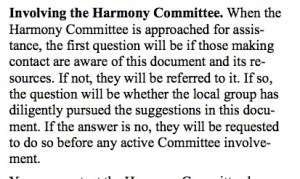
In other words, they will step in when they’ve ascertained that the complainant has done everything in her/his power to resolve the conflict by following all the directives in the guide with the very person who is or people who are part of the conflict. The shorter answer is “Never” because anyone who has experienced any level of conflict or abuse will have given up by the first request to read all of Thich Nhat Hanh’s books, let alone at the idea of sitting vulnerably in sangha or alone with the person involved. Of course, that may help with the book sales which would help with creating more sanghas which would help with creating more feelings that this document actually serves a realistic purpose.
But I shouldn’t be so jaded. I deal with insurance companies every day. This is the first thing I tell my patients when we embark on doing battle for treatment benefits: They job is to tire you out, to frustrate you, to make you believe that going away pays more than hanging in. That is their JOB, not their philosophy or their values or their hatred of you. In fact, YOU don’t exist. What exists for them is the drive to maintain their internal structure of self-preservation.
I just never thought I’d be saying that about a community that had so much potential to change the “adversarial punitive approaches to conflict that prevail in our greater society.”
I also had hoped I could go back to the woman who came to me with the experience of being sexually harassed and say, “We can do this. Together, we can take this to people who will be sensitive and compassionate as well as discerning and fair.”
To her, wherever she is today, all I can say is this: “I’m sorry. Nothing has changed because nothing has changed.”







 108zenbooks