Unknown's avatar

a thousand hands of compassion – book review

Thousand-hands1

Some time ago, one of my dharma friends sent me this lovely book. A Thousand Hands of Compassion: The Chant of Korean Spirituality and Enlightenment by Seon Master Daehaeng¹. I was strangely moved. Strangely because I have never really believed that people who haven’t met face to face actually have the capacity to activate a resonance that one might call a bond, a quiet joy, a sense of being considered kindly. More strangely because I thought I’d done enough work on my own walls and thickets, been the recipient of enough gifts from people I’ve not yet met and those I may never meet to have these walls become porous enough for kindness to flow in.

But there you have it. I am one gnarly, snarly nut to riddle with holes.

Kindness is an interesting thing. It’s one of those behaviourally-based activities that is only known when seen. I do find it easy to be kind. Ultimately it doesn’t cost anything and there is a feel-good factor when all is said and given.

DSC_0006

Compassion, however, is something else all together. It costs everything. And it requires that we are willing to be in the presence of everything. There are no options or substitutions allowed.

My one mind is the root of all things.
All things arise from it,
so all things I completely entrust to it.
This letting go
fills my heart with light. (p. 36)

This book is an amazing opportunity to practice just that fortitude. Taken from different sutras, it is compiled as a single text and chanted daily in Korean temples. The verses call on us to devote ourselves to that one mind that is the mind of all Buddhas. Some read as short recitations that almost evoke a full prostration. Others are slightly longer tracts that evoke an inner call-and-response. Each page carries a verse, Korean on one side, English on the other, and is enriched by the stunning art of Hyo Rim.
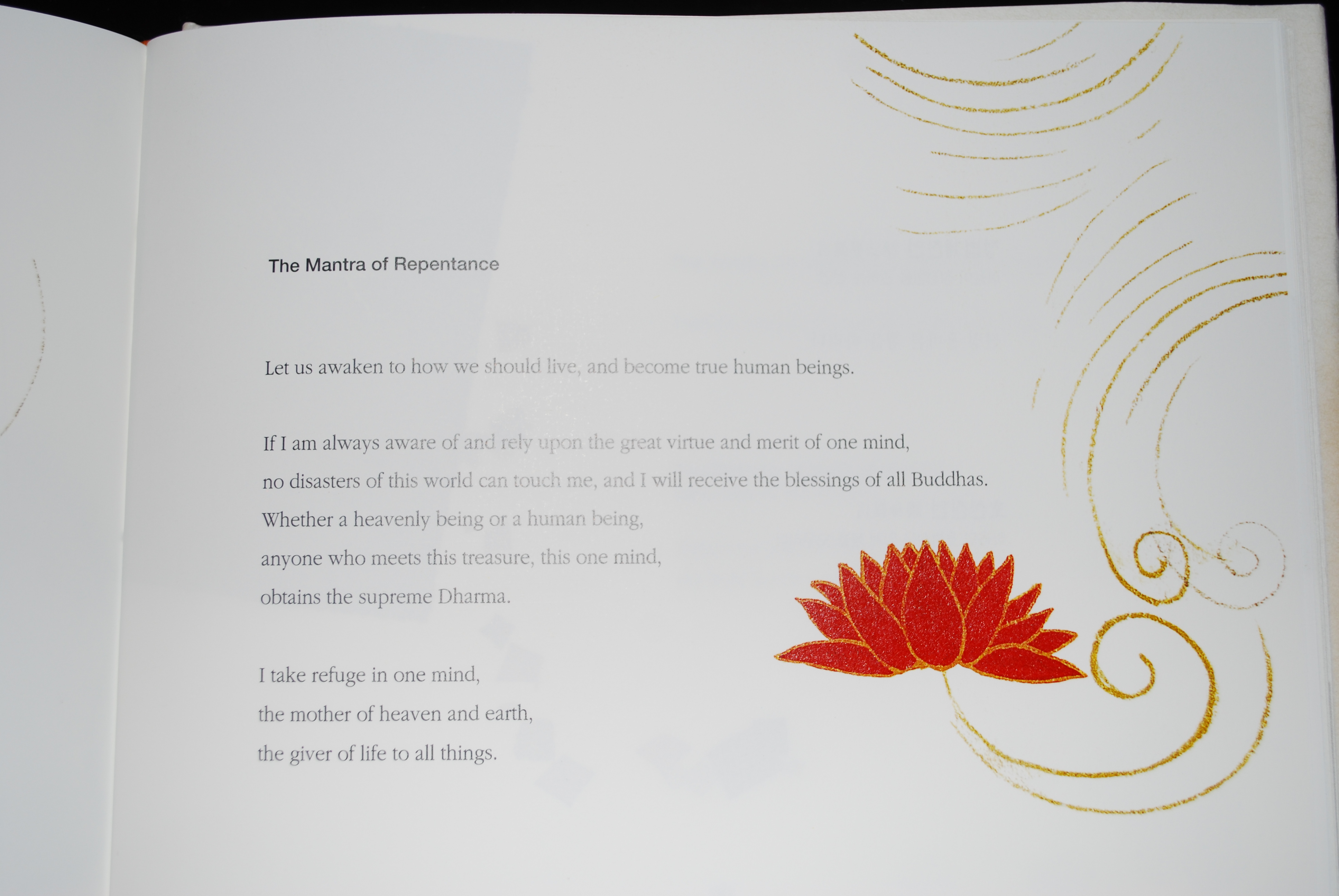
DSC_0007

The minds of all Buddhas are my mind.
Nothing I see, hear, or do
exists apart from
the truth they realized.
My one mind itself is the Buddha-dharma,
present throughout all aspects
of my life. (p.24)

Tomorrow Frank and I leave for our respective retreats. He’s off to something somewhere that hopefully won’t have him terrorizing other meditators with his death stare. I’m off to learn a bit about self-compassion. It seems an oxymoron this term “self-compassion” but I do recall spending about two years on the first two lines of the Metta Sutta.

May I be free from suffering
May I be at peace

So I’m taking this book and my mala beads and an appreciation for T.S. Eliot.

We shall not cease from exploration
And the end of all our exploring
Will be to arrive where we started
And know the place for the first time.
― T.S. EliotFour Quartets

——————————

¹You can read more about Seon Master Daehaeng here.

Unknown's avatar

gyres of time & space – a review of ruth ozeki’s a tale for the time being

So here I am, at Fifi’s Lonely Apron, staring at all these blank pages and asking myself why I’m bothering, when suddenly an amazing idea knocks me over. Ready? Here it is:

I will write down everything I know about Jiko’s life in Marcel’s book, and when I’m done, I’ll just leave it somewhere, and you will find it!

How cool is that? It feels like I’m reaching forward through time to touch you, and now that you’ve found it, you’re reaching back to touch me!

tb-cover-993x1500Ruth Ozeki, in A Tale for the Time Being, sets up an unimaginable relationship between Nao Yasutani and an anticipated reader. Sixteen years old, Nao is sitting in a parody of a French café in Tokyo, with a gutted book whose cover is the only hint that it once contained Marcel Proust’s À la recherche du temps perdu. She has a plan to write her great-grandmother Jiko’s life story, all the while also intending her suicide when the task is done. Yasutani Jiko, “the famous anarchist-feminist-novelist-turned-Buddhist-nun of the Taisho era,” is 104 years old and lives in her temple in Sendai, where the 2011 tsunami struck, sweeping most of the district out to sea.

Across the Pacific, on an island off the British Columbia coast, Ruth finds a Hello Kitty lunchbox in the debris along the beach. It is packed with several objects each packed in a freezer bag. She takes out a book, a gutted volume titled À la recherche du temps perdu. And she reads:

Hi!…My name is Nao, and I’m a time being. Do you know what a time being is?…

Like the gyres¹ weaving across the ocean carrying warm air and debris, the story of Nao and her family link into Ruth’s life on an isolated island where she unintentionally has fallen behind herself. Nao writes with a coy approach-avoidance but slowly, as the muse works its way into her heart, the pain of her losses reveals the currents in her story. Intermittently, Jiko contributes to easing her confusion or mediating the fascinating dialogue between Nao and her reader (Ruth) across time and space. Interpenetrating the narrative are Jiko’s wisdom conveyed through the essence of Dogen’s teachings which Nao takes to heart and which open Ruth to her own.

Nao’s discovery of her family history and its lineage of suffering stops the breath as it unfolds. The assumptions about weakness and strength, anger and sorrow, play out as Nao survives being brutally bullied and learns, with Jiko’s training, to see beyond the humiliation. Nao’s parents flow along a parallel current, dragging their own weighty hopelessness and misunderstandings. Like most teenaged girls, she has little time for their way of being time beings. Yet, her fears are no different from any child: that she might be abandoned by their decisions, that she has been abandoned by their neglect, that she has no refuge because the apartment they inhabit is choked with their collective pain.

Obsessed by the contents of the Hello Kitty lunchbox, Ruth searches for evidence that Nao and her family are real. A novelist herself, she dredges the internet for information, uncovering bit by painful bit what is possible to know. Woven into her search is also a search for refuge, for home, for settling into the time and place she inhabits. Her own losses are covered over by her assumptions and misunderstandings of how relationships express sorrow and hopelessness. As Ruth discovers more about one member of Nao’s family, she begins to understand that satisfaction is not a companion of living to ones values, that the complex process of being true to oneself can exact an enormous price, wittingly or unwittingly.

Ruth Ozeki has crafted a complex story of love. Nao is unflinchingly teenaged, with all the raw wisdom that it embodies and all the rampant passion with which it is expressed. Ruth (the character, though one wonders if there are threads of Ozeki herself, how could there not be) is wonderfully obsessed as a researcher, affronted when her protectiveness is disregarded, aloof in her sorrow, and intimate in her not knowing. Jiko is a solid rock in the winds that tear around her family, a solidity that comes only from profound pain and profound dedication to being alive. Crossing both time and space yet resisting actually anchoring in either requires a master craftsperson and Ozeki doesn’t fail to deliver. On reflection, although the entire book is hinged on the possibility of the tsunami’s role in bridging space, one is left with that ultimate not knowing: is it? There are other plotted moments of not knowing how…who…what?? But ultimately it matters less that the currents are purified than to simply enter the fundamental unknowability of anything.

The beauty of A Tale for the Time Being is that, despite the intricacies, it keeps the reader planted firmly in the moment of reading. And yet when the last page arrives, inevitably, there is an in-breath as if there could be more. And there is…

==========

¹Gyres are rotating ocean currents that move with wind currents.