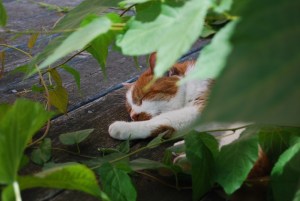
This is Oliva doing no-mind practice under the kiwi vine. I want a little bit of this in my practice.
The pesky thing about practice is in what to do about the mind. In the last post, it wandered around the room like the kid on a tricycle in Billy Collins’ poem Insomnia – (it) will not stop tracing the same tight circle / on the same green threadbare carpet. Sitting this morning, I took it by its chubby arm, wedged it under the cushion and watched it pop out as soon as my full weight sank into the buckwheat and memory foam. So I put it
~on the shelf where it berated me for not putting the Cd’s back in alphabetic order.
~on the altar where it flicked at the limp rose petals and sent incense ashes tumbling onto the table.
~in the bell where it found cat hair and dust bunnies holding court.
~on my foot where it tapped a baton sounding a prelude to numbness with a three-part tingling.
~at my nostrils where it began to tickle the edges with the cat hairs it had kept from the bell.
~in that space just under my navel where it pounced and bounced summoning the sensations of anxiety and fear.
It seemed no matter where I placed it and begged it to stop. there. stay. still. just. this. breath. it. be. came. that. place.
I wondered what it would be like to be a little more here and little less stuck to here.
Takuan Soho was a prolific writer, Zen monk, calligrapher and tea master. In Unfettered Mind are letters written to two sword masters giving advice and criticisms aimed at marrying the spirit of Zen with the way of the sword. One letter, The Mysterious Record of Immovable Wisdom (Where to Put the Mind) describes how to engage with the mind. Takuan Soho viewed the mind not as unruly but rather as too easily absorbed into a space where it becomes slave to what is there.
If you should decide on one place and put the mind there, it will be taken by that place and lose its function… Because this is so, leave aside thoughts and discrimination, throw the mind away from the entire body, do not stop it here and there, and when it does visit these various places, it will realize function, and act without error.
Putting the mind in one place is called falling into one-sidedness. One-sidedness is said to be bias in one place. Correctness is moving about anywhere. The Correct Mind shows itself by extending the mind throughout the body. It is not biased in any one place.
If the mind moves about the entire body, when the hand is called into action, one should use the mind that is in the hand. When the foot is called for, one should use the mind that is in the foot. But if you determine one place in which to put it, when you try to draw it out of that place, there it will stay. It will be without function.
Keeping the mind like a tied-up cat and not allowing it to wander, when you keep it in check within yourself, within yourself it will be detained. Forsaking it within your body, it will go nowhere.
Thank you for practicing,
Genju