Unknown's avatar

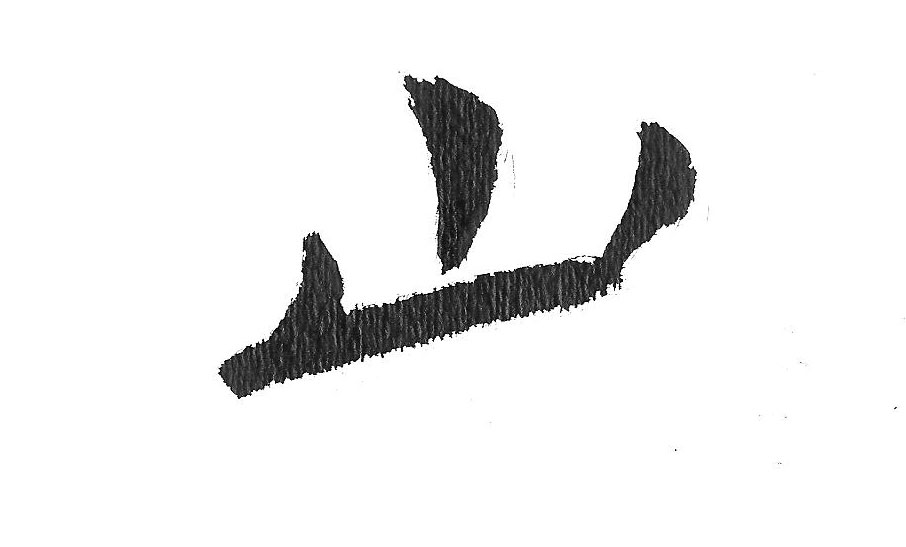
practice like a mountain

A week of playing with Dogen, the breath, and the brush.

Starting with the daunting 1171-page Treasury of the True Dharma Eye, edited by Kaz Tanahashi (Shambhala Pub 2010).  Dogen used the image of the mountain powerfully through his writings and the most familiar to us is likely the Mountains and Waters Sutra (pp. 154-164).  Another use of mountains is in an undated fascicle:

An ancient buddha said, “Mountains, rivers, and earth are born at the same moment with each person.  All buddhas of the past, present, and future are practicing together with each person.”

If we look at mountains, rivers, and earth when a person is born, this person’s birth does not seem to be bringing forth additional mountains, rivers, and earth on top of the existing ones.  Yet, the ancient buddha’s words should not be a mistake.  How should we understand this?

Dogen tends to remind me not to take things literally.  Or maybe it’s a reminder to not stop at the literal.  He goes on to say that we have no way of knowing our own beginning or ending – or anyone else’s.  Similarly, we don’t know the beginnings or endings of “mountains, rivers, and the earth.”  And here’s the hook: this not-knowing doesn’t keep us from “see(ing) the place and walk(ing) there.”  And so it is with practice, with living and with dying.

Unknown's avatar

letting go of holding on

From the Bodhidharma Anthology by Jeffrey Broughton: Entering the path through practice – seeking nothing.

The sutra says: “Seeking is all suffering; seeking nothing is joy.”

I love the twists and turns of this third practice.  Seek nothing.  This is joy.  Yet joy is one of the worldly winds that blow up the dust storms!  Gotcha!

And yet.  And yet…

Much of our path has likely been laid down by seeking and joy in the finding.  Now here’s the part we forget: it’s also tamped down by the letting go and the losing.

Broughton footnotes a story about Merit and Darkness who are sisters.  They travel together and it is not possible to invite one in without the other.  Nor is it possible to drive one away without the other leaving too.  While I like this fable, it only addresses the extremes of our clinging and aversion.  To stretch the metaphor, we can’t shine the light on one segment of our path without casting others into darkness.  Practice requires attention not only to our clinging to the lit path and aversion to the dark beyond but also to the edge where light meets dark.  This is liminal ground where transformation occurs; its presence in awareness is constantly negotiated by our open-heartedness.

In my own practice, I try (oh, I try and try) to stay with the transitions between light and dark, earth and air, heaven and hell.  The extreme manifestations are no-brainers to meet and resolve.  It’s the sliding away and into from one to the other and back again that calls for a deeper commitment.  This is where a rigid holding on to what is, what it must become, what it cannot emerge as results in suffering.

This practice of not seeking, wishing for nothing, is a practice of unhooking from a specific outcome, untying the knot that keeps us chained to the shifting winds of fortune.  It is in the merging and emerging of lightness and darkness.