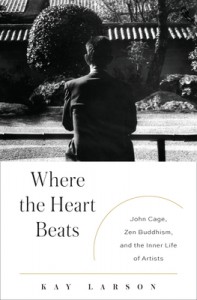
Avant-garde artist-composer-Zen student of D.T. Suzuki, John Cage would have been 100 years old on September 5, 2012. For almost 8 decades Cage has been the source of much deliberation, consternation, and experiential angst for visual and sound artists. There are a number of books, some being published almost simultaneously with Kay Larson’s rather ambitious attempt to place John Cage the man in a social matrix that explains Cage the artist.
 Where the Heart Beats: John Cage, Zen Buddhism, and the Inner Life of Artists is staged in three parts, the section titles quoting D.T. Suzuki and riffing on Dogen’s Mountains and Waters Sutra. Larson’s intention is to show us the flow of Cage’s life as a process of seeing him as mountain, deconstructing that self as he expresses the wisdom of the sages, and finally – though not permanently – takes his place in the history of modern art. It’s ambitious and far-reaching, pulling together a sociological examination of the culture in which Cage’s talents cooked and the influential role he played in the lives of all who gathered around him. In doing so, Larson’s own history unavoidably interpenetrates the story she tries to weave.
Larson is an art critic and contributor to the New York Times. She brings to the shelf a vast knowledge, not only of the matrix in which Cage was embedded but also of the larger cultural shifts that carried art from form to formlessness. And it is the essence of formlessness, of shunyata, that has her in its thrall. Larson has also been a Zen practitioner since 1994, a fact that may or may not have been an advantage to her voice in the book. However, she did begin her practice at Zen Mountain Monastery and that exposure to the art and teachings of the late John Daido Loori Roshi could have polished the lens to see the form/emptiness flow in Cage’s work. Larson therefore has the difficult task of dancing between observer and participant in the narrative. Late in the book, Larson quotes art critic Harold Rosenberg’s article “The American Action Painters.” It stands as the finger pointing to the challenge of her task and a moral tale that in our efforts we are aware that “art (is) not an object… it (is) a process.”
A painting that is an act is inseparable from the biography of the artist. The painting itself is a “moment” in the unadulterated mixture of his life… The act-painting is of the same metaphysical substance as the artist’s existence. The new painting has broken down every distinction between art and life…
[The artist] must exercise in himself a constant No…
As we explored last week, No is Mu in action, that pesky first koan we confront only to have it confront us. Larson does a valiant job for trying to hold to that essence of “No” as she works through the first section, Mountains are Mountains. Staying out of the way of the flow, her writing is rich and the relationships dance on the pages. The characters are seductive in their passion for their work and for each other; thankfully Larson stays away from portraying the sexual liaisons as over-wrought drama. They are no more or less the dust that gathers on the cultural consciousness that shapes Cage’s early life as an artist. In fact, she does a tantalizing magic with the interconnections of Cage to the growing avant-garde movement that I felt rather at home with the Dada-ists and the Surrealists, something I never managed in my Art Conservation years. When Joseph Campbell, the Allans – Watts & Ginsberg – and a variety of myth, mythology, and buddhistic beings showed up, it did begin to feel surreal. By the end of the section, there were not only mountains being mountains but entire mountain ranges interconnected in the landscape of art in the first half of the 20th century.
Cage opened a book y D.T. Suzuki on Zen around 1950. Feeling alienated and likely unappreciated in most aspects of his life, Larson sees him as suffering and that suffering being ripe to receive the first words he reads in Suzuki’s book First Series:
Zen in its essence is the art of seeing into the nature of one’s own being, and it points the way from bondage to freedom.
Later Cage attends a lecture given by Suzuki and the book could probably have ended there with the aphorism: And the rest was history. But it wasn’t, really. Cage took the teachings of Zen deep into his work and whether or not we can appreciate his “readymade” performance art (see YouTube for many) or comprehend his intentions in deconstructing music into sound sensation, we come to appreciate his message that there is everything going on in the nothing we think is happening.
John Cage, the artist, is a tough subject to write of, let alone review, because his work cannot be apprehended through rational argument. And as an guard to being seduced into liking a book just because the author has significant street creds, I spent two months listening to Cage’s compositions and researching some secondary sources of his work. His book on the Ox Herding pictures has always been a favourite but there is much that is beyond my hearing-consciousness in his sound compositions (I hesitate to call it music because Cage himself seems to be reaching beyond the name-form). Except one. The composition 4’33” is perhaps the most challenging practice I’ve encountered; it is a challenge to expectations and a command to be in full contact with the world as it is, inside and out.
This deconstructive process of awareness is where Larson’s second section, Mountains are No Longer Mountains, takes us. But here there be dragons. It may seem a bit harsh of me to criticize Larson here, having sinned in exactly the same way above, however her voice in this section is louder and somewhat intrusive. And it is ironically so because Larson tries to show how Cage’s work begins to manifest out of the Zen practice of shunyata, emptiness, or interconnectedness. The complete incompleteness of the Zen circle or enso becomes the leitmotif of Cage’s pursuit for enlightenment; there are riches to be mined here. Yet Larson’s forays into Zen teachings dangerously tread the edges of cliché, saved only by the quotes of Cage’s reflections of the influence of Zen on his work. It would be graciousness to say that this is what happens when art and life are deconstructed into the essence of sensations. However, one would anticipate that the practices of art criticism (the deep seeing it commands) and Zen would provide a steadiness in the face of the dissolution of convention and form.
Cage, as the Zen student that Larson constructs him to be, seems to have connected with the enso of practice:
[E]veryday life is more interesting than forms of celebration, when we become aware of it. That when is when our intentions go down to zero. Then suddenly you notice that the world is magical.
This openness to experience infiltrates all of Cage’s work as he carries forward the spirit of his vision in 4’33”. It is the work of being simply itself, having its own authority to contain whatever arises. It moves beyond the need to prove a point, make a mark, or leave a trace. As a compositional piece, 4’33” cannot exist without the entire world bearing witness and participating. Larson does a good job here in bringing out the essence of Zen teachings and their emergence in the mind of John Cage.
The third section, Mountains are Again Mountains, attempts to provide an historical provenance of John Cage. Larson attempts to place Cage back into a sociological matrix and roll gently into the denoument of his life. Sadly, it is choppy and filled with more characters than we can handle this late in the book; it simply doesn’t work. Here too, her voice becomes too present; she shifts from dispassionate observer to a full participant, taking our focus away from Cage’s “post-satori” life. When he comes down from the mountain, who is he? And now… and now… We learn that, in the later decades of the 20th century, Cage loses the reins on the beast he released on the art world. Yet Cage’s way-seeking mind appears to let go of the need to control where and how this bête noire shows up in the post-Cold War world of experiential expression. Cage dies from a stroke in 1992 and the circle of his influence continues to expand.
Where the Heart Beats is a fascinating book and not one to be taken on as a quick read. It is perfect in parts and imperfect in others. But it pays back with a luscious taste of a time that was creatively wild and which graced us with wise sages who came down from the mountains. As Zen scholar and artist Kazuaki Tanahashi often says, “The enso contains the perfect and imperfect; that is why it is always complete.” For that, Larson’s own enso is to be commended for her diligent effort and aspiration to completeness.


 108zenbooks