

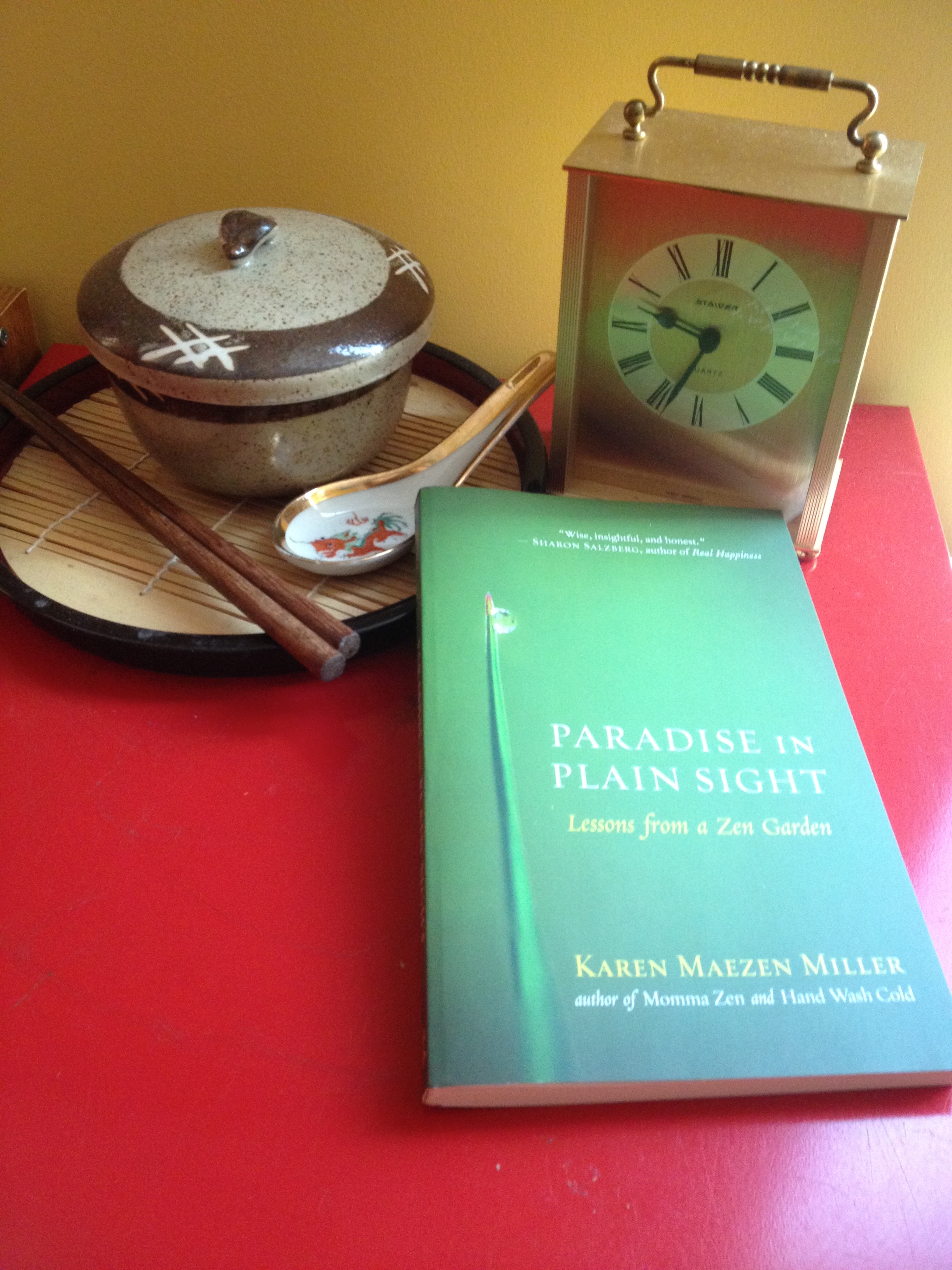
 In an exchange with Karen Maezen Miller, author of Paradise in Plain Sight, I wrote, “I have Paradise on standby (pending a number of other activities that crowded my schedule).” I suspect that truer words were never written, spoken or lived. If I learned but one lesson from Paradise in Plain Sight it is how determined we are in obscuring that it is. Our days are filled not with what inspires and impassions us but with things that eat time and offer little nourishment. And then we are astonished that we feel overwhelmed or incapacitated.
Maezen Miller takes us on a gently disciplined stroll through her life as she cultivates this clear seeing of paradise. First, she tells us that paradise means an “enclosed area” and ultimately it is the enclosure of our own backyard, our own life. The lessons of how to tend to that life are offered through teachings stories of her experience in tending simultaneously to her own life and the Zen garden she tends.
It’s actually quite simple. First, she writes, find a garden. I looked out my window at the dishevelled stretch of the west garden. Well, that was exciting, I muttered to myself, at the same time realizing this is how I meet whatever I notice in my life. In the first chapter Maezen Miller brings us into the push-pull of her own life, decisions that should have been made but weren’t, tentativeness about going this way or that, until a chance word turns it all around: “The whole thing was built for Zen.” The real estate agent likely meant the garden itself; Maezen Miller soon discovers it means the thing was built for the whole of Zen, life itself.
Of course life doesn’t come in neatly weeded plots of springing-up roses and gracefully bowing willows. It was heartening to read that ground is hard to break in her world too. Apparently Zen teachers don’t get pre-tilled soil or Super-Gro on demand. They too struggle with the Great Matter. In the chapter “Moon,” she offers the tenderest of teachings by her own teacher, Maezumi Roshi.
“Whether we see a crescent moon or a half-moon, in any of the phases of the moon before it is full, is anything truly lacking?” Maezumi said in the talk (she had transcribed for him). “Perhaps you are more logical than me,” he laughed, “and you don’t wait for the day your life will be full.” p. 42
Maezen takes up the teaching and points to the way we see ourselves as lacking because we mistake the waning moon of our abilities as a true diminishing of who we are.
Your heart is always whole, just as the moon is always full. Your life is always complete. You just don’t see it that way. p. 44
The moon is always full. It is our vision that waxes and wanes. And that is the purpose of practice, to see that fullness.
The point of Zen is to settle on the ground. Feet, knees, butt: on the ground… There is no Zen that is not on the ground. p. 29
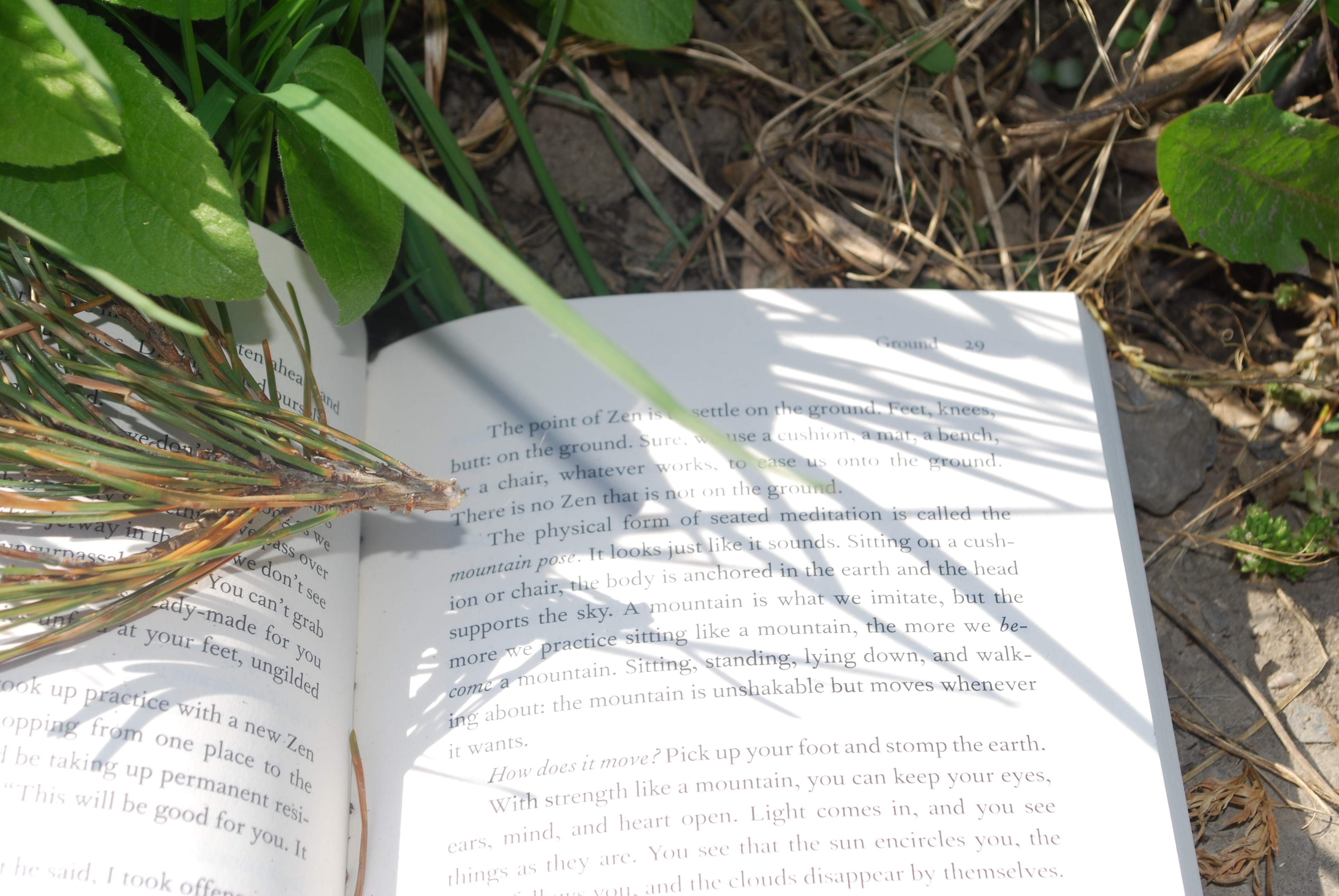 It’s reassuring, especially if you garden, to know all that time in the dirt and mud is not just for putting a pretty face on the house. It has been cultivating the solidity we all crave so we can be unshakable in the storms and upheavals of our lives. This solidity defines the spaciousness which is crucial to understanding what life truly is about. And if what life is about must be spelled out: It’s bamboo. Really. Strong, solid yet hollow bamboo which stand firmly planted yet boundless in its infiltration of the ground. It reminded me of the Bishop’s Weed my cousin gave me. Boundlessly indestructible. Maezen Miller crafts a manifesto of being out of her war against bamboo (and I grasp mine against the Bishop’s Weed); it is only a war with ourselves.
- Be quiet
- Drop your personal agenda
- Lose all wars
- Give up your seat
- You’re as ready as you’ll ever be
- Reject nothing
- What appears in front of you is your liberation
And my favourite: Start over. Always start over.
 Finally, though I wished it had been at the beginning, she takes us into the weeds! However, without the tantalizing tales of how the Zen garden came to be, how her life unfolded petal by petal, how roots take hold and vines entangle, I don’t think I would have been ready to take up a vow to live all weeds as an intricate part of my life.
Maezen Miller’s book is an invitation to stop using the constructed clocks around us to define paradise, that enclosed area which we render as a cage or a trap. She appeals to us to seek out the natural timing of our heart beat and the rhythms of our breath so that we can design a space that is livable, sustainable and truly boundless.
Paradise cannot be deferred or put on standby. It wouldn’t matter if it was because that would not keep it from unfolding. It would just keep us from seeing it.
Maezen Miller respectfully reminds us:
Life and death are of supreme importance,
Time passes swiftly and opportunity is lost.
Let us awaken, awaken!
Take heed!
Do not squander your life!
============
On a personal note, this book has been an a-maezen gift (yes, I just did that) as I enter my 7th decade this week. Half of it has been spent trying to avoid weeds and overgrowth while tentatively plunking down the flowers in all my gardens. At least now, the trowel looks like an old friend.
 Pat Enkyo O’Hara roshi is the Abbot of the
  108zenbooks