

 From Mind in Life: Biology, Phenomenology, and the Sciences of Mind by Evan Thompson:
We living organisms are historical and developmental beings. We descend by reproduction, not only from our human ancestors, but from countless other living beings, forebears who preceded the human species, all the way back to the earliest bacterial organisms…. Although our parents and ancestral organisms supply our bodies with developmental resources and help to guide our bodies on the path they tread in life, that pathway does not lie pre-determined within us – in our genes or anywhere else. Rather the path is our footsteps laid down in walking… there is no clear separation between path and footsteps, the way and its walking.
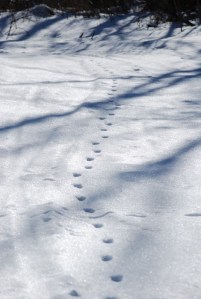
I went into the woods a few days ago, an appointment with life I have missed for many years. From the house to the barn, the path is clear, the grass and snow thrashed down by tractor and truck each Summer and Winter. At the barn, long empty of horses and now the domain of raccoons, wild cats, and pigeons, the path curves down to the fields and then up to the woods. On this day, the snow is pock-marked with prints of dogs, coyotes, a nd deer. Up in the woods, there is, among the hoof prints left by the neighbours’ horses drawing a sleigh, a trace of of moose tracks.
The woods are tight and close but I’m familiar with them. Yet as I wind my way through the new p ath cut for the sleigh rides, I’m anxious because there is no internal map that tells me which curve leads out onto the road or back to the fields. I see the trail but have a little faith in it. In fact, it’s no path to my mind because it was designed to and constructed by someone else’s agenda. Half an hour into it, I want out.
One of my teachers pointed out that when things are difficult, the common assumption is that getting out of the situation is the solution: The only way through is out. In practice, however, we see that only way out is through. So, I plod along wishing I had brought my walking stick if only for defense against a rampaging coyote.
Thompson writes that “the human body, unless it is dead, is always the lived body.” As I tread down this path of practice, I am caught by how defenseless I am, I must be, in order to fully experience this “lived body.” The feedback from brain to environment and back to brain not only generates but orients and grounds me. I have to let go of the signs and directives that suggest safety in old understandings, that lulls the body and mind. Even my understanding that the path is defined by edges and borders can be misguiding.
And yet, this practice of laying down a path in walking has its challenges – especially when my lived body is flat on its back because it interacted with the ice under the non-path.

Thank you for practicing,
Genju
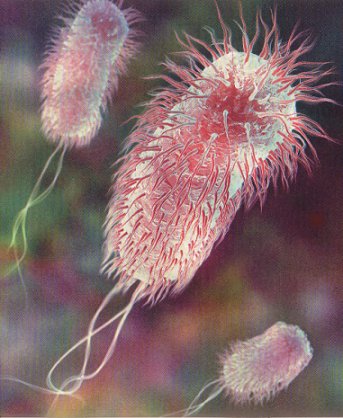 This is a picture of e. coli. It’s an autopoietic organism, dynamically interacting and adapting to its environment. It orients to a food gradient and moves uphill to greater concentrations. It is focused on self-generation, creating a world in which its needs are met. The emergence of this world of nutrients and the self-made-thus leads to sense-making of its self-environment dynamic relationship. Sense-making leads to valuing and creating significance of parts of the environment that are critical to life. That is, value and significance are brought out of (enacted) by the interaction of a living being with its environment. They are not intrinsic to the environment.
 108zenbooks