

The third characteristic of Japanese art, according to Addiss & Seo, is “empty space allied with asymmetrical compositions.” Within this space, there can be movement and a sublime expression of emotions. It asks of us a willingness to forego the safe and secure. It evokes a sensation of vastness and the possibility of everything.
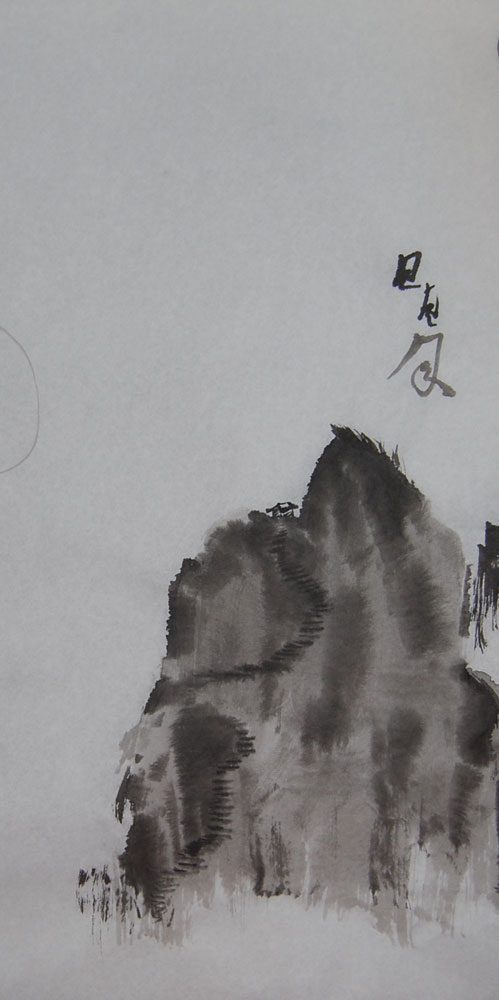 This aspect of practice challenges me most. I have a love, an obsession, with symmetry. Of course, it’s all only an illusion of balance. Yet, it served me well when the world was chaotic and unpredictable. The idea that I could force a sense of equal weight on either side of the axes that ran through the desk, room, house, and surroundings acted as a mental force field, keeping the Wild away. Each time it failed, I would desperately try to find the right axis which could hold a balanced distribution of emotions, thoughts, feelings, sensations. I’m not sure I’ve learned to live with the uneven distribution, the mis-allocation of energies but that’s likely tied to my belief that the accounting will even out – or as my father used to say, “It will all come out in the wash.” Sometimes, however, like the painting I practiced on the left, the weight of the effort is intended to unbalance the frame so that what is fragile or delicate can rise.
Recently, I was listening to a dharma talk about fearless compassion. It struck me that compassion is always uneven and, being that, it requires fearlessness to embody it. There is no quid pro quo; there cannot be because that renders compassion ineffective or, at worst, misguided. Compassion is asymmetrical. And if I look closely I think I would see that the other three bhrama-viharas are also asymmetrical. There is beauty in the off-kilter though I may never appreciate it to the degree it deserves. The ear is given a real test of generosity in allowing the lines of haiku to wobble 3 – 5 – 3. The eye must open with equanimity to the wabi-sabi simplicity of ladle and clay. The weight of fearlessness grounds the experience and, in that space, synchronistic joy rises.
If I take away the grid lines that order my life, what might fill the unrestrained space?
Thank you for practising,
Genju
 Addiss & Seo continue with the second characteristic of Japanese art. It is the “ability to borrow and transform features for the arts of other countries. Successive waves of influence from China and Korea brought to Japan Buddhism, a written language, and new forms of government, as well as different styles of art.” This capacity to contain anything and allow time to work on it gives Japanese art its enduring quality as well as its infinite variety. Addiss & Seo point out that a less confident culture may have submitted to the influx of new ways, becoming mere echoes of the original. Japanese culture however emerged from the waves of external influence to offer a unique perspective.
 108zenbooks