

 The self is a performance and therefore not substantial. It emerges out of conditions but is not reducible to them.
Life is a process of “I-making”.
Notes from Evan Thompson’s talk at Zen Brain retreat Upaya Zen Center
Thompson is a professor of Philosophy at the University of Toronto and author of Mind in Life: Biology, Phenomenology, and the Sciences of Mind. There are many reasons to admire someone like Thompson: the dedication to precision of thought and word, the commitment to an embodied practice, the ability to pronounce “autopoiesis.” I admire the man simply because the backflap of his book articulates his history in very pithy terms: Evan Thompson is a Professor of Philosophy at the University of Toronto. That’s it. That’s all. No overpowering list of books he’s authored (although he wrote The Embodied Mind with Francesco Varela). No list of imposing journal publications, presentations, or the cheery notes about spouse, kids, and anipals. Just a simple statement going to essence.
So, with faith in his ability to get to essence, I have dug into Mind in Life and struggle with the implications when Thompson writes in the chapter Autopoiesis: The Organization of the Living:
In every life beginning is unique, but none is isolated and self-contained…. Every beginning has a beginning before it and another one before that, leading back through the receding biological past to its time and place of origin, the beginning of life on Earth.
I’ve made several false starts at trying to understand and summarize autopoiesis here; I’m proud to say I can now type the word without misspelling it. My limited understanding is that it is the process in which a cell uses the materials at hand to create both itself and the materials at hand in a cycle of continual self-production. That very process of self-generation also renders it separate from and self-contained in its environment yet continuing to need the materials in the environment to support the self-making.
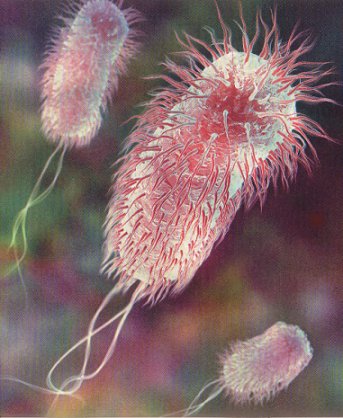 This is a picture of e. coli. It’s an autopoietic organism, dynamically interacting and adapting to its environment. It orients to a food gradient and moves uphill to greater concentrations. It is focused on self-generation, creating a world in which its needs are met. The emergence of this world of nutrients and the self-made-thus leads to sense-making of its self-environment dynamic relationship. Sense-making leads to valuing and creating significance of parts of the environment that are critical to life. That is, value and significance are brought out of (enacted) by the interaction of a living being with its environment. They are not intrinsic to the environment.
As it proceeds to create itself, it creates value and discernment of its environment. Not bad for a bacterium.
In all our complexity, moving through our environment, with a type of I-making that arises from a feedback loop of perception and action, we too engage in this “I-making”. This performance that arises out of the conditions through which we enact living.
Thank you for practicing,
Genju
 108zenbooks