

 The third characteristic of Japanese art is “the ability to go to extremes,” write Addiss & Seo. An artist may paint an intricate scene one day and, in the next, dash off a line or a splash in a split second. It is not a contrast of content or style, really. It’s more that the arc of the pendulum is so wide. More than that, Addiss & Seo add, there is no competitiveness between extremes. They are all equally contained in the broad canvas of creativity.
I wandered through the house looking. The extremes, if they exist in my life, may not be apparent to me in this unenlightened state. But I did note the variety of materials that tend to come home with me. Acorns, twigs, stones, sand – all have followed me from various parts of the North American continent. I don’t think I could experience the world differently. The stick in the lower part of the picture above sits on my altar. It is the Wood Dragon of practice, creative, inquisitive, imaginative. I heard in another dharma talk that in order to transform our fears we must be willing to enter the cave of the Blue Dragon. There we come face-to-face with our despair and all aspects of mind (read a great talk by Geoffrey Shugen of Zen Mountain Monastery here). The twig in the upper part of the picture is from the root of a giant maple tree we cut down last summer. Interestingly, that maple had no trouble with the extremes of its being: from broad crown to the finest hairs of its roots.
The two dragons together are an interesting contrast of determination and delicacy. They challenge the conventional concept of going to extremes in practice. We already know that deprivation isn’t going to work simply because the Buddha went there, came back, and offered a different t-shirt. Yet we do just that. Serial retreats, restricted diets, intense scrupulosity. I wonder if that serves more to avoid the gaping maw of the cave of the Blue Dragon. Frank pointed out in his talk on Tuesday night that standing at the mouth of the cave of the Blue Dragon and yelling, “I’m not afraid!” is not the same as entering it with compassion for who we will find.
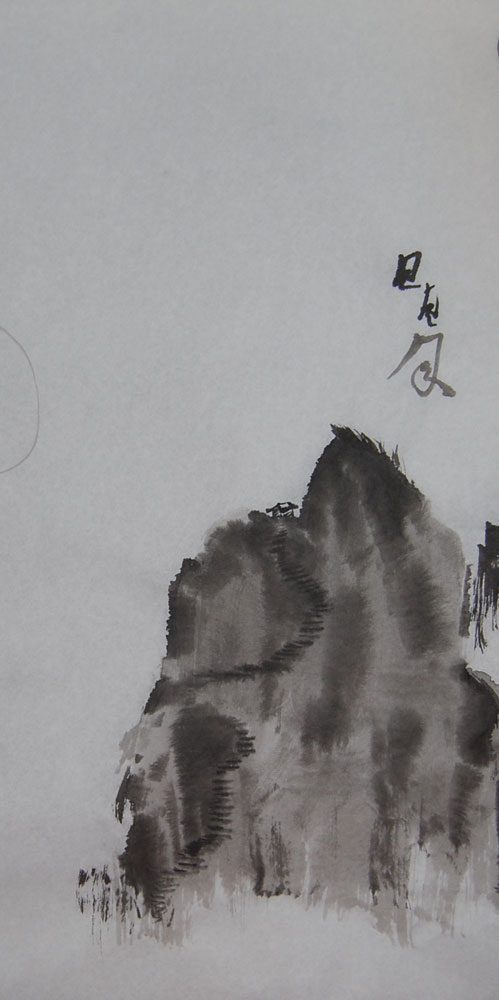
The extremes that we find in the sensibility of Japanese art is not about living with disregard for our mortality or disrespect for our limits. It is not one of deprivation but of delight. Delight in the grossest brushstroke and the finest line of ink. Delight in the fragility of the plum blossom and the coarse boulder in the garden. Delight in the raucous Ikkyu and the determined Hakuin. These are the extremes of experience that are meant to be tumbled into, fearless of the edge. And, here’s what we may find in the cave of the Blue Dragon: there is no edge.
What might happen if I am not the extreme I thought?
Thank you for practising,
Genju
 108zenbooks