


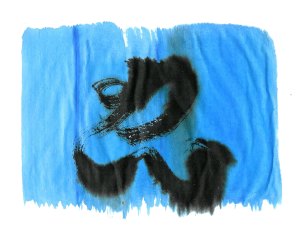
There’s a book of variations of kanji script that is the calligrapher’s Bible. Every kanji character is reproduced in dozens of versions, some by ancient masters of shodo, some by unknown clerical scribes. Because I don’t actually read Japanese, it takes hours to find the kanji character I want and then to track down the variations. Then it’s about practicing the strokes, hour after painstaking hour. The deeper practice in working with the variations is that they don’t tend to look like the original script. It requires a level of understanding of the stroke sequence to grasp (or even read) the variation. But more, it requires trust that all the lines are present in the final variation even if you can’t see them.
I’ve started to understand this process as one of transformation not unlike what happens when we commit to spiritual practice. We start with the traditional ways of doing things, focusing on form. Slowly as we begin to understand the unfolding of breath and body, we can play with variations. I think benefits from that phase of practice only accrue when we acquire a level of trust in our ability to represent the whole with only the hint of a part.
Last week was my personal deadline to finish editing my Chaplaincy thesis and putting together the portfolio. I’ve felt somewhat ambivalent about whether I actually accomplished anything in the last two years. Sure, there were tons of papers on wide-ranging topics and reams of reflections and oodles of analyzed data. But I wondered if there had there been any real transformation? I think I saw a hint of it as the portfolio took shape – a shift in adaptability, an openness to new perspectives, an accommodation of concepts that didn’t assimilate well initially, a willingness to be vulnerable in black-and-white (which is an improvement over being black-and-white to avoid vulnerability).
No, I’m going to be more self-supportive than that. I was astonished by the shifts in my perspective, my connection with the work, the training, the way of being as a Chaplain. If you asked me if I noticed any change, I’d have said I didn’t. But there it was in folder after folder, neatly slipped between transparent sleeves and falling nicely into the spiritual journey of the 10 Ox Herding pictures. While I truly cannot point to it as I sit here, I have to trust in the variation of my life script that is contained in that package flying south thanks to UPS.
Practice is patience, endurance – as trust forms.
 108zenbooks