

Some time ago, I read this article to our sangha. The original title was “Why I hated Jack Kornfield for 30 years so it could transform my life.” It was meant to be a tongue-in-cheek explore of a question people frequently ask me: Why did you choose the Zen path instead of Theravada? It’s a legitimate question given my roots in a Theravadin culture. I had no ready answer simply because I didn’t know. In fact, there is enough history from the Japanese occupation of Burma to make my choice of a Japanese Zen path problematic in my family. The article, which will unfold over this week, is a slice of my practice over one Rohatsu period. It’s just a fun exploration – albeit it had important insights for me in the end. As a side note, it was interesting that some folks in sangha had trouble with the article. Apparently it’s not Kool to Kick Kornfield… more accurately, it’s not cool to say one has difficulty with iconic and beloved teachers… That may be a good topic for a future post!
How I hated Jack Kornfield for 30 years so I could transform my life
It’s 10 AM and I’ve already lapsed in my diligence for the day. I have 7 days alone on this sacred farm I call Home: alone, in silence, filled with intentions to rise at dawn, sit zazen, listen to 7 days of talks recorded during the retreat offered by Thich Nhat Hanh in Vietnam. So far, all I’ve managed is to rise at that point where guilt masquerades as discipline and the cats are becoming fierce in their demands. It doesn’t matter, I say to myself. When all has been lost, when all has been given to everyone else, what is there left but the heating of water, the steeping of tea, and the sound of the bell to bring me home. I’m surprised by the depth of emotion I hear in that inner dialogue.
Heat water, steep tea, sit. In sitting, I bring myself to that feeling of “home” and find there is a deep ache. For years, I sat with that profound ache which was most painful when it manifested as confusion, irritation and even anger each time I read books by Jack Kornfield and other teachers in the Theravada tradition. How could I feel such deep anger towards these teachers who were giving so much, who seemed so loving and gentle, who continued the roots of my culture? All these qualities I knew were good nutriments for my ailing life yet, being fed at that table, they stuck in my throat, closed my heart. It was a dharmic allergy to good food. So, like most things that trigger shock, I tasted of it minimally. Mostly, I stayed away seeking refuge instead in the teachings of Japanese roots of the dharma and finding solace in such sanghas. Eventually, I found a form of safe haven in the Vietnamese tradition of Thich Nhat Hanh.
Thay’s tradition was close enough to my Burmese birthright and memories of practice. And the food was just as good as grandma’s cooking. But I was still left with a profound reactivity to good old Jack. And there seemed no way to build up a tolerance. I tried all the usual methods: inoculation irritated me; desensitization frustrated me; flooding triggered a defensive superiority. Out of desperation, I even hauled myself off to a weekend retreat with Kornfield and Trudy Goodman. I sat in front row, attentively following my breath. It was Woodstock without the chemical high.
Growing increasingly frustrated, I chose one day to sit with these feelings and observe them closely. After all, I knew it had nothing to do with Jack or Joe (Goldstein) or Sharon (Salzberg) or Sylvia (Boorstein) or Trudy (Goodman) or anybody (including many Western Theravadin monks and nuns) in that tradition. I had been watered sufficiently by Thay’s teachings to see that we are all of each other and that the teachings of compassion are non-discriminatory. But there seemed a powerful purpose in hating Jack and I vowed that for one day’s sitting it would be my dedicated and devotional practice. It was Bodhi Day; and I made a date to truly see Mara – secretly expecting Jack to show up, of course.
Next: embedding home
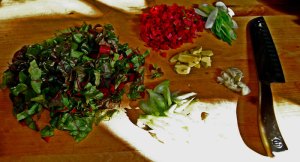
 Heat oil carefully. Like my practice I tend to start out hot and then burn up in a smoky mess.
 108zenbooks