Unknown's avatar

practice compounding

A writer sifts his reading through his emotional, psychological, spiritual and aesthetic experience, transmuting into language that is his own.  This in itself is stabilizing.  Instead of floating around on effervescent clouds of disappearing thoughts, he gradually becomes rooted in his own approach, his own vision, and imagination.  Even if he just writes a paragraph, he will “have” something from which he can build.  Money isn’t the only commodity subject to the “power of compounding.”

Robert D. Richardson, Jr., quoted in Gail Sher’s One Continuous Mistake

The art of practice is not different.  It slips through the openings of our experience and transforms into a lexicon, a syntax that is unique to who we continuously become.  If we trust it, it is stabilizing.  In my practice, I find myself tentative about trusting this ever-shifting process.  I realized when I read this passage that this sense of ungroundedness may be related to my focus on watching those “effervescent clouds of disappearing thoughts.”  It makes sense then – this feeling that I am continually sliding off to one side or the other of the path.  Or, in an effort to not let a single disappearing thought feel unwitnessed, I tend to cultivate a meta-ruminative approach which has me spiralling out in ever-widening arcs of watching the disappearing disappear.

As much as it seems blasphemous to aim for stabilizing, it is unavoidable if practice is to have a solid base.  (I think we’ve become to caught up in the literal language of practice anyway, rendering it into pseudo-dharma gobbledegook at best.)  It is interesting to bring attention to my language about practice.  Not just the verbal lexicon but also the physicality of how I communicate my concepts and understanding about practice are revealing.  We got a late start one morning and I noticed how my body moved as if sitting was no longer an option; the time had come and gone – as if once the clock hands moved past the appointed hour, intention too is spent.  I noticed the hugeness of the effort to break through the trance of “too late.”
It’s easy to reframe these moments as some type of noble truth.  Oh, notice that suffering.  Oh, isn’t it great that you noticed the noticing noticing.  Oh, do a metta practice of not-sitting.  This is the tyranny of the forebrain which loves to complicate to obfuscate.  How about we just sit?  How about we eat?  How about we write?  How about we pick up that brush?

I think this is the process of stabilization.  In doing what is intended, I build the core, the central mold around which I can layer on the materials of my life.  This is the “having” Richardson writes of in his biography of Ralph Waldo Emerson.  Not the acquisitive, avaricious greed of materialistic or spiritualistic ownership but rather a confirming of true nature.

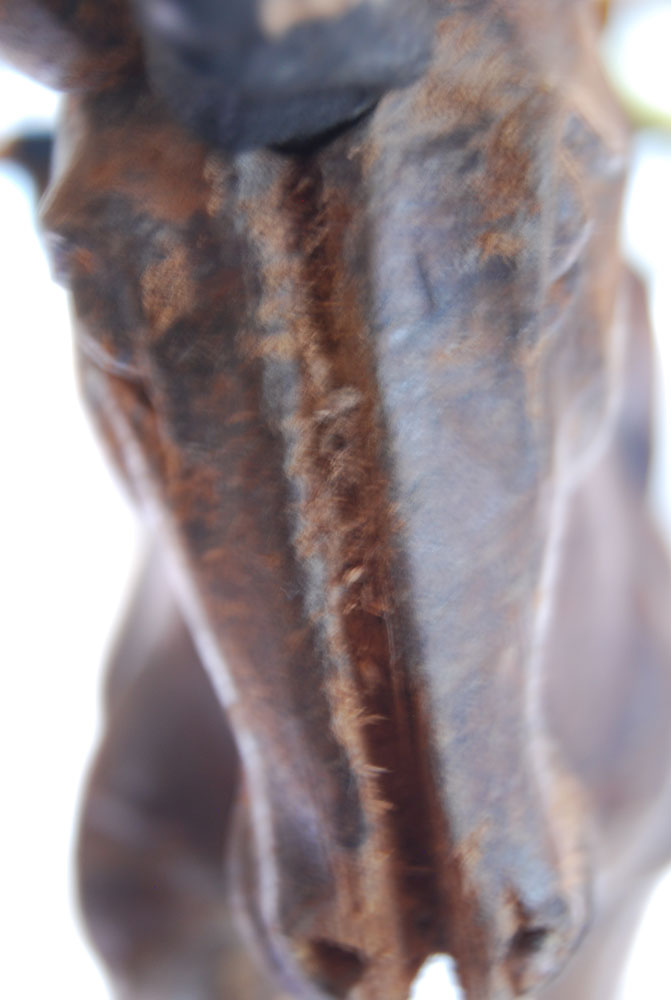
On the cedar chest is a wooden unicorn that once lived as a mold for making sculptures.  Some years ago, it broke in two around the girth and the right leg fell off.  I finally got a moment that was a repair opportunity and glued it back together.  The gouges in along the midline of the creature are a revelation of building that core of practice.  The channel marks where the material was cut to separate it from the wood carving.  I imagine the hundreds of sculptures it took to create the deep groove and in some places, where there isn’t a sufficient volume of wood, an eventual wearing away.

The strength in the core of the unicorn sculpture came from a long timeline of compounding that began in the walls of cellulose cells of the tree it once was.  Building that core in the art of practice means compounding the strength in the body, heart, mind cells so that it endures our efforts to sculpt it into a form at once unique and of service to all.

Thank you for practising,

Genju
Unknown's avatar

habit forming

A habit is the link between inspiration and self-realization.  Sometimes the hardest part of an undertaking is not when you start out (you have your initial enthusiasm) and not as you near the end (you have the anticipation of being almost finished) but the middle when your motivation dwindles and all that you seemingly have is your resolution.  That’s enough.  “We are what we repeatedly do,” Aristotle said.  “Excellence…is not an act, but a habit.”

One Continuous Mistake, Gail Sher (pg. 18)

The first day of each year is a starting block.  Like the ones used to position sprinters, I brace against it and breathe, waiting for that starter pistol.  The last two years, the block has been more of a chock block – the kind you use to keep a truck or airplane from wandering off on an adventure of its own sans chauffeur.  And certainly, there have been moments – no, lengthy time spans – in which the blocks got pulled out and I wondered who was driving this buggy.  When I would reflect, it seemed to boil down to practice.  What was my practice?  What was I practising? For all the dedication to formal and informal practice, it seemed there was an accumulating incongruity between areas of my life and between the inner and outer practitioner.

In the Fall, Frank and I made the tough decision to move sangha to our farm.  The decision has been two years in the making and yet it was likely the most painful decision I had to make.  (I say “I” had to make because Frank has been more reasoned in his process of letting go although I don’t think it was any less difficult.)  We shared our desire to make the move with sangha and, as is often the case, the heart-words were inexpressible.  What came out and what was heard was a litany of “can’t” – a can’ticle of rationales?  In end, we expressed it as this: our deepest aspiration is to create a sacred space in which the joys and suffering of all who visit can be cooked into a strong broth of well-being.

To do that we, as a couple and as community leaders, need to be in a space that encourages practice.  We need to approach the hour of formal practice steady and quiet in our being.  It seems selfish and self-serving but the alternative is an edge to our leadership that violates the Prime Directive of Practice: “…help… but at least do no harm.”  What we needed to create for our personal path was a space in which practice can become habit-forming.

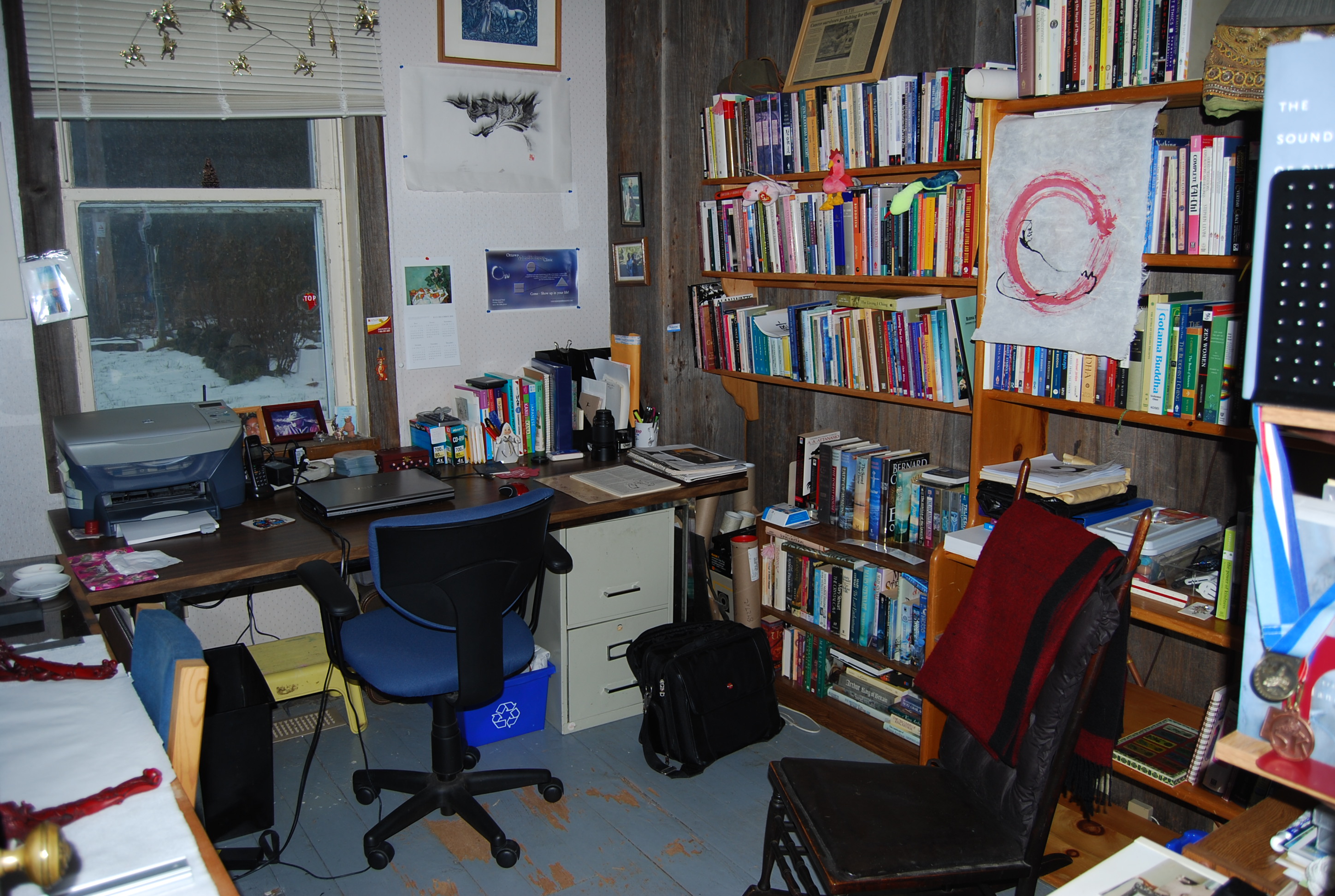
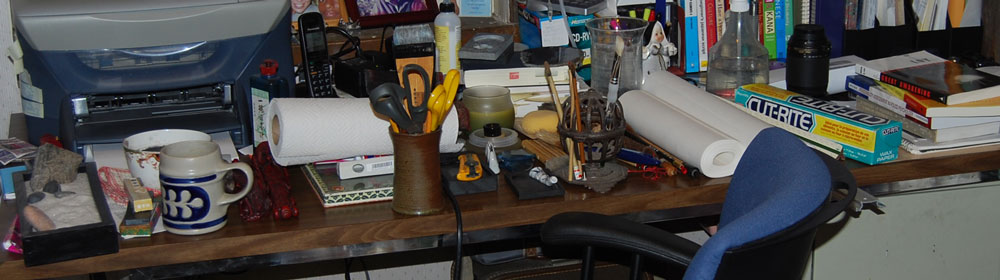
So, on the first morning of the this new decade, the starter pistol fired and I set out to clear space.  The zendo, as you’ve seen is already set up.  But my personal practice space – for what Sher calls “invisible practice” – was a mess.  It reflected two years of surrendering to chaos.  Because the zabutons and zafus needed a home, they took up the shelves and nooks and crannies of my study.  Books, art materials, recycle bins stuffed themselves into whatever horizontal openings were left over. It is not possible to be authentic in my formal practice if the rest of my life qualifies for an episode of “Hoarders.”  When the principle guiding my life is one of disregard of well-being, then any truth I may speak is automatically a lie.

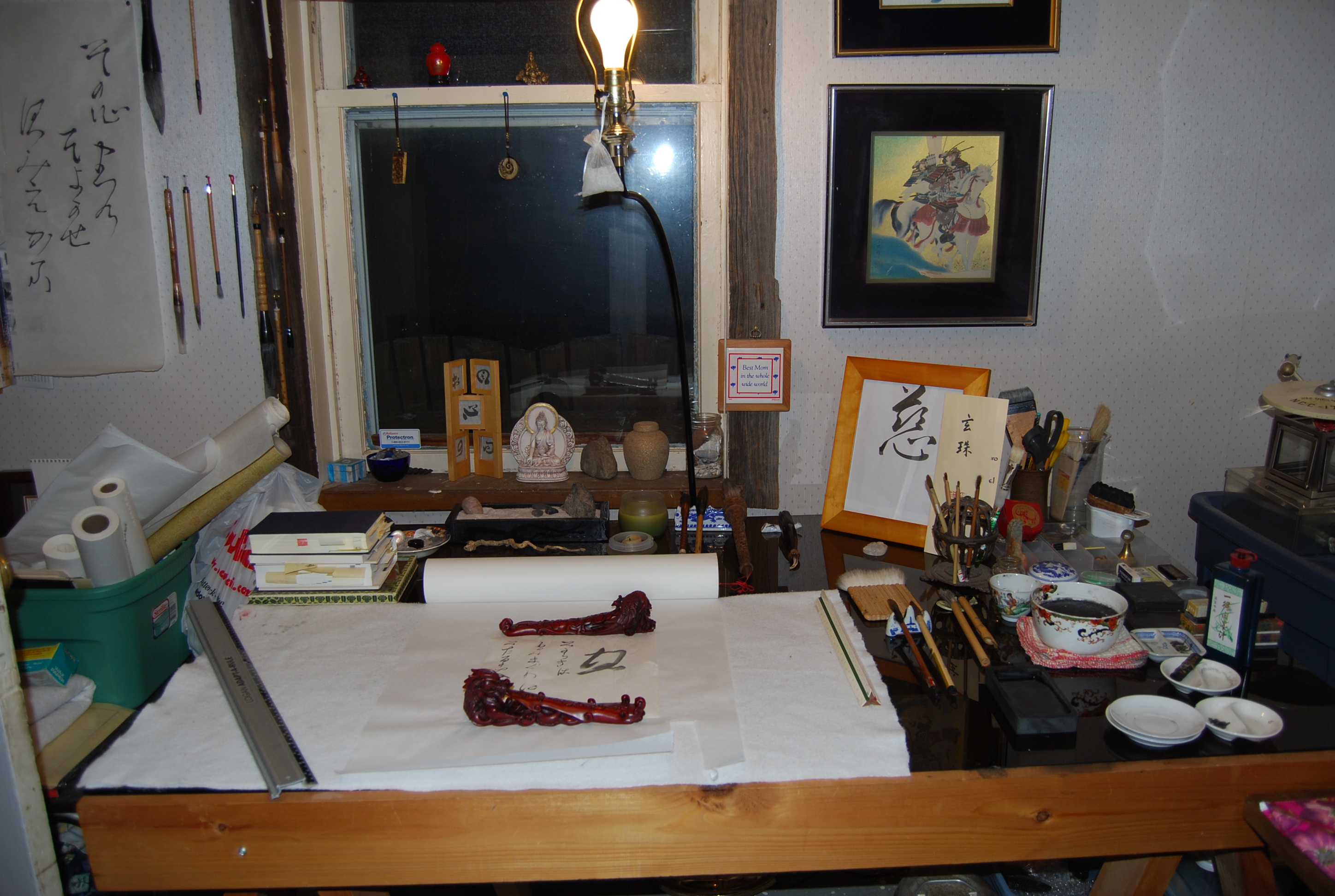
So I started with the art table:

Take all this...

organize it on this...

to look like this!

The order of the table is comforting, like the rituals of offering incense, bowing, and dedicating merit.  Sher quotes Issan Dorsey on cleaning: “You just go around and make things look like somebody paid attention to them.”  Paying attention to the spaces that feed me, interestingly, generates a readiness in me to be fed, to receive the feeding (paraphrasing Edward Espe Brown).

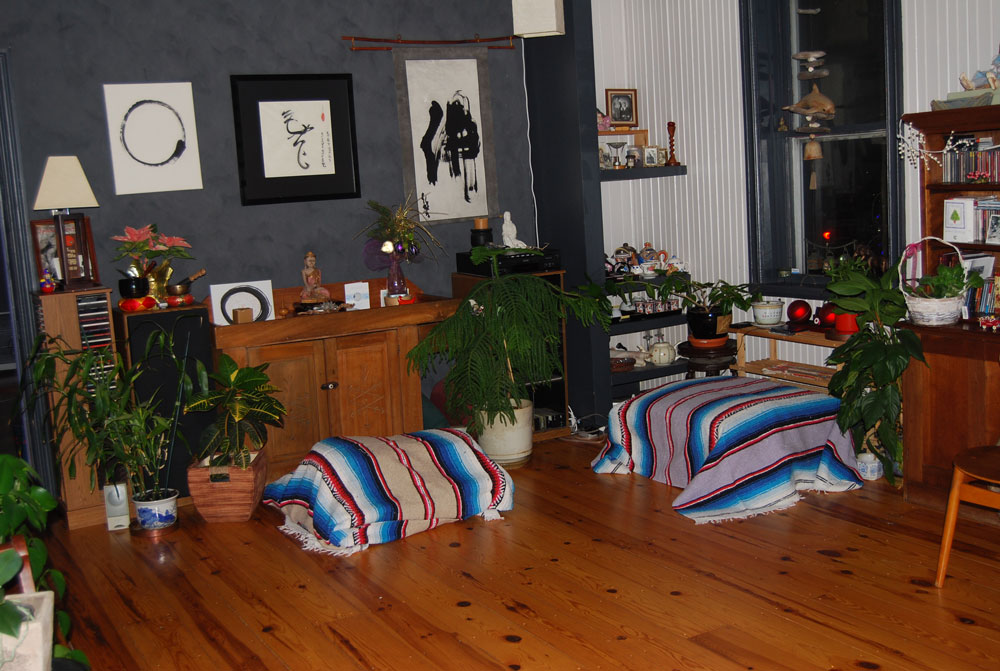
The zabutons and zafus found a new home as well.  I had long-resisted putting them in the zendo because I am childishly attached to wide, open, uncluttered spaces.  That is, I was until I realized it was an untruth to have an “uncluttered” zendo if it meant creating and hiding the mess behind closed doors.  The environment Sher speaks of that supports practice is not just external.  In fact, it is not so much the inner or outer practitioner that is important but the congruence between them.  So, the Z’s found a new home:

Notice the stack in front of the altar.  That’s our two Z’s for practice every morning.  No quarter given!

And look what happened in the study:

Thich Nhat Hanh warns that lone practitioners are like tigers who wander alone into a village and come to a hasty end.  Sher refers to this allegory and adds (in the context of writing but equally applicable to the practice of any art) that “(y)ou must use your heart and your will to create an inner environment of “prowling” intention and an outer environment that is harmonious with your goals and includes like-minded prowlers.”

Welcome!

Thank you for practising,

Genju