

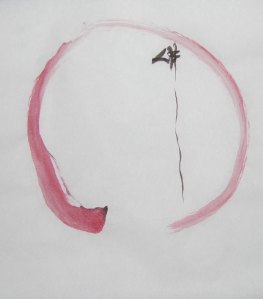
It’s a travel day again… going home from the Chaplaincy Intensive. I feel as wobbly as the enso and think maybe there are slithers of dharma dribbling out my ears. There are slivers of drama embedded in my system too.
I have yet to process all of it and may never. Zen Brain was a challenge to digest. Scrambling from Jim Austin’s tour de force of ego- versus allo-centric processing to Susan Bauer-Wu’s immensely compassionate and wide-hearted program which takes on the once-iconclastic MBSR, I cheekily suggested the retreat should be renamed: Zen-Fried Brain: yummy morsels served with dollops of compassion.
Jimmy Santiago Baca and Fleet Maull surprised me. Not so cheekily, I quipped that the “Dharma of Ex-cons” was going to leave me having to explain to my employers – yet again – why I was hanging out with the Dark Side. But apparently, that’s where the Dharma is at its most transformative. I’ll have very much to say about the two amazing teachers in the following weeks.
Fleet continued his teachings with “Dharma on the Edge” and suffice to say that we aren’t talking about just a double-edge of the Wisdom Sword. And, I learned that there are many things that can fade and pass on if I’m willing to bear witness to the process rather than engage in old stories about victimhood. Fleet said at some point that our work is about burning away our hooks that grab onto others or that allow others to grab onto us. There was much smoke from these burnings – which likely explained the watery eyes.
Somewhere in this timeline, Aitken Roshi passed on to continue his work with us through another realm. Gate, gate, parasamgate.
I quit the program a three times in the 10 days. Once when I felt my powerful victim-self, once when I stepped into my powerful aggressor-self, and once when I felt my powerful rescuer-self. It was good to meet them – again and this time with a fully embodied presence. If you recognise Karpman’s Drama Triangle in this, you win a chance to fix me. There will definitely be much more of the conjunction of the Drama Triangle and the Dharma Tetrad in posts to come.
Finally, a heartfelt “Thank You” to my blogger sangha! When I had a chance to read them, your posts reassured me that the world outside this cauldron was still there, going on, and there was a place for me to land when I got out of the boiling.
Thank you for practicing,
Genju


 108zenbooks