Unknown's avatar

book review: Chopra’s Buddha

Buddha – a story of enlightenment by Deepak Chopra

The Patheos Community invited me to read Deepak Chopra’s latest book, Buddha – a story of enlightenment, and share my thoughts on their newly setup Book Forum.  Unfortunately, I can log on but not contribute because there aren’t any “reply” buttons visible to me.  Fortunately, my fellow blogger Nate of Precious Metal is there so, if you manage to get in the group and if the Reply button is magically available for you, do consider his questions.

Having worked my way through the book, however, I think it’s worth making a comment or two here.  This may seem like a reprise of my caveat in Brad Warner’s “Sex and What I Want Zen To Be” book: Deepak Chopra is not an author I enjoy or read at all.  I’ve tried one of his books, an attempt at Arthurian fiction (The Return of Merlin), and swore off any more.  So, I was surprised by the readable start of the book.

Chopra begins with a well-crafted back story of Gautama’s childhood.  Suddhodana’s grief transformed to anger by the loss of Maya is displaced onto the child and the emotional neglect leads the young Gautama to find comfort in various parts of the palace.  All the elements of palace politics between Priest and Warrior castes are woven into a neat rationale for isolating the young prince.  Chopra then makes an interesting move in showing how this is doomed to failure.  He does this not through any mysterious encounters but through following the everyday playfulness of a young boy-child.  Gautama finds the truth of life, aging and death in the lives of soldier ants, dragonflies, and minnows.  These are not held up as any huge insights but simply left to percolate in the mind of a child where they are layered over with the usual distractions of puppy love and infatuations that handsome princes and winsome girls are prone to.  Life happens for Gautama when the adults are not looking.

Other characters who play a significant role are introduced simply.  Devadatta comes to the palace to toughen up the by-now Hamlet-like Gautama.  His sociopathy is glaring but very psychologically consistent with a child who knows he is nothing more than a pawn in a kingdom he will never possess.  Mara and Asita , at least initially, are crafted as the voices of a growing conscience in Gautama.  My favourite line comes from Krishna who appears to the starved Gautama prostrating himself in front of this vision of a blue-purple god.

“I have waited to meet you all my life,” (Gautama) murmured.  “I have abandoned everything for you.”

“I know,” Krishna said… “Now go home and don’t do anything so stupid again.”

Gautama doesn’t and forges on to his historic and mythical realization under the pipal tree.  Chopra slides into this enormous moment without much drama.  Gautama meets Mara who introduces him to Mara’s three daughters.  The verbal fencing between Gautama and “Desire,” “Lust,” and “Aversion” is a treat and the Prince Who No Longer Exists goes beyond.

Chopra would have done well to stop here.  His treatment of the various threads that wrap and traverse together in a complex life was admirable.  The writing was choppy in parts and the conclusions sometimes trite but mostly free of the New Age preaching Chopra is often (and rightfully) accused of channeling through his books.  Nevertheless, I particularly disliked the steal from Conan Doyle: “When all else fails, whatever else is left must be right.”  (Really?  Were we not to notice?)  I will give him credit however for putting together a decent and almost psychologically viable developmental history.

Then, I’m guessing, his editor called and likely said, “Deep, dear heart, we’re getting onto publication time and you’ve got to wind this baby up!”  I find many authors get caught in this 11th chapter dilemma.  So much to explore, so little time to prep for the book tour!  The last two chapters become a roller coaster of various myths of the Buddha’s life: the marauding elephant, the Turning of the Wheel, Angulimala (no, really!), Devadatta’s attempted coup, the war with Bimbisara, the reunion with Yashodhara and Rahula, Ananda and a hint of the future Socially Engaged Buddhists as the Buddha walks through the carnage of Devadatta’s war philosophizing about karmic connections.

Humanizing mythical figures is a dangerous game.  We have our pre-conceived notions of the myth and magic infused into these characters and we are not given to having these challenged by historical fact or psychological forensics.  Often these attempts sink, overburdened by trying to explain too much or be too clever.  Chopra hasn’t dodged the first bullet and was grazed by the second.  But he seems to have survived.

At the risk of blasphemy, Chopra’s attempt (at least the first chapter), along with two other treatments of the Buddha’s life, forms an interesting constellation.  Thich Nhat Hanh’s version, Old Path, White Clouds, weaves the origins of the sutras beautifully into the life this wandering mendicant painting a story of a growing community with all its joys and missteps.  Karen Armstrong’s Buddha is a more philosophically complex figure and definitely, hands-down, my favourite treatment of the Buddha’s life, despite the supra-human presentation of it.  Combining the three books, we actually have a decent insight to the life this amazing philosopher-king:  Chopra’s for the making of Buddha, Armstrong for the cultivation of Dharma, and Thich Nhat Hanh for Sangha building.

My recommendation: enjoy Chopra’s the first section: Siddhartha the Prince.  Go to the scholars for the rest.

(Edited 10 Oct 04 @ 1054: The book is divided into three sections: Siddhartha the Prince, Gautama the monk and Buddha)
Unknown's avatar

selling out to sex and sin

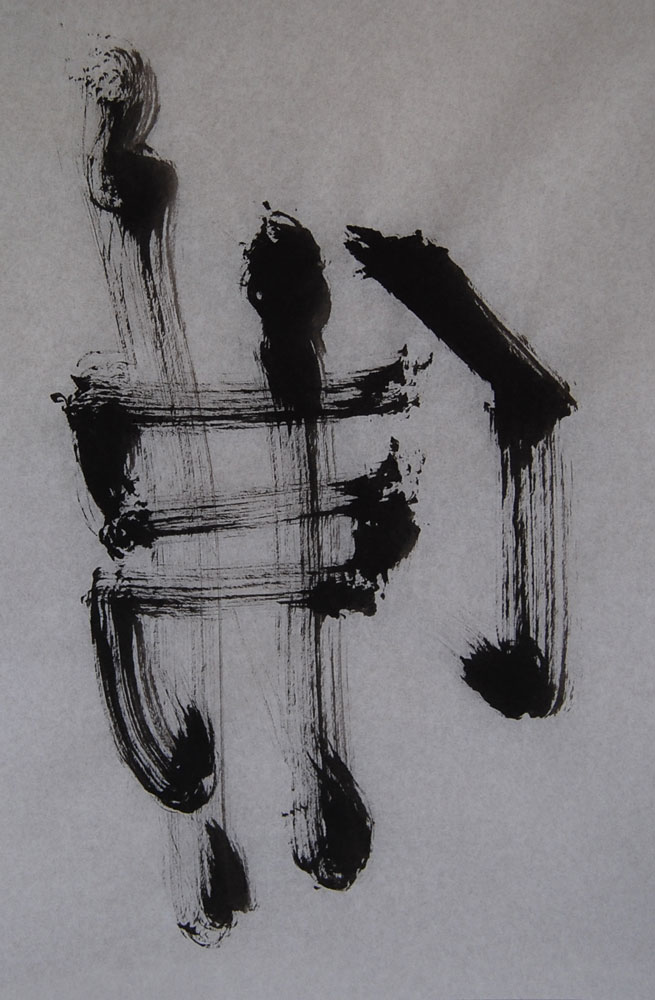
OK.  We’re back on track with the 108buddhas.  Buddha91 is a mirror image of the kanji for Buddha.  At least, it’s my attempt to draw a mirror image which turns out to be a lot more difficult than one would think given it’s just lines.  Being true to one’s nature is like that too.  It’s quite simple to be true to ourselves and messy when we try to run contrary to it.

I receive many requests to review books; something about the title of this blog, I’m guessing.  What most folks may not realize is I’m not reviewing books on this blog.  I test drive them as maps for practice and it could take years before I feel I can write about it.  But then again, I keep thinking everyone actually reads what I write.*  So, on principle, I’ve turned down all requests until this latest one.  It’s about sex.  And sin. And, peripherally, about Zen.

Let me backtrack a bit now.  I only heard of Brad Warner when I started blogging but I was aware of his book, Sit Down and Shut Up, which I thought was a graphic novel about Jabba the Hutt.  I did follow online some of the weird escapades between Warner and the World back in October 2009.**  It was all too “Days of Our Endless Lives” and “All My Histronic Children” for me so I quickly lost interest, formed evil opinions, and wandered back to my original intent of writing: write.  every day.

When the agent for Warner’s new book sent me an email asking for a review of “Sex, Sin & Zen: A Buddhist Exploration of Sex from Celibacy to Polyamory and Everything in Between,” Warner’s latest foray into the world of punk literature wrapped in Zen, I thought about it.  Rejected it.  Then thought about it again.  I don’t like the “Angry Young Man” personna and find the “in your face just because you have one” wearisome.  But I wondered if I was being overly judgemental and if this may be a way to challenge myself.  So I succumbed to the seduction and said, “Yes.”  Despite my joy in getting a book for free, I have come to wonder if this will portent well for my life as an erst-while writer.***

Experiments testing Festinger’s theory of Cognitive Dissonance showed that if we get something for nothing and are asked to describe it positively, we find a way to elevate the object so it seems to have value because nothing else justifies our actions.****  Now the problem with being a poor Zen student is that I strive to do better when faced with the mirror of dissonance.

So here it is.  A review of the book that is annoying as hell to read and which will likely be another best seller for Warner for no reason other than that it’s a slippery, easy read and no one’s likely to notice that it’s caramel wrapped gratuitously in Zen.  But I don’t want to be too harsh.  There are redemptive moments in the book.

One is that it evokes a visceral reactivity which you have likely experienced by tracing all the asterisks in this post. Yes, this is what it’s like to read “Sex, Sin & Zen.”  Flopping up and down, to and from the asterisks he puts into his text induced literary vertigo.  If the asterisks were explanatory or moved the text along, it would have been tolerable.  Instead, they were just a device for coy sidebar commentary on how funny his last sentence was.  Or worse, he actually seems to think he has to explain his puns.  As I said yesterday, one element of being a good writer is trusting your reader and honoring their intelligence.  I doubt all of Warner’s audience lack the intelligence he thinks they do and the puns are blatant enough that the continuous cutsie giggling wore thin by the first three pages.  Why is this redemptive?  It is practice of Right Effort – and the latter 1/3 of the book rewards that effort.

The second redemptive part of the book is that he manages to fold some good explanations about Zen into the strum und drang of his commentary on sex and sin.  (In trying to be fair to Warner, I did some “research” and checked out his Suicide Girls and Hard Core Zen blogs.  The chapters are for the most part the posts with a bit more Buddhist-y commentary thrown in.)  Although he’s pretty insightful about the sex part, he gives sin short shrift, confusing it with guilt and consigning it to an idiosyncrasy of Christians and other non-Eastern religious/cultural groups.  Clearly, Warner has not sorted out the intricacies in Asian cultures which rely on the loyalty/betrayal axis as means of social control.

Despite the useful Zen, there is the issue of being true to oneself (he does deal with this in a well done chapter on nonself).  His teaching presonna is diminished by constantly backing away from what he claims is the spirit of the precept against sexual misconduct.  Warner seems to want to straddle both sides of the bed – a feat he may well be capable of given his lusty paeans to casting off trappings and doing what feels right for oneself.  He would like us to see that the Zen Buddhist concepts are important to engaging in respectful relationships.  And yet, he backs off actually making it clear that self-delusion about those very concepts can result in significant damage.  Too often Warner slides away from an honest inquiry into the precepts by trying to appease those in his readership who may lean towards an open attitude to the physicality of relationships.  This liberal approach to sexual exploits results less in liberation and more in exploitation but he’s not going to go there.  It’s equally annoying when he makes a statement and then backs off by saying he has no real knowledge of what he’s said but is just saying it.  After a while one begins to feel stuck in foreplay.

The final redemptive part of the book is his interview with Nina Hartley, the porn star zen brat whose website contains adult explicit material so please don’t go there unless you really want to and now I have to go scrub my hard drive before Frank gets home.  The interview with Hartley was terrific – growing up in a zen center with two narcissistic parents who became zen priests and ending up a porn star and author.  The interview worked because Warner could do little but go along for the ride.  Hartley, who is sexually multi-oriented, makes it really clear (on her website which  I only went to for “research” and read really quickly so the images haven’t lingered much but I wish I had some eraser eye drops right about now)… where was I.. yes, Hartley makes it really clear that when she’s “with” men she can “switch” depending on “how their energy mingles.”  But with women she’s in the driver’s seat.  “nuff said.

I really can’t fault Warner too much; he does let go of the silliness by Chapter 23.  One does have to earn a living and dana doesn’t allow for much disposable income.  He has a talent for making the obscure accessible if you`re willing to get past the antics and props; he does have a following who seem able to see the Buddha nature in him.  You must admit, someone who likes being on the edge, yet who can foster acceptance for his attitude and his attempts to be iconoclastic, is getting across some dharma.  Unfortunately what could have been a turning word for me wasn’t.  I think I would have enjoyed the book if I (1) didn’t have to wade through the rather juvenile editorializations; (2) grit my teeth past the gratuitous iconoclastic bombast; and, (3) got more of a sense that he could be as courageous about the dharma and precepts as he is about the drama of being an angry, wounded, tragic anti-hero.  But then again, if we’re talking about being honest and true to who you are, may be Warner is.

Thank you practising & I promise I won’t do this again.  Maybe.

Genju

*Thank you for reading what I write.

**If you want to read more about this, there’s tons.  Just Google.

***It’s likely a sign of my poor status as a Zen student that I am so attached to outcome.

**** I’d quote research but I’m too lazy and Wikipedia, the Oracle of All Wisdom, has a good summary of Cognitive Dissonance Theory anyway.