

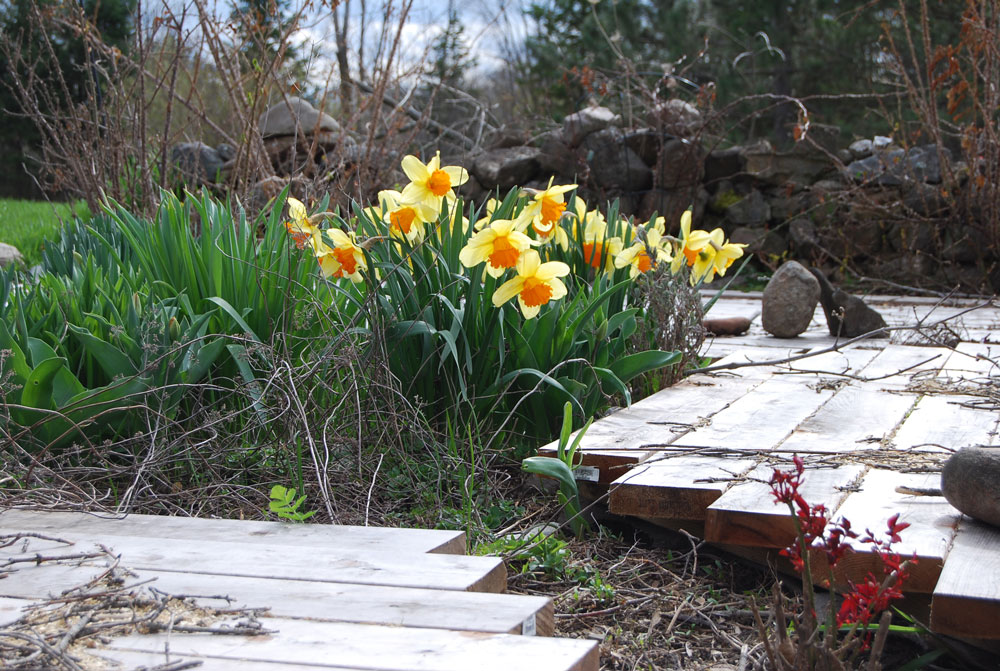
 Last summer, Frank replaced the weathered and broken boards of the deck in the rose garden. The boxes in the background are a version of Square-foot Gardening that has been a passion for a few years. But last year was very wet and we never got around to weeding it or planting anything. Then, while away at Upaya, I arranged for a neighbour to cut down the scrub maples around the east side of the rose garden so that there would be more sunlight on the roses and the vegetables. The final result: a mess of timber and the accumulation of bad karma exposed!
But I’m grateful. For many things: that this has been revealed, for neighbours with chainsaws, a husband with eternal patience, and friends with boundless love. These teachings don’t shy away from messes just popping up when I need them. It’s always been a deeply held truth that we would not have survived out here on this farm without the kindness and wisdom that flowed through all connections with the sentient and the insentient.
There is nowhere in the world that I feel more grounded and connected than on this vast acreage of land we co-inhabit with coyotes, moose, deer, hawks, finches, cardinals, evening grosbeaks, and a multitude of insects and reptiles. It is decorated by the pines, spruces, birches, wild and contained flowers, and yes, even nasty scrub maples that tangle and strangle everything. It is sewn together by three streams that carry down the effluents of other farms, rain, and golf balls from the club upstream. On this patch of the world, I worry more about my decisions and actions than anywhere else. The impact of ecologically unsound decisions seem so much more frightening, perhaps only because I know the faces of the animals, plants and minerals. Yet for the three decades we been here, I’ve related to this land only tentatively, uncertain about my capacity for stewardship.
I find now a tiny book on my shelf that helps secure the relationship: Teachings of the Insentient by John Daido Loori.
In general, our ecology is based on separation. The teachings (of the Buddhadharma) are about intimacy.
 Often when we take on these endeavors, I feel desperate to save things. Save the rose garden, the vegetable garden, the strawberries growing helter-skelter on the fringes of both. Pull every weed, sweep every shaving and dessicated leaf. Sometimes, I’m not sure if I’m saving the garden from damage or forcing a change so I don’t have to see or feel damage. I think in past years, this desperation has prevented intimacy and the reason is ridiculously obvious. Saviours require victims (usually) – a relationship that precludes true intimacy because it is one of power over another. Intimacy requires nothing other than a willingness to be with just what is.
On this day, something has shifted. I am motivated by this early Spring, these unbelievable days of sunlight and blossoms. There is a tiny blooming of a belief that I have survived a harsh winter, that I was able to walk through the storms and bone-deep chill because of many visible and invisible workings of the sentient and insentient around me.
Dew on the pine, the grasses, and trees are the real form of truth. They are the limitless life of the endless spring. ‘Endless spring’ is used in Buddhist texts to refer to enlightenment or realization. The question is, Where do you find yourself?
In her retreat at Upaya on Work That Reconnects, Joanna Macy asked a question that could precede Loori’s.
What would happen if that was your task: not to save the world but to love it?
Then, where do I find myself? Where do you find yourself?
 Thank you for practicing,
Genju


