

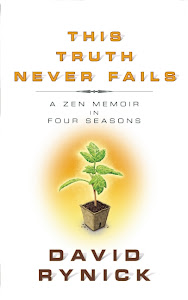
This Truth Never Fails: a Zen memoir in four seasons by David Rynick does not fail to bring the heart of Zen practice home. Rynick, a Zen teacher and Life Coach, offers his lived experience of Zen in delightfully intimate detail and in a manner that dissolves the bewildering, misleading myths of Zen practice. With the ever-constant changing of the seasons as a guide, Rynick takes us on a journey, bearing witness to the simplicity and elegance of the every day, the moment in hand, the singular and unique breath. The lessons we learn are not only about waking up and choosing which self we will wear for the day. They are about joining with Summer’s aliveness, Autumn’s release, Winter’s hope, and Spring’s re-birth. At its core, Rynick’s teachings in the book, like the truth of practice, the essence of Zen, show us that it is all here, effortlessly gifted.
It is a sweet, quiet set of teachings and you can read a chapter here. But there is something more important than what is held between the pliable front and back of this book. I am of the firm belief that anyone can write a book. Truly. However, the real teaching is not in what we write but in the courage to let those words reflect the truth of our life. Most of us tend to shy from conveying the intimate truth of our life and lean towards crafting this or that image. We can’t help but live in our readers’ minds, seeking not-so-subtly to manipulate who we are in the folds of their brain. The power of this particular book is that David (and I feel free to be so familiar) writes without such guile, unassuming and unpretentious. It is something I hope for as the way of Zen: intimate, pure, and joyful.
In the interests of full disclosure, I should tell you I’ve experienced David as both teacher and coach. I met David Rynick several years ago when I attended my very first sesshin at Boundless Way – it might even have been when Boundless Way was only on its way to being such. David’s spouse, the ever amazing Melissa Blacker (now Roshi), had trained me in MBSR and was my first (and so far only) koan teacher. I had never met David until that sesshin in Worcester and our dokusan brought a massive shift in how I engage in relationships. But life swept me in other directions and yet I carried always their generous teachings and this one vision of a snow-covered, emerald-leaved rhododendron framed in the window of the zendo. Living in a climate where rhododendron didn’t survive winters this image remained a heart-filling paradox of relationships and the adaptation and equanimity they demand of us.
About six months ago, David and I met through our respective blogs. The universe is fascinating and somewhere there is Bodhisattva laughing. I read an early draft of his book and set it aside as David and I began a coaching journey that has brought together some powerful threads which weave together authenticity and intimate truths. These are powerful lessons that animate my life, breathe awareness into it, and hold my feet to the fire when I think I can slide off the track. In fact, much of what you’ve read on this blog in the last six months has come out of the direct influence of our coaching sessions that teach me to always come into alignment with my own intimate truth.
Coach or Zen teacher, David’s own authenticity is evident in his connection and as a result is found in every chapter of This Truth Never Fails where he brings to the fore a comfort with the everyday connections we live. He is likely one of the few practitioners who can write as passionately of the “View from My New Toilet” as he does “Remembering” that joy is in the everyday things like the handle of his coffee cup. There is honesty in the opening lines of each chapter which are typically about waking up (what a metaphor!), poking through the clouds of worry, or relishing in a moment’s surprise of “Being Myself.”
My favourite quote somewhat predictably is in the chapter, Being Myself, where he writes:
The rhododendron is rhododendroning – that is all it knows how to do.
I am like this too – I am David and I am Daviding.
Without thinking, my cells and my internal organs, my fingers and my brain, all know what to do.
If I understand the teachings, this “selfing” is the “mysterious truth of the Buddha.” This is the truth that never fails: “in every moment and every place, things can’t help but shine with this light*” of who and what we truly are.
_____________________
*Torei Enji

 108zenbooks