Unknown's avatar

holding down the world

Spring rains have watered many seeds in the garden.  In fact, seeds I don’t recall planting have been sprouting happily everywhere.  The Buddha which holds down the world in the rose garden enjoyed a bath in the rain last weekend on his birthday.  This past weekend he enjoyed heavenly waters.  In between times, the narcissus bloomed over his shoulder and the chives pretended to be kusa grass at his seat.

Family discussions have wound in and out of the topic of integrity and when to cut loose the deadwood that accumulates in one’s life path.  Perhaps it’s because I’m exploring various writings and teachings on the fundamentals of Buddhist practice, the often painful evidence and consequences of desire seem to pop up everywhere.  And desire for the deadwood is a bizarre but noticeable phenomenon lately.

It’s likely because these planks and plastics are familiar boarders in my life space.  At one time some of them promised much and, over time, delivered little.  Others were thrown out to help me stay afloat and now,waterlogged with their guilt generators, threaten to sink, hoping to take me with them.  Yet others are new – the artificial plastics of ambition and greed which have begun to float together forming an emotional version of the Great Pacific Garbage Patch.

I’d love to lay blame on others for this accreted mess of toxic relationships but really, I can’t.  That’s the integrity part, taking responsibility for it.  I may not have remembered planting those narcissus but there they are – irrefutable evidence that I took trowel to ground.  There’s another aspect to this letting go: allowing for the possibility that what is deadwood to me may be very useful raft material for someone else.  All the more reason to cut it loose, give it up, send it on its way.

May it shelter, save, soothe other beings in ways it once did for me.  May it hold down whatever edge of the world it can.
Unknown's avatar

gratitude

Nefarious comparison.  After reading a book on Object Relations Therapy my then-therapist had suggested for me, I told him the author made him (my therapist) look good.  To put my comment in context, therapy with Dr. S. was a jousting match of conflicting therapeutic ideologies.  I got a lot out of the years I spent with him and do miss the dharma battles; but we seem to get along more through our own nefarious comparisons than any directly valuing connection.

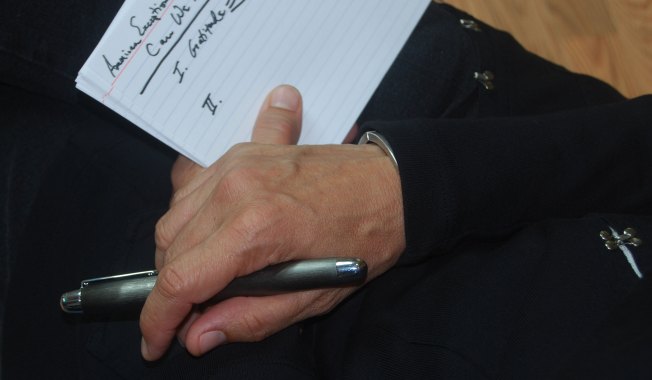
It’s hard not to resort to these types of comparisons.  “There but for the grace of God” is one form.  “At least it’s not….” is another.  More and more, however, I’m noticing that even my sense of gratitude is tainted by nefarious comparison.  What would it be like to simply feel grateful for what is?  To sit down with folded hands and a blank list, feeling gratitude.  Just that.

I was working with someone who felt a deep and honest loss of her life as she had lived it.  The usual strategy is to make a list of all the things she can feel grateful for.  It works – after a fashion.  Yet, as I thought more about it, every list carries an affirmation that is also a negation.  Form and Emptiness.  Yin and Yang.  Good and Evil.  It’s unavoidable.

As we made the list, created the resources she had, my patient and I sat and noticed the tendency of the mind to gravitate to the negations.  “My kids are wonderful (not like the ones down the road).”  “I’m really feeling better (not like before).”  In essence, we are linking our joy and suffering as deadly partners: Compared to my suffering, my joy feels good.  Slowly, as we continued to work on it, the consequences of this pendulum of subtle comparisons revealed itself as an inertia of holding onto suffering.  Nefarious comparison places positive in counterpoint to its negation; we need one end of the oscillation to define the other.  Thankfully, our inner life is not slave to Newtonian mechanics; we have a choice to let go, to dampen the oscillations.

Gratitude by nefarious comparison has serious consequences beyond our inner life.  We not only end up needing the world to serve our illusions, we cling to our fear and woundedness as a necessary part of our total experience.  At the time of the announcement of Osama bin Laden’s killing, I was in a large gathering of military types and had read the various reactions in the newspapers and on the web.  The mood in the room was subdued but there was a sense in the online pictures and words that the world was safer now with the ending of his life.  I almost heard and felt, through the wires, a sigh of relief and gratitude which clashed with the reality that killing cannot give rise to gratefulness or safety.  Adam at Fly Like a Crow wrote of his response to the death of Osama bin Laden which reflects well many of our conflicting emotions.  Yesterday, I read Maia Duerr’s brilliant post on her blog, Liberated Life Project, that explores the traps of conditioning a conditioned state of mind, in this case freedom by nefarious comparison.  Ultimately, can we call it gratitude if it is chained to, conditioned by, our cravings, anger, and confusion?

Perhaps a liberated form of gratitude begins in noticing that we become easily coupled to negations.  In that stance of equanimity, we may find a way to simply feel gratitude without needing it to be propped up by any alternative experience.