

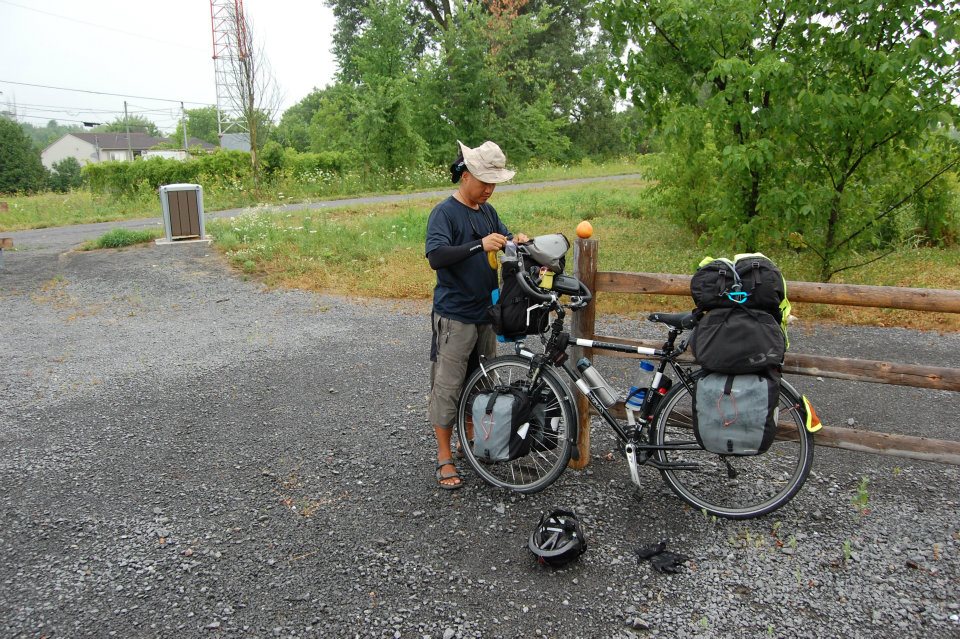
A little update on hosting Korean monk, Daeung Sunim at our farm. It was a hectic schedule as Frank and I were leading a teacher training retreat from July 13-15 at our clinic. Of course it was Friday the 13th which completely explained the sweltering heat, the broken air conditioning at the office, 21 people crammed into an already small space, and no available venue to move to. We did find a landing place for the retreat (without much a/c) and coped. By 6PM on Sunday the 15th, the appointed time to meet with Sunim and his other Ottawa host, we were physically limp and mentally fried. And I truly hoped Sunim was not going to mind if I face-planted in a bowl of mac and cheese for dinner (his host kindly agreed to feed him so as to spare me the embarrassment of serving junk food on his first evening with us).
Sunim arrived at the farm with Frank as I completed grocery rounds. We had an interesting evening learning about his life at his temple and he was fascinated by our lifestyle. Two adults with only one child who didn’t live at home, Frank was not retired, and it wasn’t until the next evening that he clued into the big empty room being a “zendo.” I thought we would have snags in understanding around words or food or the cats who were skittish around new people. Those didn’t pose any problems; Sunim’s English is relatively good and when propped up with mime gestures or shifts in words, communication flowed quite nicely.
He was totally taken by the number of books in the house. However, I think he was a bit taken aback by the lack of Korean Zen books. “Books. Japanese Zen big. Korean Zen small small.” I thought he was talking about the zeitgeist of Zen in Canada so launched into a seminar on the state of Buddhism in Canada. Communication difficulties always highlight our blind spots. And yet, there were so many commonalities: relationships with family and teachers, finding a path that challenged us, and not encouraging the fear that can so easily surface to defeat our intentions to practice.
One of the best part of his visit was showing him my little art table. He immediately gravitated to Kaz Tanahashi’s calligraphy of “compassion” and explained to me how the terms come together in Korean. Suddenly his English was precise and without hesitation. We laughed over my herd of Mu paintings (see last week’s series) and he was excited by my attempts at the ox herding pictures. The next morning, Sunim lead a Korean chant and prostrations as the morning service and declared it “a good experience.” As I was preparing supper, he came into the kitchen beaming from ear-to-ear: “Ginger and garlic fry. Good.” I explained that we were having a Burmese dish normally reserved for weddings and blessing ceremonies. “Ah,” he laughed. “No junka food?”
I caught myself wanting to give him a good visit. In fact, he was quite happy sitting in the library with the cats, plotting his route on his netbook. I wondered how these somewhat intense connections with his hosts balanced with the solitary long distances he cycles. And then, it seemed irrelevant as he headed down the Rails to Trails path to Montreal.
Sunim is headed to Newfoundland and then through the US. If you can help in any way by providing a place to stay or food and rest along the way, please contact Dave via the Journey of Spirit website.
Sunim’s Canadian route is here. The US route is here.



 108zenbooks