

 I foolishly wandered into this part of my shelves. There are neighbourhoods in my library which, like my mind, are dangerous places to be. The gentrified shelves are in my study, refurbished condos of colorful renditions about this kind of Buddhism and that kind of Buddhablah. Along one wall are books about calligraphy, haiku, homages to Stephen Addiss, Kaz Tanahashi, and translators of Hakuin, Ikkyu and Ryokan. May Sarton, Emily Dickinson, James Merrill, Wendell Berry inhabit a sort of poet’s intelligentsia supporting their Asian counterparts. This is a safe neighbourhood where the crime rates are low. Cognitive assaults rarely happen and the wide open areas are safe to meander through even in the darkest of soulful nights.
Yet, on this day, this chilly softened morning, when I managed to get out of bed at the moment my eyes opened and awareness of being awake registered, I found myself in the Outer Banks of bookdom where many a thought has been lured to its doom. French philosopher and cultural theorist, Rene Girard’s concepts of mimetic desire are explored through a series of interviews in Things Hidden Since the Foundation of the World. I’m drawn to his discussion of acquisitive behaviours and imitation, which he argues are intricately intertwined.
Imitation (or mimesis) is the mirroring of another’s behaviour and serves many purposes: an indication of commonality, a gesture of respect, a reciprocated aggression. It can also become mimetic rivalry in which each person tries to outdo the other; think about that great cartoon sequence of “You first!” “No, no, I insist, you first.” Aggression is also a form of mimetic rivalry, trying to outdo the other in strength of presence. The neurology of mirrored actions is fascinating but that’s in a different neighbourhood of the City of Books. Along with acquisitive imitation, Girard proposes there must be a prohibition of action in one of the participants otherwise the mutual reaching for an object creates conflict. Implied in his argument is that the conflict transmutes into something beyond the desired object. (OK, maybe more than implied. He likely says that later in the book but so far, I’m only on page 9! I’m going to write a book one day about things hidden in the first ten pages of philosophy books!)
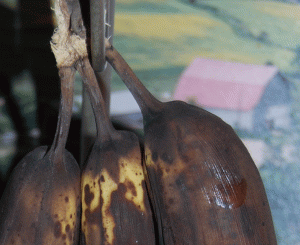
What this means in plain language is that you and I can see a banana. Initially, our reaching and prohibition of reaching too quickly (if we’re well-socialized or not too hungry) is about acquiring the banana. The thought sequence goes something like this: I’m hungry, there’s a banana, taking the banana soothes the hunger, no wait, YOU want the banana too, oh, now what, I should let you have the banana, but I want the banana. Then it goes something like this: you’re moving faster than I am, you’re going to get the banana before I do, hey, that means I lose, you can’t have that banana.
Did you see it? It’s no longer about having the banana. It’s now about being the one who has the banana.
Girard refers to the Pacific Northwest peoples’ ritual of potlatch as acquisitive mimesis inverted to a mimesis of renunciation. By giving away everything in a ritual of generosity, we shape the clinging, grasping, self-centered “I” away from a fear of deprivation. If the neurologists and neuropsychologists are on the right track, our neurology is available for these transformations through the practice of mindfulness. And what is implicit in their results is the need to practice the precepts and paramitas in a way that is clearly perceived by each other.
In other words, we not only must bear witness but also reflect in order to effect transformation.
Thank you for practicing,
Genju

 108zenbooks