

Sometimes it’s all about letting go. And letting go comes in various forms.

It can be a powerful draping backwards into a river.
.
.
 It can be a resolute stance of acceptance, a realization of being constructed by so many disparate experiences.
It can be as simple as noticing that something has turned a corner. It can be as complex as convincing oneself that any consequence which follows an action can be borne with equanimity.
Letting go is an adventure in fear, trust, and inclusiveness.
You may not have noticed my practice of letting go last week. Likely you might have noticed a gap in the posts. Perhaps you thought, Oh she’s deep into the thesis! Or, she’s probably off saving the world from Heffalumps. Or you might even have thought, she’s won the Lotto 649 and abandoned the life of ne’er-read-well author/artiste. I’m not to sure about the saving the world part and my bank account is pretty firm about the Lotto 649 part. As for the depth of the thesis, I’m happy to report that the mind-numbing psychologese part is written and now I get to play with the “What Would Buddha Do” part.
But letting go. That was pretty dominant in the two weeks past if only as a realization that I can be releasing my death grip on all manner of fixations, metaphors of Self, and craven desires and what is apparent to the eye or ear could be as simple as a “yes” or “no.”
I practiced this noticing on our (now) annual trip to NYC where we met up with friends, one of whom was running the NYC Marathon. In the days before the race, we toured around the city and as Chaplains we felt it was important to head down to Occupy Wall Street to bear witness to the beginnings of this very powerful shift in societal awareness – as confusing as the process may seem at times. Personally, I still don’t quite know what I feel about it all but I was intent on bringing myself to that place of discomfort and watch the “yes” and “no” surface over and over again. Since the beginning of the Occupy movement, I’ve felt a huge level of discomfort, edging on the hyper-vigilance you might feel if you think you’re being blamed for enjoying unearned assets. I’m beginning to hate those websites that tell you’re part of the 1% or the 99%. (I’m neither unless you consider a global or restricted range as a measure of income.) I dislike now feeling the need to justify what I have, what I bought, what I pictures I upload to Facebook, what trips I take, and what my groceries cost.
I would like a sign I can hoist over my new car (the old one dates back to 1999 and has 290, 000 km on it):
Refugee kid made good
because she married a hard-working Southerner
who would sooner die from fatigue
than take a vacation.
So standing there on the edge of OWS taking pictures, I felt like a sleazy tourist and probably took on a 100% defensive posture. I tried to strike up a conversation with two men who had a terrific sign but my request for permission to photograph the sign earned me a dismissive grunt – sleazy tourist. For a moment, I thought of walking away, going around the corner where the unemployed grandmother sat knitting mitts and scarves for the residents of OWS, where the gas-masked, person-pillar draped in black performed eschatological street art, down towards the drumming that called out to all the hearts that beat. But I didn’t. I took the picture and thanked them.
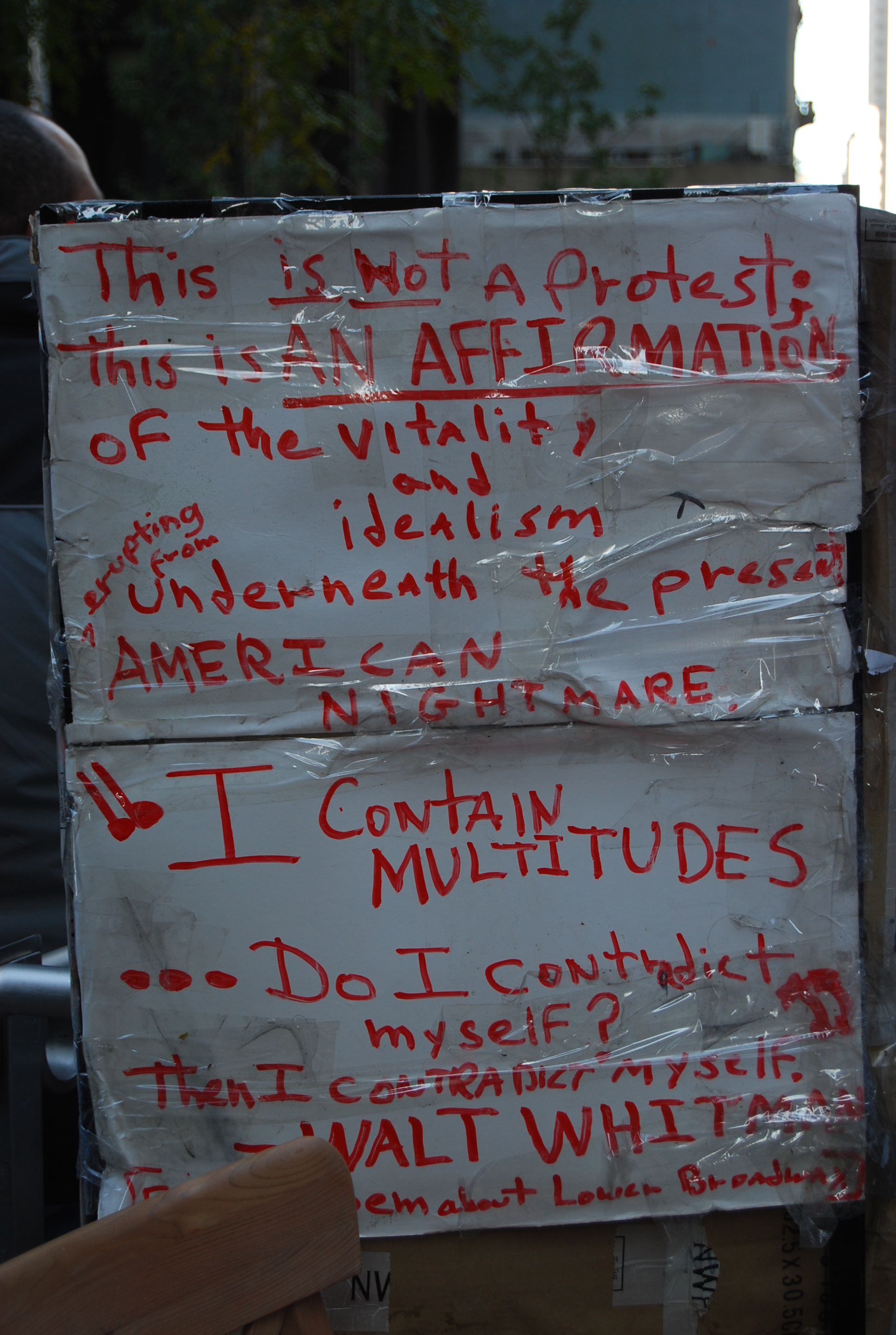 In case you can’t read it, it says:
This is not a protest;
this is an AFFIRMATION
of the vitality and idealism
erupting underneath the present
American nightmare.
I told them I wanted to post this for all the Occupy sites because it captures the essence of this shift, this letting go of how we have lived our lives and how we want to continue to live our lives. To do this, I have to climb out of the minds of those two people. I have to let go, release what I think they thought of me and my digital camera. I have to add myself to the % who don’t give a damn about being judged, appraised, counted in or counted out.
Letting go is an affirmation that we can occupy this moment, this self, this being completely, without hesitation or reservation.


